One patient was wheeled down the hallway, stable after an open-heart surgery.
A cardiovascular nurse practitioner whizzed in and out of the office, called to scrub in on another procedure.
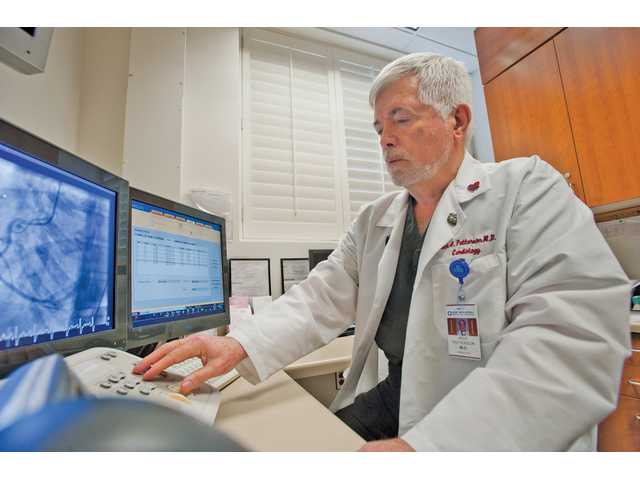
In his office, Dr. Jack Patterson watched black-and-white images take shape on his computer screen, reviewing the treatment of a successful case.
On a typical Monday morning, the STEMI Receiving center at Henry Mayo Newhall Memorial Hospital was pulsing with activity. From the hallway buzz of conversations to the quiet of an operating room, the Henry Mayo staff was busy treating hearts and saving lives.
In December 2013, the hospital received a STEMI Receiving Center designation, allowing heart attack patients to now be transported directly to Henry Mayo, where they can receive a full spectrum of cardiac care, said Jean Marie Stewart, the senior director of cardiovascular services.
Gearing up the center to receive heart attack patients took a couple of years, Stewart said. The hospital had to recruit enough doctors and specialized interventional cardiologists to support the center 24/7.
The revamped center now offers risk modification, coronary diagnostics, coronary intervention, open heart surgery, valve replacement and cardiac rehabilitation, Stewart said.
“We were lucky to recruit great clinical staff,” she said.
Time is muscle
From the moment a patient begins showing symptoms of a heart attack, the patient has 90 minutes to be transported, evaluated, taken into the lab and treated, Stewart said.
“Time is muscle,” she said, stressing that muscle deteriorates as time passes. “The outcomes are superb when a patient listens to symptoms and takes them seriously. Don’t ignore the symptoms.”
Reacting quickly to symptoms is absolutely essential to the success of treatment, she said.
“When a patient shows a typical presentation of chest pain, we mobilize the patient to the (lab), find the problem and fix it,” said Patterson, medical director of the center. “We suck out the clot in the artery, restore blood flow, and it stops the heart attack dead in its tracks.”
When a blockage forms in the artery, cutting off blood flow to the heart, the heart muscle is damaged, essentially starved from a lack of oxygen. The faster the blockage is cleared, restoring proper blood flow and oxygen to the heart muscle, the less muscle is critically damaged, Stewart said.
Previously, the closest hospital for heart attack patients was Providence Holy Cross Medical Center, Stewart said.
The condition becomes more serious when a patient has multiple blockages, Stewart said. Often, this requires open-heart surgery.
Almost like opening a detour on the freeway, Patterson will take a vessel from another part of the body and create a new route for blood flow, which bypasses the series of blockage, she said.
Once the heart is pumping normally again, cardiac rehabilitation is the next step.
Nursing a broken heart
Not only did the designation bring needed services to residents, but it was also the missing piece in the full spectrum of adult cardiac services now available at the hospital.
After a patient is finished with treatment in the lab, they begin the education portion of their rehabilitation program, Stewart said.
“It’s about working with them to make the patient stronger and improve quality of life,” Stewart said. “Our philosophy has been to care for the patient in every phase of treatment.”
At the cardiac rehab center, staff works with heart patients to identify and modify risk factors, such as smoking, diet or lack of exercise.
“The heart is a forgiving muscle,” Stewart said. “You can slowly work up into exercise mode in a monitored environment.”
After recovering from treatment, the patient returns to the hospital to participate in the next phase of the cardiac rehab program: a closely monitored exercise program in a controlled environment, Stewart said.
With a cardiac rehab program, the support is available from doctors and nurses. Patients can monitor their heart rates and check in with medical professionals.
“We’re here if you need us,” she said.
Future goals for the center include expansion of the cardiac rehabilitation facility, more community education and, ultimately, more prevention, Stewart said.
“This is a life-saving program for the Santa Clarita Valley,” Stewart said. “We are establishing a long-term home for cardiac health in the community.”