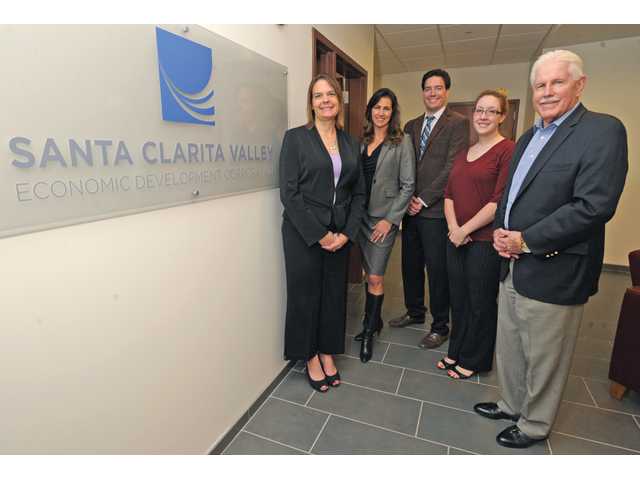
The Santa Clarita Valley Economic Development Corporation fills many roles including serving as an information resource as to what’s happening in the local economy, and by providing businesses and commercial real estate brokers with an analysis as to whether relocating to the SCV is the right decision for a company.
But those are only two key services that it provides. The nonprofit group becomes a bellwether of sorts coordinating between the efforts of all local entities to work in the same direction and achieve the same goals, said its executive officer.
Working in concert with the city, county, college, and other key institutions and players in the community allows the EDC to plan a strategy that aligns all of the economic activities for the benefit of local residents and business, said Holly Schroeder, president and CEO.
Santa Clarita community leaders had the foresight to say “we want to grow and diversify our economic base so we have a robust economy,” Schroeder said.
“A community that takes its businesses and underlying economy for granted is taking a huge risk,” she said. “If left to chance, then other communities that aren’t leaving it to chance are more likely to attract those companies.”
For Schroeder, who was hired last August, the new CEO has her sights set on actively recruiting companies that complement the Santa Clarita Valley’s existing business clusters of advanced manufacturing, aerospace and defense, medical devices, digital media and information technology.
“Good quality companies want to take care of their employees and create good working conditions where employees can be both happy and productive; they want to give them conveniences like places to park and a beautiful and safe city to work or live in,” she said. “Santa Clarita has all that and has a wonderful business climate that is very supportive of companies.”
Schroeder points out that the SCV is a region that she says is well-planned with business and industrial parks that are designed to meet modern business needs in terms of work requirements, movement of goods and modern equipment.
“The business parks didn’t happen by accident. We planned for these parks, planned buildings to meet modern manufacturing (requirements) that are much more technologically-driven than 50 years ago,” she said. “And our business and industrial parks are designed with easy access just off the freeway for any company bringing materials in or transporting products out to its customers. Much of our industrial space is on the I-5, the west coast freeway mainline for delivery both North and South. Other business parks have convenient access to SR-14.”
While the region’s attractiveness and rapid growth led to an industrial vacancy rate of just under 2 percent, that is all about to change as well, Schroeder said.
“There’s tremendous opportunity in Santa Clarita starting in 2014. We have 2 million square feet of new industrial space under construction, some of which will come online as early as fourth quarter,” she said. “Nowhere in Los Angeles County will have as much new construction of industrial space coming available.”
The welcome growth of space further stabilizes the area’s economic growth by creating a robustness and diversity of jobs for local residents, Schroeder noted. Armed with a strategy to bring the types of jobs that are higher caliber and higher paying creates a positive ripple effect in the economy.
“Our goal is to continue to grow the base of high-quality jobs here so fewer residents have to travel outside the valley for employment options,” she said.
But there are already a number of amazing companies located in the Santa Clarita Valley that “fly under the radar” since they don’t have name recognition because they aren’t business-to-consumer direct companies. Schroeder points to medical device companies like Advanced Bionics, the leader in the cochlear hearing implants for the hearing impaired, and Aerospace Dynamics, a major aerospace supplier. Each company employs hundreds of workers. SCV is home to many smaller companies doing similar innovative work.
Schroeder and her team are working on identifying existing companies to learn what kind of support they need to grow locally. Some of that support might come in the form of creating new training programs, bringing particular service partner companies that will help with their business, so they’re located closer to each other, and making connections between companies that are already operating locally, she said.
The EDC also wants to create more connections between the cluster-based businesses. Existing cluster businesses end up attracting other like-businesses because there’s a lot of synergy in what they each do. Combined with College of the Canyons, which is able to develop workforce training programs, companies are better able to recruit and attract more talent. It increases the overall quality of industry and raises the performance of the business community, Schroeder said.
“We can help to bring more innovative thinkers together, and when that occurs, magical things can happen,” she said.
Growing the business clusters are an important benefit for both residents and the local economy as a whole. Home to five distinct clusters, the Santa Clarita Valley has a broader economic base than cities with a single large industry like tourism, she said.
And that distinction has helped to keep its unemployment rate for residents far lower than surrounding cities, as well as aided local businesses when they were able to depend on each other for some added business during the recession.
For the SCV, a valley of 300,000 people, to have a level of diversity of business that we have is pretty unique, Schroeder said. It allowed Santa Clarita to weather the recession better than most California cities.
“We have something that is less susceptible to huge peaks and valleys than other areas in a changing economy, disaster or recession,” Schroeder said. “We want to remain diversified because it makes for a stronger economy.”