As the only white guy seated in the horn section of a segregated, otherwise all-black Army Band at Camp Reynolds in Pennsylvania during World War II, Dirk Fischer stood out. Musically, however, he was a perfect fit.
Long before being drafted at age 18, Stewart Rousin “Dirk” Fischer had honed his jazz chops playing with a touring quartet throughout his teenage years. Both his parents played instruments, and Fischer first picked up the trumpet at age 13. Although he volunteered for kitchen duty while in the Army, his prowess on the horn and as a composer earned a spot on the Camp Reynolds band and later on the Army Band at Camp Lee in Virginia, where he formed life-long friendships with several top jazz players also stationed there during the war.
After the war, Fischer performed in territory bands and with various jazz musicians, including his more famous brother, Clare Fischer, did studio work and composed music for other musicians. When the jazz music scene got a little dicey financially, he turned to his other great passion, cooking, opening a coffee shop-type restaurant in Van Nuys called the Owl Cafe, which he operated for 14 years.
With that more stable source of income, Fischer was able to re-enroll in college on the G.I. Bill and complete his teaching credential.
It was Fischer’s wife who suggested he visit the music program at College of the Canyons in Valencia as a way to meet other musicians. COC administrators, who had been looking to create a jazz music class, soon discovered they had a seasoned jazz veteran right under their noses.
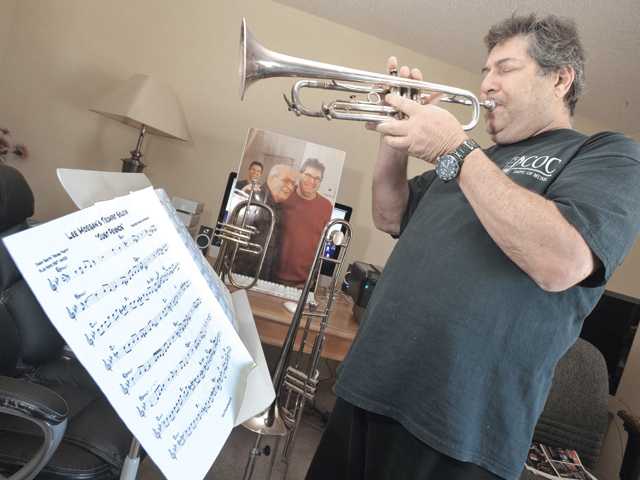
“He was always a big fan of the origins of jazz music, which is primarily black music,” said Skip Spiro of Castaic, whose 10-piece band, Skip Spiro’s Little Big Band, will perform several of Fischer’s compositions and arrangements at a tribute concert Wednesday at the Newhall Vincenzo’s, 24504 1/2 Lyons Avenue, at 7 p.m. Admission is free.
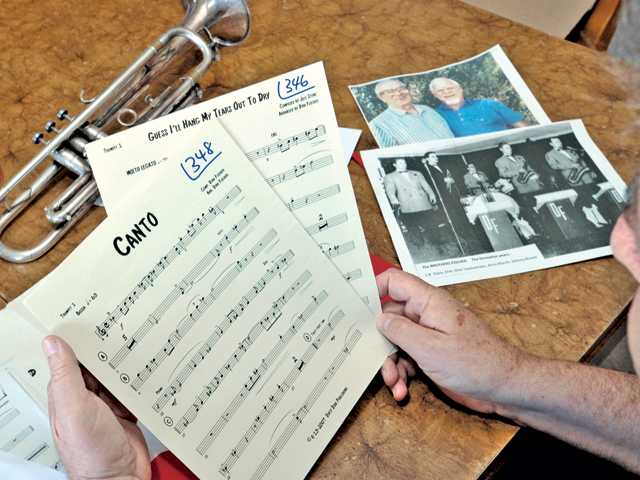
“He was a big, big Duke Ellington fan,” Spiro said at his hilltop home in Halsey Canyon, with sheet music of Fischer’s tunes fanned out on his dinner table. “A lot of his writing was influenced by Duke Ellington.”
In 1977, Fischer became jazz band director and instructor of jazz studies at COC, remaining at the college until he retired in 2005. He died last year in Valencia at age 88 — which as Spiro noted happens to be the number of keys on a piano keyboard.
“He lived a very full life,” Spiro said.
It was at COC where Spiro first met Fischer, whose compositions include both dance-style big band tunes and complex and challenging jazz numbers. Spiro, a former TV and film producer who plays trumpet, flugelhorn and trombone, found out Fischer’s touring band at COC needed a substitute horn player, tried out and got the gig in the mid-1980s. He ended up staying with Fischer for the next 30 years, becoming intimately familiar with the man and his music.
“His writing was very, very complex,” Spiro said. “He would do things with the music where he would write chords and the notes would intentionally ‘rub.’ It would create friction; it would make the chord very thick and very interesting. It was like drama. In drama you create tension and then out of the tension there’s resolution. The same thing with Dirk’s music. He would create incredible tension and then there’d be that resolution. It was very dramatic.”
Fischer’s more complicated work will highlight Wednesday’s concert, Spiro said, but the band also will perform Fischer’s arrangement of “Bye, Bye, Blackbird,” a classic jazz dance tune by Ray Henderson that Fischer made uniquely his own.
“It’s a very simple arrangement, but very beautiful in its simplicity. It has many of what you might call ‘Dirk-isms,’” Spiro said.
Even Fischer’s language was unique, “filled with his own personality,” Spiro said. He had a habit of creating his own words to get his point across. For instance, instead of saying, “I’m going to practice,” Fischer would say, “I’m going to practice-ize.”
“When he wanted you to get up in front and play a solo, he’d say, ‘Just step right up to the microscope,’ instead of ‘microphone.’ In a way it is like a microscope. You blow into that thing and it magnifies what you’re doing.”
Fischer also had an over-riding rule for his band members.
“One of the things that he always said was, ‘When you play music you’ve got to sing it. You’re not just blowing wind into a horn and pushing keys. If you can’t sing it, don’t play it,’” Spiro recalled.
He also was inspired by Fischer’s emphasis on composing original music and arrangements, something Spiro encourages his own band members to do.
“That’s why Dirk was able to attract some really, really great musicians,” said Spiro. “There just wasn’t anywhere else where you could play that type of complex music.”