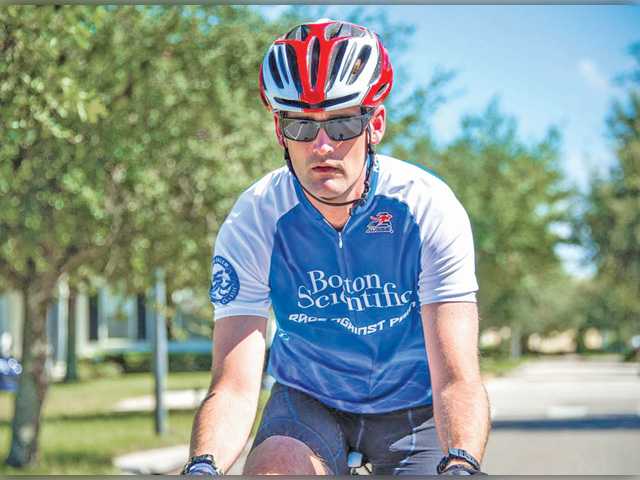
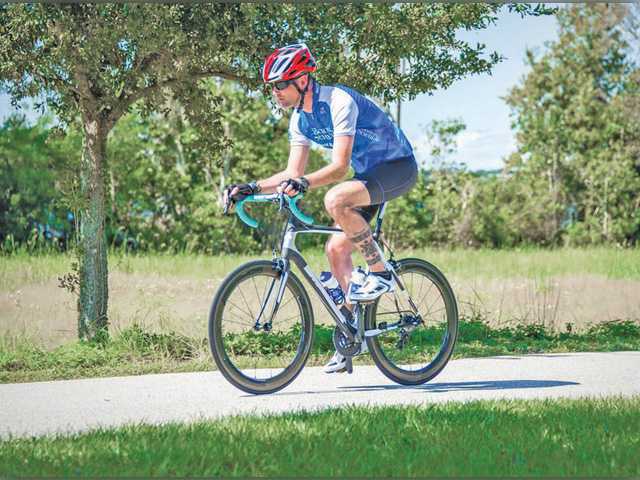
Justin Minyard is having the ride of his life.
Seven years ago, the 34-year-old former U.S. Army first sergeant was in a wheelchair. He struggled with a virulent opiate addiction from the pills he needed to take each day to fight off chronic back pain. He was so heavily medicated that his memories of those times are cloudy.
“I was taking daily what three or four terminally ill cancer patients take a day to deal with pain,” recalled Minyard, now an avid bicyclist. “I would drool on myself. My eyes would roll in the back of my head. I really don’t remember much from that time period. It got to the point where my quality of life was non-existent.”
These days Minyard travels around the country taking part in competitive bicycling events. In a typical week, he rides 300 to 400 miles, he said.
And today, he will be among thousands of cyclists who will ride 90 miles from Rodeo Drive in Beverly Hills to Pacific Coast Highway in Malibu as part of the Gran Fondo Italia cycling event.
It’s a grueling course that will take riders through the steep Santa Monica Mountains — and Minyard says he can’t wait.
“It’s going to be a great ride on a very challenging course. I’m looking very much forward to it,” he said.
Minyard said his second chance at life came in 2008, when surgeons implanted a small medical device about the size of an Oreo cookie under his skin.
The implant — called the Precision Spectra implant and made by Valencia firm Boston Scientific — sends tiny pulses to the nerves, masking pain signals as they travel to the brain. It produces a tingling sensation that reduces the feeling of pain.
For Minyard, the implant “saved my life,” he said.
“That’s the most rewarding part of the job is meeting people like Justin,” said Stan Van Gent, marketing director for Boston Scientific.
Unlike spine surgery, the outcome of which is often hard to predict, patients get to try out the Precision Spectra implant device before a permanent version is implanted, Van Gent said. During the trial period, patients work closely with their doctors to make adjustments to the pulses sent out by the device until an ideal setting is reached.
“We call it a test drive,” said Van Gent. “It’s a great way for the doctor and patient to determine if it decreases chronic pain” before the permanent device is implanted.
The implant helps chronic pain sufferers — more than 1 million are in the U.S., usually people 50 and older — live a normal life, Van Gent said.
Minyard first injured his back on Sept. 11, 2001. As part of a team of soldiers assigned to presidential escort duty, Minyard was stationed across from the Pentagon when a hijacked jetliner crashed into the complex, he said.
“The plane flew over my head — I saw and felt the explosion,” he recalled.
“I was one of hundreds of people who responded,” he said. “I injured myself trying to reach someone who was trapped” under the rubble of the Pentagon.
To cope, Minyard took pain pills and soldiered on. He was next deployed to Afghanistan as America’s new war on terror took aim at al-Qaeda and its Taliban allies. During a night raid that required him and his fellow soldiers to rappel by rope from a helicopter onto the roof of an enemy compound, Minyard lost his grip.
“I missed the rope,” he said. “I fell, and then my fellow soldiers landed on top of me.”
He fractured several vertebrae in his spine and suffered other injuries. But Minyard’s military career wasn’t over. Against the advice of doctors, he signed up for yet another tour, this time in Iraq. But the pain from his accident in Afghanistan followed him into the new combat zone.
“Before going into action, I would strip off my weapons and vest and inject myself” with pain-relieving medicine, Minyard said.
Finally, two months before the end of his tour, Minyard could no longer cope with his pain. He was evacuated from Iraq in a wheelchair and spent the next several years trying to deal with chronic pain that “ruined my life,” he said.
After his implant surgery, Minyard’s friends in his hometown of Tampa, Fla., threw him a party.
“We had a big bonfire, and we threw my wheelchair into the fire,” he said.
Today, Minyard is on a new mission, working to get the word out to other veterans and chronic pain sufferers that there are options out there beyond addictive pain pills. He serves as spokesman for RaceAgainstPain.com, an online forum for chronic pain sufferers.
About a year ago, Minyard founded Operation Shifting Gears, a nonprofit group that helps veterans overcome physical and mental injuries through cycling.
“We take a holistic approach to recovery, helping veterans take that first huge step. Now we have a nationwide network of physicians who offer their services pro bono,” Minyard said.
Helping former soldiers who are struggling to cope with combat-induced pain, as he did, has opened a whole new chapter in his life, Minyard said.
“I’m smiling right now, because I’m thinking about a guy we’ve been working with. He had been dealing with a massive amount of pain for years before he got the implant,” said Minyard.
“Yesterday, he called me and said he has not experienced this type of pain relief with any other form of treatment. Now he’s going on his first job interview.”