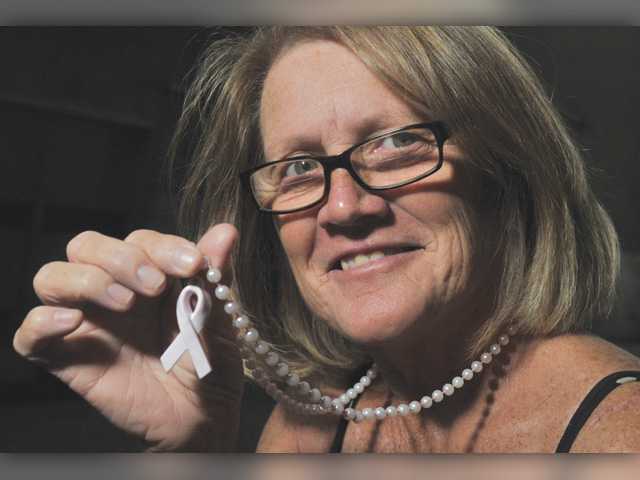
When Wendy Thrush was diagnosed with breast cancer, she had to decide how much she would let the disease into her life.
Would it stop her from running marathons? Would it take her away from rearing her two children? How much of herself could she give to fighting this disease?
When she went into remission and her family put the fear of loss back in a box — and Thrush made a choice to live passionately and without fear — was she thankful for the cancer? Or should she forget her battle and move on?
Thrush recalled those questions as she was interviewed in Bridgeport Park last week. The Valencia resident pressed a hand to her chest and closed her fingers around the pendant hanging from her neck.
The remission was some four years behind her, but though she beat the disease, complications from the treatment left her with a compromised immune system, requiring her to take medication that makes her feel much the same way chemotherapy did.
She pinched her eyes shut and breathed through the nausea. As the medication worked up a heat inside her body, shadows of leaves danced around her feet. Day four of the treatment is the worst.
Once it passed, she opened her eyes and dropped her hand, the imprint of a breast cancer ribbon glowing white against her red palm.
She’s come to understand that her life, her body, her family, will never be the same, but Thrush has chosen to thrive.
And like many women who beat breast cancer, she chooses strength over self-pity, perspective over pain.
“There are dark places in a cancer battle, and people go there,” she said. “But I don’t.”
Fight
Thrush was diagnosed with Stage 2 breast cancer on Dec. 22, 2008, after a routine mammogram.
“My Christmas present was breast cancer,” she said.
Upon diagnosis, her doctor considered the catch an early detection. In shock, Thrush and her husband, Matt, went to a coffee shop before returning home to their kids.
“We sat there and just stared at each other,” she said. “We thought, ‘We can get through this.’ But I remember crying in my coffee.”
Since doctors also take holiday breaks, Thrush had to wait until January for her lumpectomy, a surgery to remove the cancer cells while leaving the breast intact.
But by then, Thrush’s scans revealed growth; the cancer had accelerated to Stage 3 metastatic — it spread to her lymph glands.
“Everything happened so quickly,” Thrush said.
After the surgery, Thrush received six chemotherapy treatments, with Matt by her side, and soldiered on through 38 rounds of radiation.
“When radiation was completed in 2010,” she said, “I was told I was in remission, and everything looked good.”
Trying to remember what normal felt like, she focused on regaining her strength, training for marathons and immersing herself back into her children’s lives.
“You’re never the same person,” Thrush said. “I remember the tears I shed, the nervousness I had, the pain I went through, the tubes sticking out of my breasts.”
Everyone deals with the trauma differently, she said. Some survivors struggle with anger or denial, and almost all struggle with fear.
“But the best thing I can do for myself and others is to truly believe that everyone has a purpose,” she said. “The cancer wasn’t going to determine who Wendy was.”
Still, she couldn’t rid herself of the fear.
“I knew inside that the treatment would lead to other problems,” she said.
Survive
“There are a lot of quiet survivors who go through so much after cancer,” Thrush said. “Different parts of their body are still struggling.”
As more information becomes available about cancer treatments and their effects, the breast cancer community is paying more attention to “survivorship issues,” or complications that arise years later as a result of treatment.
During Thrush’s treatment, she would occasionally experience a rash on her hands and would need special medical attention. As she recovered, the rash gradually spread up her arms and onto her chest.
She saw multiple specialists before she was diagnosed with systemic lupus, a chronic disease that causes inflammation in the body, as a result of either her chemotherapy or radiation treatments.
“I am completely inflamed internally,” she said. “It was a shock to us at first.”
Every three weeks, Thrush receives intravenous infusions of protein in the same chair where she once received chemotherapy. Afterward, she experiences many of the same side effects as chemotherapy. She will need these infusions for the rest of her life.
Rather than letting the familiar scenery drag her back to her cancer days, Thrush uses her unique qualifications to support the women sitting beside her each week.
“I have a very strong will and torpedo vision,” she said, “and a big heart that wants to serve.”
Each treatment, Thrush comes in toting favorite snacks and small gifts to lift her friends’ spirits.
Though she walks in with the intention to serve others, these women often end up fortifying Thrush’s resolve.
“We’re warriors, not survivors, because each day we wake up with aches and pains, and we’re trying to put them in perspective,” she said. “We all want to live. We all have things to live and fight for.”
Thrive
From about the time Thrush was diagnosed, she started volunteering for the Santa Clarita Valley breast cancer nonprofit Circle of Hope Inc. in whatever capacity she could. Quickly Thrush found that finding a purpose helped her find the strength to fight.
With a chemo-created bald head, Thrush took on coordination of all the vendors at the nonprofit’s annual breast cancer 5K and walk in 2009. And when she was declared cancer-free, she hosted a huge bash to raise funds for Circle of Hope.
Her daughter, however, didn’t immediately understand her mother’s newfound purpose.
“One day she asked me, ‘Why are you staying around cancer?’” Thrush recalled. “When you’re diagnosed, the whole family is diagnosed. My kids have gone through a lot.”
But for Thrush, volunteering became her strength, support and perspective, as her family later came to understand.
“I’m around women who don’t get stuck in the diagnosis,” Thrush said. “They find a way to live through it.”
Now Thrush sits on the Circle of Hope Board of Directors as a client representative.
“They’ve got me as a lifer,” she said with a laugh.
Thrush hosts support groups for the organization and hopes to expand the program to offer more services for the family, not just the patient or survivor.
And though cancer will never be completely gone from her life, she refuses to live in fear.
“I never look at life like there’s not going to be another tomorrow,” she said. “I don’t walk in fear. This, too, I will overcome — one day and one step at a time.
“I have a business, wonderful kids and a husband who loves me,” she said. “It’s hard to get depressed with all of that. We were born to thrive. I was born to thrive. We weren’t born to be victims.”