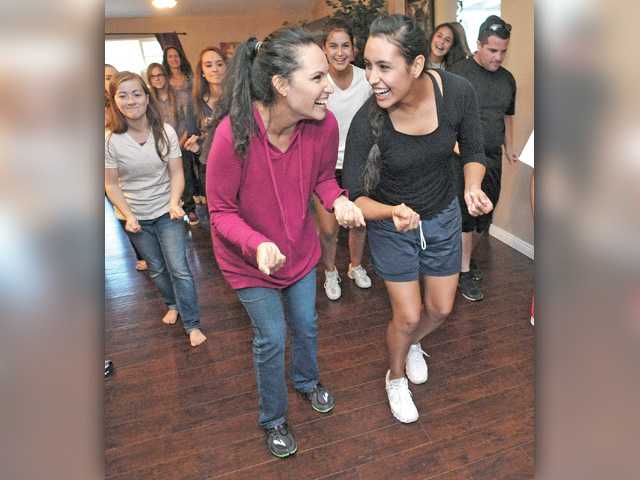
As 17-year-old Belicia Cespedes walked up to her door, about 30 of her family and friends readied for the surprise, falling into position in the kitchen.
The door swung open. The upbeat tunes and sweet falsetto of the song “Happy” by Pharrell Williams infused the room with a soulful cheer. And 15 people broke out in a flash mob.
“This, for me?” Belicia exclaimed, throwing her hands to her face and twisting sideways. She was nearly turned around with joy.
She didn’t yet know why her family had staged such a big production, but the entire room knew it was warranted.
Before she’s even old enough to be legally declared an adult, the Canyon Country resident has earned a bachelor’s degree, passed the CPA exam and completed two years of part-time work experience under a licensed CPA.
Last week, her CPA license was shipped to the Cespedes house, and her family waited to tell her until this moment.
Joy mounted as Belicia’s friends and family watched her realize the gravity of the moment. Falling into step, she sheepishly looked sideways at her mother and whispered, “Mom," slowly dragging out the endearment, cracking a huge smile and raising her hands for a snap to the beat.
As dancers took turns at solo parts — with sunglasses and a slick, 360-degree turn or some fancy footwork reminiscent of decades past — Belicia ran through the crowd to her father, where he presented her with her framed license.
Through an alternative education plan, the Cespedes family has worked hard to find a path that best suits each of its five daughters, setting them up for early success and intense specialization in their chosen fields.
Alternative education
Belicia’s accomplishment, however, is a result of years of hard work and her family’s outside-the-box approach to education.
“Mastery became the goal — not just the grade,” said their mother, Vicki, explaining the philosophy behind her girls’ education. “If they could demonstrate mastery, they could move on.”
Abandoning the traditional approach for something radically different tends to earn them looks of disbelief, they said.
By throwing convention out the window, however, the Cespedes examined the purpose of education under their own lens. And they overlooked no education tool as a possible piece to complete their program.
In the end, they drew up an ever-changing homeschooling program that bends and shifts to the girls’ interests and strengths as they explore the world of education and the careers of their dreams.
Instead of taking multiple classes at once, like most curriculum dictates, the Cespedes daughters completed one course at a time throughout their secondary education, working through the material at their own pace.
“It was really motivating,” said Vicki during an interview in February. “They could accelerate or slow down if they wanted.”
They completed their courses, mailing in the work to their homeschooling program and earning credit. The program worked so well that the girls completed courses much faster than their public-school peers.
The four oldest girls — Ivana, 19, Belicia, 17, Briana, 15, and Giana, 13 — have all graduated high school between ages 11 to 14. The youngest, 4-year-old Ellie, will work with her parents to choose a plan that works for herwhen the time comes.
After accelerating through high school, the sisters began acquiring college credit through the College-Level Examination Program, a credit through examination program by the College Board.
Each girl would study the material, take as many attempts as she needed to pass the College Board CLEP exam and earn anywhere from three to 12 college credits in the subject. Those credits are then stored in a “bank” and can be used toward any college degree that accepts the program within 20 years, Belicia explained.
“By finishing early, we have the time to learn our crafts and actually start practicing them,” Belicia said.
Translating into a career
The road to achieving her license has been long, and Belicia began at age 13. After graduating high school, she worked toward her bachelor’s degree in accounting, earning a specific number of credits in mandated subject areas such as business, ethics and mathematics.
In the meantime, Belicia accumulated what was equal to one year of full-time work under a CPA, which she earned over two years of part-time work.
Then came the exams — five of them. The first four are comprised of knowledge-based testing, and take a total of 14 hours to complete. The fifth is an ethics exam.
Roughly about half of test-takers passed each section so far this year, according to the American Institute of CPAs, and the Cespedes can’t find record of any test-taker who passed as an adolescent.
Holed up in her room for about six months, Belicia logged 12-14 hours of studying each day, skipping weekends most of the time, said their father Jan.
“You have to be very focused and dedicated,” he said, “and you have to understand concepts to pass that exam.”
When Belicia passed, after two failed attempts, her parents submitted her accomplishment to the Guinness World Records.
“They don’t have records of it, so they don’t know if she’s the youngest,” Jan said to the crowd. “So Mom and I decided to name Belicia Cespedes the youngest CPA in American history.”
Flanked by her proud parents, Belicia enjoyed the moment.
“I feel so blessed — it’s surreal,” Belicia said. “I can’t believe I’m done.”
After a break and some well-earned relaxation, Belicia will begin working as a CPA for her father’s company, and possibly some contract work, said Belicia and her father.
“Actually, I think I get my first paycheck next week,” she said laughing.
The next step will be for Belicia to choose a specialty, and in typical Cespedes style, they are preparing. Belicia has been meeting with CPAs in various specialties to learn the job and explore the field.
She also will start an internship in a CPA office in Ventura, now that she can drive.
As far as her age difference, Belicia only has nerves normal to any new employee.
“Working with people is exciting to me, not nerve-wracking,” she said. “The only thing I’d be nervous about is not having an answer when someone asks me for help. I feel more comfortable around an older crowd — I always have.”
Philosophy of excellence
For the Cespedes family, setting the bar at excellence is the norm and the goal. And their family philosophy translates into their relationships, faith and extracurriculars.
In attendance at the celebration, many families had different stories and had chosen various education paths.
Some were homeschooled. Some went through public school. Many tried a combination or chose differently for each child. For most, education, community and faith were important.
“The community here is very strong,” said Jeanne Mumper, a close friend of the family. “Community has a lot to do with it.”
Though these girls met education benchmarks at an almost unbelievable pace, none expressed a feeling of missing out.
Throughout their years of study, they’ve taken up activities and sports, as well.
Whether it was piano, tennis or a daily field trip, the girls said they had something to look forward to each day.
“They had lots of slumber parties, too,” Vicki said. “We were always celebrating something.”
After the flash mob finished, the group sat down for a slideshow of Belicia’s journey to this point. Friends and family shared stories and praise.
“Our goal in life was to disciple these children,” Jan said to the crowd. “You walk through life, and opportunities come your way. When you live with purpose, you can do good. Think of all the good Belicia can do counseling people who can’t afford it.
“School wasn’t the goal,” he said. “This is.”