Valencia Technologies is a pioneer on the medical device front in more ways than one. The Santa Clarita-based company is challenging conventional treatment assumptions, allowing it to innovate a smaller device to treat hypertension. And under new federal rules it is laying all its cards on the table to attract investors for its next step of conducting U.S.-based clinical trials – a possibly risky move, but one more companies will are expected to adopt.
Tackling high blood pressure successfully would give Valencia Technologies access to a huge market of people battling the condition. In fact, it’s the leading cause of death in the United States. One out of three adults is estimated to be battling the condition in the nation, and of those numbers nearly 49 million people have yet to bring it under control. A total of $47.3 billion was spent on treatments in the U.S. in 2008, $21.3 billion of which was spent on prescription medicines.
“People with high blood pressure are in great danger of having a stroke or living a life with cardio vascular disease,” said Jeff Greiner, founder of Valencia Technologies.
Working off the theory that that the brain’s pattern of operating can be re-programmed with a targeted amount of electrical stimulation given only once a week, Valencia Technologies is challenging the assumption of other medical devices in the field that the stimulation needs to be continuous.
“We found a body of literature that suggests we could stimulate just 30 minutes per week and the brain would remodel itself just based on that small amount of time,” Greiner said.
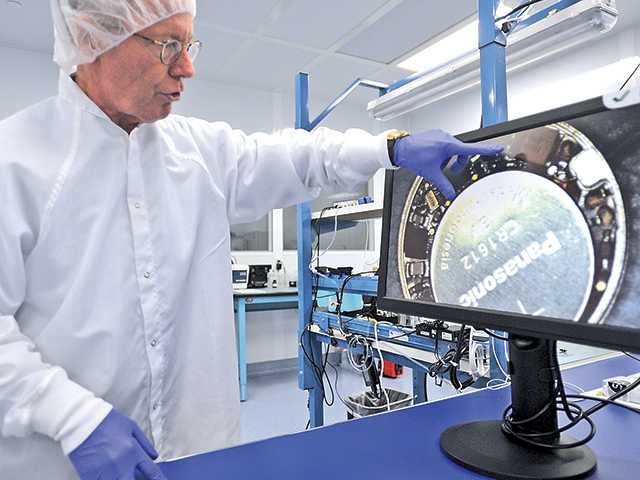
The innovation of applying significantly shorter intervals of electrical stimulation also translates into some very big benefits. Greiner describes his firm’s device as “radically small.” The device is very small, the size of a nickel or a dime so it can operate with a very tiny watch-size battery, he said. And it doesn’t need lead wires attached to it so it can be implanted in about 10 minutes in a doctor’s office.
Valencia Technologies’ device works by stimulating the median nerve in the arm, nudging the sympathetic nervous system so that the brain operates to moderate blood pressure. Early clinical results of the firm’s international, double-blinded, and controlled study are positive. Results show clinical significance compared with baseline and compared with an implanted control group. More than 38 patients have been implanted with the device, the company reports.
“This is therapy for people who are on three or more drugs and yet their blood pressure is still high,” Greiner said. “In clinical trials blood pressure seems to be subsiding. The goal is ultimately to come off meds. The first implanted patient is a year out and very close to normal.”
Founded by Greiner in March 2011, this isn’t his first trip down the aisle with a biomedical company. He served as one of the initial operational leaders of Advanced Bionics, where he remained until the company was sold. While with the firm, he helped build the company from seven engineers and no revenues into a company with 2,500 employees and revenues exceeding $300 million, he said. And Greiner has some good company.
His Chief Technology Officer, Dave Peterson, led the design of Medtronic’s first wireless defibrillator before being recruited to design Advanced Bionic’s spinal cord stimulator, now handled by Boston Scientific after it acquired the technology, Greiner said.
In November, Valencia Technologies launched a crowdfunding campaign in November seeking $30 million at $6 per share from accredited investors only for its implantable coin-sized pacemaker-like device for the treatment of hypertension. New SEC rules now allow companies to seek investment through general solicitation.
What’s novel is that the firm is laying all its cards on the table, publically describing its intellectual property and the company’s plans on its website in completely transparent fashion to attract those investors.
Having invested $8.5 million to date, Greiner said the purpose of raising money through crowdfunding is to expand clinical trials to secure Food and Drug Administration approval in the U.S. Valencia Technologies has already conducted trials overseas but a U.S. trial will involve hundred of patients which is an expensive process.
The next step for the company is to finish those clinical trials and then submit the results for pre-market approval from the FDA which takes a year to get. Upon approval, Valencia Technologies plans to build its own sales force to market the treatment device.
“You have to give up a lot of control if you take on a partner,” Greiner said. “With our own sales force under our control, our competitiveness is secured. You’re always worried about whether your product will their own baby or not.”
And with its innovative size and design, the device was created with costs in mind, he said. Based on his knowledge of the cost of spinal stimulators for chronic back pain and cochlear implants for the hearing impaired, Greiner believes Valencia Technologies has the opportunity to price its device much lower.
“We spent time designing this implantable device. The team took three to four years to develop it and by choosing a simple design and having the right team in place we cut in half the amount of time developing the product,” Greiner said. “We have significant patent applications and are developing a patent portfolio to lay the foundation to manufacture it in higher volumes. Policies, procedures and processes need to be refined for a complex set of rules that govern our industry.”
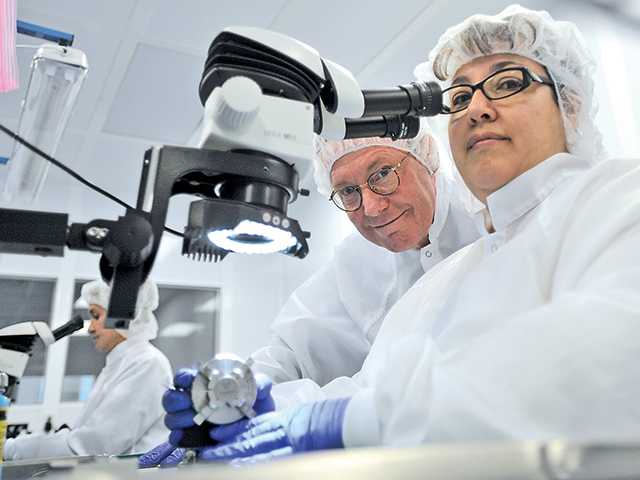
But Valencia Technologies is in a good position for growth thus far. Operating out of its own 4,600 square foot facility, Valencia Technologies has a 1,100 square foot clean room for assembly and 15 employees. The company is also located in Santa Clarita with a growing biomedical industry including companies like Boston Scientific, Advanced Bionics, MannKind and more. All it needs now is move to round two of funding.
“The crowdfunding is progressing fine,” Greiner said by mid-December. “We've raised over one million dollars and we have requests for over 35 investment packages. We're in active communication with at least ten of these potential investors.”