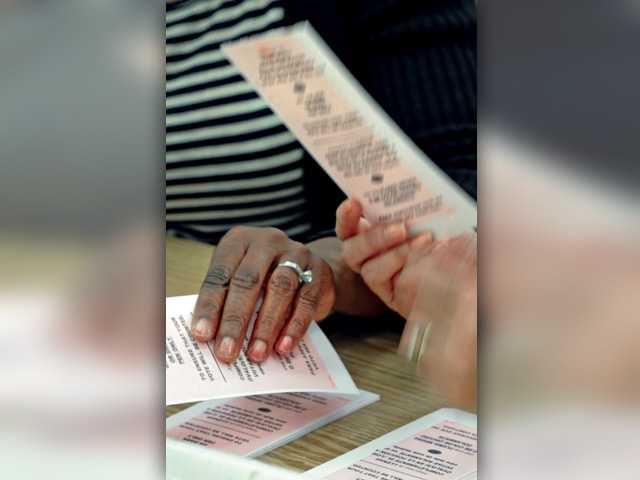
Editor’s note: This is one of a series of articles concerning issues that will be in the forefront in 2015.
Elections in the Santa Clarita Valley used to be a simple affair.
When voters cast ballots in local elections, they knew going in that they would be able to vote for as many seats as were up for election in a given year.
Three spots on the Santa Clarita City Council up for grabs? Check up to three names. Two seats open for a local school board? Choose a pair of candidates.
Thanks to the California Voting Rights Act, that’s changed dramatically over the course of the last year.
An almost uniform collection of at-large elections has instead given way to a mishmash assortment where some Santa Clarita Valley officials will now be elected at-large, others from voting areas and some using a system that is foreign to most voters: cumulative voting.
Since March, four Santa Clarita Valley school districts, the Santa Clarita Community College District and the city of Santa Clarita have all agreed to change their election systems.
In doing so, they’ve dramatically changed the election landscape of the Santa Clarita Valley in 2015 and beyond.
Lawsuits
The Santa Clarita Valley’s electoral saga began in 2013, when a trio of lawsuits were filed in quick succession against the city of Santa Clarita, the Sulphur Springs School District and the Santa Clarita Community College District, which oversees College of the Canyons.
All three suits contained roughly the same allegations, namely, that the at-large election systems currently in place, whereby voters can cast ballots for all open seats in an election, violated the California Voting Rights Act by preventing Latino voters from electing candidates of their choice.
All three would later settle those lawsuits and agree to change their election systems.
In doing so, they drew the lines for what have become the two primary ways local agencies are either settling, or trying to avoid the possibility of lawsuits under the California Voting Rights Act.
Safe harbors, new paths
Sulphur Springs was the first local district to settle its lawsuit, doing so in March by agreeing to shift to voting-area elections, where voters will elect a representative to the district’s five-member board based on where they live.
Though the district itself was not sued, board members in the William S. Hart Union High School District also made the decision to also move to trustee-area elections in July, saying that doing so would provide a safe harbor against such suits.
“The only safe harbor for a violation of California Voting Rights Act claim that is filed is transitioning to a by-trustee area election system,” said Milton E. Foster III with the firm Fagen Friedman & Fulfrost LLP, when he presented the board with information on the Voting Rights Act in July.
Other agencies in the Santa Clarita Valley, however, decided on a different tack — cumulative voting, where it would be possible to vote multiple times for the same candidate.
Cumulative voting
If you think the idea of cumulative voting sounds confusing, you’re not alone.
“There will be more spoiled ballots, more mistakes, more people that miss the publicity about the change and are confused about their votes,” said Brian Gaines, a professor at the Institute of Government and Public Affairs at the University of Illinois, in an earlier interview. “I wouldn’t be at all surprised if in the first election there’s extra confusion about voting and counting the ballots.”
Proponents of cumulative voting say the system allows minority voters, such as Latinos, to lump their collected votes behind a chosen candidate or candidates.
Though cumulative voting has been used in elections elsewhere in the country, the courts had to settle whether the city of Santa Clarita could use the system as part of a settlement of a California Voting Rights Act suit.
A judge ruled in September that it could, clearing the way for the city to move forward.
The community college district has also announced plans to move to cumulative voting.
The Newhall School District board decided to switch to cumulative voting, if doing so was deemed legal. The Castaic Union School District board also signed off on the switch as well.
One exception to the deluge of Santa Clarita Valley election changes is the Saugus Union School District, which, as of this month, had yet to officially announce any determination on how, or if, to change its election system.
“We’ve been monitoring it, which is what the board asked me to do when they met in July,” said district Superintendent Joan Lucid, adding that the district had been tied up in recent months focusing on getting its Measure EE bond passed and filling a vacancy on the district’s board.
Election dates
Voting systems aren’t the only way Santa Clarita Valley elections are set to change. The dates for which some of them will be held are also scheduled to shift.
The city, for instance, agreed to change its election dates from April to November of even-numbered years as part of its settlement.
Doing so raises the possibility of consolidating elections with the county ballot to encourage higher voter turnout, officials say.
The Castaic and Newhall districts, as well as the Santa Clarita Community College District, have also said they could change their election dates to November of even-numbered years.
Officials in the Sulphur Springs district, however, have said the district plans to hold its voting-area election in 2015. The Hart district, too, has also indicated its next election will be held in 2015.
Complicating matters further are the constraints of the county ballot.
Because of limited capacity on the Los Angeles County ballot, it’s not a given that elections held in even-numbered years would be contained on the county ballot.
“Because of just the capacity issues that we face when it comes to the ballot, and these being the heavier-load elections, we have to guarantee ballot capacity for statewide, federal and county races,” said Efrain Escobedo, governmental and legislative affairs manager for the Los Angeles County Office of Registrar-Recorder/County Clerk, in a previous interview.
This could lead to a situation where county elections and the elections for agencies in the Santa Clarita Valley are held separately on the same day.
That may lead to double vision for voters: two sample ballots in the mail, two ballots to cast and potentially two different polling places to go to.
Escobedo also has said that the county’s voting system is likely unable to handle cumulative voting, meaning, moving forward, that a typical Santa Clarita Valley election day in November of an even-numbered year could mean local residents voting in two different elections using two different voting systems on the same day.
661-287-5525
On Twitter
@LukeMMoney