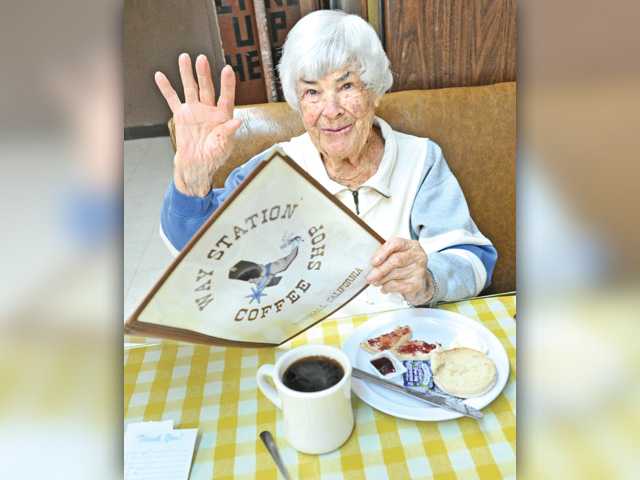
More than 200 people showed up Thursday on the doorstep of the tiny cabin where Melba Walker Fisher was raised with 12 siblings in the early 1900s.
Under towering, sun-dappled sycamore and oak trees that grew where Fisher loved to play on the grounds of what is now the Placerita Canyon Nature Center and Natural Area, friends and family gathered to remember a remarkable woman.
Born July 2, 1916, the sixth of a dozen children born to homesteaders Frank and Hortence Walker, Fisher died New Year’s Day. She was 98.
A memorial service was held at 11 a.m. Thursday at Eternal Valley Memorial Park. A public reception and barbecue followed on the property where Melba Walker Fisher grew up tending the family’s gardens and animals. The barbecue was her wish, a descendent said.
Among those on hand for the reception were Fisher’s children and grandchildren and other relatives. The lessons she taught them, her children said, are the skills they use today.
When her daughter, Gayle Starbuck, was just 5 years old, Fisher taught her how to make cheese, she said. Today Starbuck runs a successful cheese-making business in Oregon called Curds on the Way, as well as teaching cheese-making.
“(Mom) used to hang a bag of cheese from the clothesline and I used to watch it drip,” Starbuck said. “We made our own cheese; we made our own butter.”
That was just one of hundreds of pioneering skills mastered by homesteaders like Fisher that she passed on to her children, Starbuck said.
The lifeling Newhall resident also taught her grandson, Gayle’s son Richard Nuss, how to pan for gold in the Santa Clarita Valley — a skill he says he bases his life on today.
“I was 4 years old when Grandma Melba taught me how to mine for gold,” Nuss said in an interview Thursday. “She brought me to her secret spot and she basically showed me how to gravel out the material for gold.”
Nuss said those early lessons gave him enough knowledge about prospecting to start a career as a gold miner. A testament to Fisher’s legacy hangs from a necklace around his neck, anchored with a raisin-sized hunk of gold that he mined.
“I’ve prospected every canyon in this area and I still say there’s gold to be found in these hills,” Nuss said.
The most important lesson learned from their mother, Gayle and George Starbuck said, was how to be free.
“The only thing she would tell us was have fun and be home before dark,” George said, smiling. “We would take off and hike all over these hills. My sister, Gayle, would be running behind us on those short legs.”
“She might tell us, ‘Take your .22 in case you see a bear,’ but that was it,” he said.
Gayle smiled as her brother recalled those early days before anyone ever thought of establishing a city in the area.
While Melba Walker Fisher’s descendents are quick to share happy memories of her, their matriarch’s secrets are another matter.
Where is Fisher’s “secret place” to pan for gold? Her grandson isn’t saying.
Where is the biggest den of rattlesnakes in Placerita Canyon? George Starbuck is not saying.
“If I said where it was, somebody would just try to disrupt it,” he said.
The sprawling Walker Ranch in Placerita Canyon was eventually deeded by patriarch Frank E. Walker to the state of California and became Placerita Canyon State Park.
Administered by the county of Los Angeles, it has become a favorite hiking destination for Santa Clarita Valley families and a field trip destination for children in the SCV and throughout the Los Angeles area, some of whom never encountered native trees, landscape and animals until their visits to Placerita Canyon Nature Center.
661-287-5527
On Twitter
@jamesarthurholt