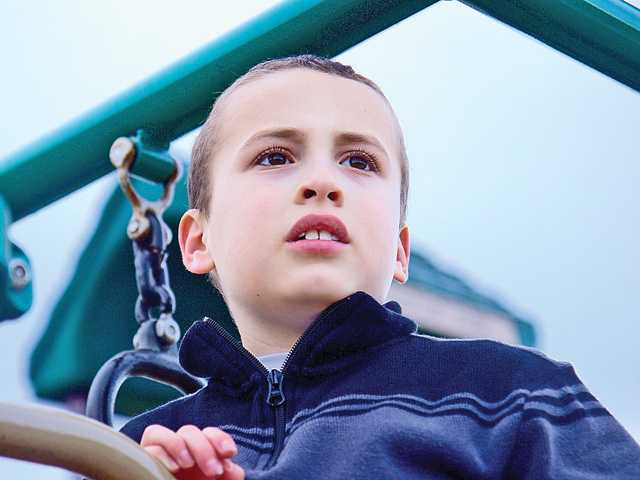
The sun was setting on a late afternoon in Valencia as 12-year-old Charlie Kayne climbed the playset at Bridgeport Park and reached for the monkey bars.
Clasping his fingers around the first rung, he paused and, silently, decided against the leap. Watching closely from outside the sandbox, his father interpreted his hesitation as a gesture for help.
“What’s wrong,” asked Charlie’s father, Rob, who firmly but lovingly rubbed Charlie’s chest.
To most anyone else, Charlie’s response would be difficult to understand — he stresses unusual syllables, skips others and, sometimes, chooses the wrong word or sound entirely — but Rob speaks Charlie’s language.
Within seconds, Dad is back outside the sandbox, and Charlie jumps, swings and reaches for the next rung, filling his silence with laughter.
When he was 2 years old, Charlie was diagnosed with autism and apraxia, a speech motor disorder that makes coordinating the parts of the body that produce speech — the tongue, lips and lower jaw — difficult for Charlie.
“A person (with apraxia) tries to make sounds or words, but they have great difficulty,” Rob said. “They believe they are making the sounds and words, but they’re not; he’s making verbal approximations.”
Common in stroke patients, apraxia is neurological in nature and not related to muscle weakness, development or a limited range of motion, according to the American Speech-Language-Hearing Association.
“He believes he’s saying the words correctly, which obviously leads to a great deal of frustration,” Rob said. “It takes a great deal of practice to understand his approximations.”
The diagnosis
“At age 2, he had no speech — no precursors to speech, no babbling — there was nothing like that,” Rob said.
Concerned about his late development, the Kaynes took Charlie for a speech evaluation.
“His doctor didn’t seem overly concerned,” said Charlie’s mother, Faye. “Within the first hour of observing Charlie, the comment said to us was: ‘Do you know the movie ‘Rain Man?’’ As parents, that’s not something you want to hear.”
When Charlie was diagnosed, the Kaynes were told he was in the bottom 1 percentile.
“That was a hard thing to hear when no one had even said the word ‘autism’ to us before,” Faye said.
Completely unprepared for this new challenge, Rob and Faye quickly adjusted their perspective.
“We took our few minutes and cried and dealt with that,” Faye said. “Everyone has challenges. It’s hard. It’s difficult. It’s life-changing, but life goes on. So then we said, ‘Let’s get to work.’”
New milestones
“Anytime you have a child, you want him to be the valedictorian,” Rob said, “and that shifts to just wanting him to go to the neighborhood school. Our focus changes.
“We celebrate different types of milestones,” Rob continued.
After extensive research into the challenges ahead and the resources available to overcome them, Rob and Faye did everything they could to get Charlie the help he needed.
“We made the calls and got him in the right programs, and we haven’t let our foot off the gas pedal,” Rob said. “It’s not a sprint; we’re in a marathon.”
Charlie is enrolled in a class for children with moderate to severe autism at Bridgeport Elementary. He takes speech therapy classes seven days a week, sometimes taking more than one form of educational therapy in a day. Active and progressing in academics, Charlie usually spends his after-school hours plugging away at homework or taking karate class with other special needs children.
“He’s made tremendous strides,” Rob said.
Today, Charlie speaks full sentences, which get longer and longer with practice. He shows promise in his academics and, most importantly, shows pride and happiness in his work.
“At times, he enjoys doing work more than having fun,” Rob said. “He’s responding, so we keep going.”
As Charlie rises to every challenge, however, his parents want to ensure he gets to just be a kid, too.
The ultimate goal
“Ultimately, we want him to be happy,” Faye said, “and we want him to be as independent as possible.”
With Charlie’s language barrier, typical social interactions that can be difficult for any 12-year-old are amplified. Practicing speech, especially spontaneous conversation, in a safe environment is vital to socialization.
“When he wants to communicate, we have to ensure a certain level of success,” Rob said, “because when he practices talking to strangers, they’re not going to understand him.”
Aside from challenging his social development, Charlie’s struggle with language presents a certain danger for his parents. Currently, Charlie is mostly dependent on electronic devices to communicate with strangers.
“If for some reason he wasn’t around someone he knew and didn’t have his iPad, that would definitely concern us,” Faye said. “We’re out watching him like a hawk because we can’t risk anything. That’s the fear — he’ll land in a situation where he can’t communicate.”
Charlie wears a bracelet that would alert authorities in an emergency, and the Kaynes are prepared for that situation. But they’ve found one solution that may do more than give them a mild sense of security.
A helping paw
“Our son has been developing a love for animals,” Faye said, smiling widely. “Charlie will just be attracted to dogs, putting his head down on the dog’s back. There’s this connection there that’s just missing with humans.”
Last year, the Kaynes discovered 4 Paws for Ability, a company in Ohio that trains service dogs for individuals with special needs. To ensure that the service dog is a match for the family, the Kaynes were asked to send hours and hours of video footage of Charlie to the trainers in Ohio, so they could understand his personality, moods and needs.
“They told us to make sure we show the moments we don’t want anyone else to see,” Faye said with a laugh.
Once the family flies to Ohio to work with the trainers, the dog will be a huge safety net for the Kaynes.
“Knowing the dog is there will give us peace of mind,” Faye said.
Besides attracting other children his age, dogs seem to spur spontaneous speech in Charlie — he’ll talk to pets when he won’t talk to people, Faye said.
“He can bring the dog to school, and children will engage in conversation where normally they wouldn’t approach a child with autism,” Rob said.
When Charlie gets anxious in social situations — or medical, as well — the dog will help provide comfort and ease tension. Charlie will also learn a sense of responsibility and purpose from caring for the dog, Faye said.
Most of all, a service animal will be with Charlie if he ever finds himself in harm’s way, and with tracking skills, the dog will help reconnect the family if they are ever separated.
“It’s that one step closer to independence,” Faye said, “to bonding and making friends.”
Swinging back and forth, Charlie gave it one more go to reach the end of the monkey bars.
“Charlie handles all these challenges like a champ. He’s a generally happy kid,” Rob said. “There are these times where you just see it in his face. I don’t know what I have to do to see it all the time, but I’ll do it.
“He has fundamentally changed us,” Rob continued. “There are so many life lessons we would have missed without him.”