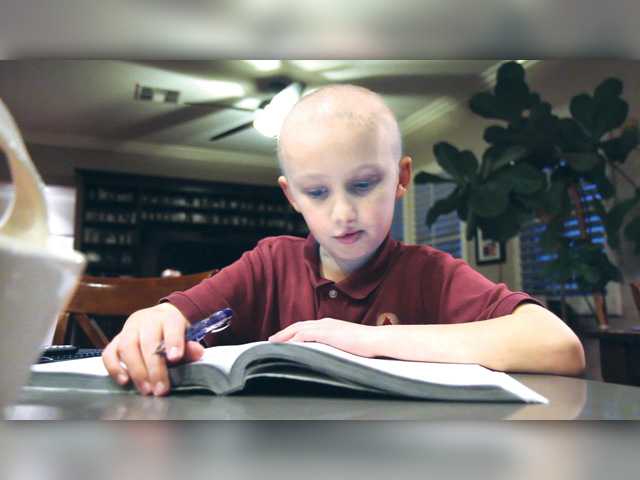
Zachary Johnson was eating Cheetos when his parents came home from the hospital carrying scans. In a flurry of hastened explanations and frantic packing, the Johnsons were out the door in minutes — the bag of half-eaten Cheetos left sitting on the counter.
They had thought it was a bad headache.
In the car, Maria and Jerry Johnson went over the doctor’s words in their heads: mass, surgery, tumor, life, death. At 10 years old, their only child sat behind them, contemplating the same.
“They said, ‘You have a mass in your head. We have to get it out,’” Zachary recalled. “Really all I was scared of was ‘Oh my goodness, I might die.’”
With little explanation, the doctors had told the Johnsons to go back to their Santa Clarita home, pack up and come back to the hospital. They’d found a mass near Zachary’s brain stem, and they needed to remove it immediately.
“There was no time to cope or adjust,” Jerry said. “We certainly weren’t prepared for the magnitude of what we were about to encounter.”
When the Johnsons arrived at Children’s Hospital Los Angeles, the chief of neurosurgery stood waiting.
“How can this be?” Maria recalled thinking. “How can this be happening to my child?”
Out of their hands
Until Zachary was wheeled into surgery, Maria and Jerry had been putting out fires, reacting without time to think or understand. But then it was time to wait.
“Any time your child goes in for surgery, you worry if they’re going to wake up,” Maria said. “I didn’t know if he was going to come out being the same child he was before.”
The entire process moved at dizzying speed. Zachary had gone from the MRI to surgery within 24 hours; there were many questions and far too few answers.
“There is just no way that someone can tell you they’re going to open up your child’s head and you’ll be OK with it,” Jerry said.
As they waited, a team of three neurosurgeons worked to remove the mass in Zachary’s brain. When he came out of surgery, the doctors said they’d been successful.
It was indeed a tumor. Medulloblastoma is a fast-growing, aggressive brain cancer that arises from very young cells at the earliest stages of their development.
The doctors, however, were reassuring.
As Zachary woke up from surgery, he came out of the anesthesia in “layers” of consciousness, Jerry said.
“I was looking for two things: for him to open his eyes and say something, and for him to wiggle his fingers and toes,” Jerry said. “I thought everything else after that would be a piece of pie.”
Finding the fight
At first, everything seemed great. But as the minutes passed by, Jerry noticed differences emerging.
“His voice wasn’t the same,” Jerry said. “It was a little robotic.”
Standing next to the hospital bed, Jerry watched his son struggle to speak.
“We knew the thoughts and words were there in his brain, but he couldn’t get themout,” Maria said. “His brain was running at full speed, but his motor skills couldn’t keep up.”
As Maria and Jerry practiced small gestures and words with their son, they saw inconsistencies. In the morning, Zachary could raise his eyebrows; in the afternoon, he could give a thumbs-up but no longer raise his eyebrows.
The doctors were again reassuring. Just opening up the brain for surgery could cause enough swelling and disruption to temporarily affect function. But the doctors had gone further, removing matter, Jerry said.
“There are an alarming number of cases where not everything comes back,” he said.
Again, it was a waiting game. In the meantime, Maria and Jerry did everything they could to help with Zachary’s frustration.
“We had one of those father-son moments, and I told him we would make it better,” Jerry said. “After that day, Zachary decided if it was going to get better, he was going to make it better.”
Employing the same willful determination he uses to approach his school work, Zachary got to work. Staring at a Lego piece for minutes on end, his shoulder would flinch. Minutes later, he’d hurl his arm onto the table. Then again with the other arm.
“He’s just determined to make it work,” Jerry said, breaking into a rare smile. “The normal time line (for recovery) just wasn’t going to work for Zachary.”
Answers
Soon Zachary progressed, accelerating the healing process through practice, research and the support of his parents. But regaining speech and motor function was only half the battle. Soon after surgery, Zachary began chemotherapy and radiation.
In traditional radiation therapy, the X-ray penetrates the mass but doesn’t stop there, creating an exit path previously healthy tissue damaged in the wake of the X-ray.
In Zachary’s case, the X-ray would pass through the tumor and hit his spine.
While the Johnsons wanted to give Zachary the best chance possible at beating the cancer, they also wanted to minimize damage to their bright, determined 10-year-old’s healthy brain tissue. So Jerry researched.
He soon discovered proton therapy, a new form of radiation available at about a dozen hospitals across the nation — including Scripps Health in San Diego.
Proton therapy, unlike traditional radiation, doesn’t leave an exit path of damaged tissue. Instead, it targets the mass in precise, high-powered beams as determined by the doctors.
With a limited risk to healthy tissue, doctors are able to increase the dose of radiation to better battle the cancer.
“If we have fewer healthy cells exposed to less radiation, logic would suggest that’s just better,” Jerry said. For six weeks, Zachary received proton therapy at the Scripps center.
“I was pretty nervous inside,” Zachary recalled of his first treatment, “but they told me I was as cheerful as ever.”
After surgery, chemotherapy and proton therapy, Zachary has no visible cancer cells — his scans are clean. In about three years, the chance of recurrence drastically lowers, Jerry said.
“We’re cautiously optimistic,” said the youngster’s father.
As Jerry talks of the future, Zachary looks to his dad. Maria puts a hand on her son’s knee.
“He is our one and only. He is our everything. He is our life,” Maria said. “He’s going through this, not us. With his attitude, it’s hard to be sad for him. He’s given us the strength to get through this.”