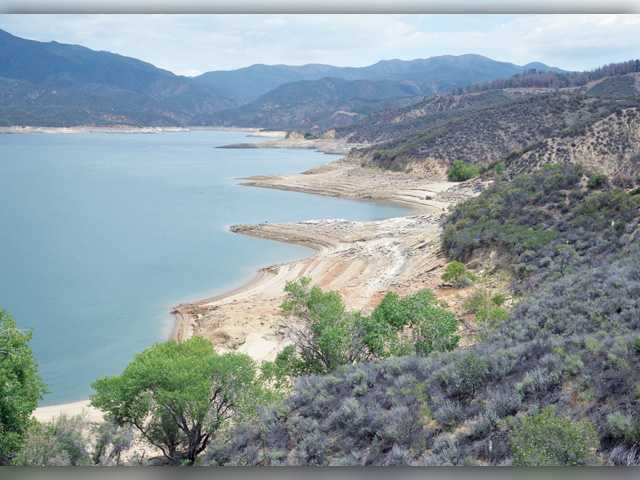
A year after local water czars unveiled their drought action plan in the face of stark water shortages, they this week Tuesday to news of deepening drought and diminishing reservoirs.
Members of the Santa Clarita Valley Water Committee, including officials representing each of SCV’s four water retailers, met Tuesday night at the offices of the Santa Clarita Water Division on Centre Pointe Parkway.
It was Feb. 4, 2014, when officials reviewed comparative aerial photographs of Northern California Sierra Nevada snow packs in January 2014 and 2013 and noted the starkly with a barren brown peaks in the more recent photo.
Tuesday’s offerings included numbers, charts and maps that showed the worrisome trend of below-averge rainfall, shrinking snowpacks and state reservoirs all well below their historical water average.
Most critical for leaders of local water districts eager to assess the amount of water they can expect from Northern California under terms of the State Water Project was the amount of snow in the Sierra Nevada range. Melting snow recharges the state’s rivers and lakes, enabling state officials to send water to Southern California.
Current snowpack conditions tabulated by automatic snow sensors show the Northern Sierra mountain range contains only 14 percent of its normal amount of snow as of Feb. 1.
Despite diminished water resources, the state was recently able to allocate 15 percent of the water normally delivered to the Santa Clarita Valley through the Castaic Lake Water Agency, up from a severe 5 percent allocation delivered locally last year, said Dan Masnada, general manager of the water wholesaler.
A look at the amount of water in a dozen of the state’s major reservoirs showed grossly diminished supplies except for Pyramid Lake, which remains at 94 percent capacity.
As of the Jan. 31, some other reservoir levels were reported to be at:
- Castaic Lake: 34 percent capacity.
- Lake Oroville, considered one of the principal reservoirs containing water earmarked for Southern California including Santa Clarita Valley: 41 percent.
- Shasta Reservoir: 44 percent.
- Folsom Lake, 46 percent.
- New Melones: 23 percent.
- Don Pedro Reservoir, 41 percent.
661-287-5525
On Twitter @jamesarthurholt