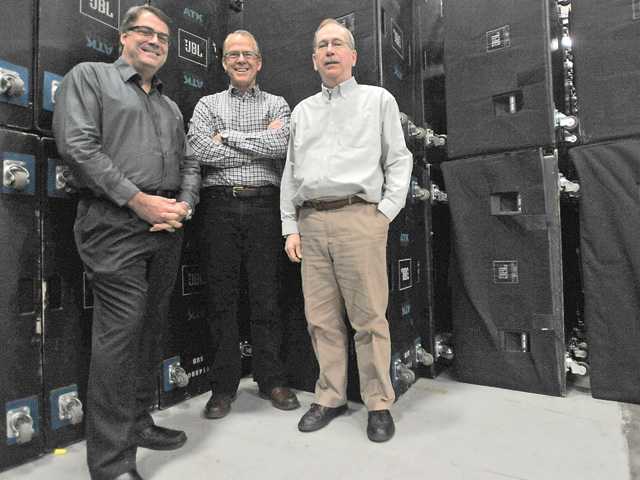
It’s doubtful any person has not witnessed the work of ATK Audiotek, and yet just as likely that the general public has never realized the 32-year old Santa Clarita-based company was working behind the scenes of so many major televised events.
As sport devotees tune in to the watch the Seahawks challenge the Patriots in the Feb. 1 Super Bowl, ATK Audiotek will have spent nearly a year planning for the few minutes they have to set up the half-time entertainment show – which they’ve now supported for 17 straight years.
The firm will barely have packed up and shipped all of its gear out before it’s back onstage – for the 24th straight year – providing audio systems installation, engineering, integration and technical support for the Grammy ceremonies on Feb. 8.
By then, fans have already been a witness to the work they do on countless Olympic game opening and closing ceremonies, the Academy Award Oscars presentation, Pasadena’s Rose Bowl championship game, game day sound systems for USC and UCLA, the recently held International Consumer Electronics Show in Las Vegas, episodic work for NBC’s “The Voice,” and TV shows that aired nightly such as Jimmy Kimmel, Conan O’Brien and more. Audio crews for large events can include as many as 24 sound technicians.
Managing 12 to 14 events daily makes the logistics complex and pivotal, but even more herculean a task is the redundancies the company builds into each sound experience so that a show never skips a beat – that if one system fails, it routinely rolls over to another; a feat President Michael MacDonald refers to as “fail over gracefully.”
“We’ve been very actively involved with getting the Grammies nailed down,” MacDonald said. “It’s one of the most complicated programs we’ll do all year. Track performances are out, and live vocals are in so that every sound has to go out live to the audience. There are 20 live bands going on stage, and every single instrument is miked.”
A complicated endeavor to satisfactorily capture every sound going live and make it work is a quite a learning curve, he said. It’s not at all unusual to have 30 to 70 inputs for every musical act. It’s quite a learning curve to figure how to make that work,” he said. “The biggest challenge is that you only have a few minutes between musical acts to be prepared.”
Privately owned by three partners – MacDonald, Scott Harmala, CTO/vice president, engineering and Mikael Stewart, vice president of special events, ATK Audiotek started out in Burbank, but relocated to Santa Clarita Valley nearly nine years ago. Occupying 55,000 square feet of space for inventory, and with 75 employees, this summer the firm will have been in business for 32 years.
And with several thousand pieces of equipment ranging from cables to mixing consoles, loud speakers and amplifiers, Brett Valasek, general manager/director of operations is kept plenty busy ensuring the equipment is in working order, the inventory is managed, and the thousands of pieces that go into each show are matched up and packaged for each production.
In the early days of the company, there was a definite seasonality to its televised events business, but the plethora of broadcast and cable network channels looking for new windows of time to air their shows throughout the year, ATK Audiotek remains busy year-round these days. And then, there are those especially busy years.
“Once every four years we have the election cycles and Olympics which always provide a lot of interesting business potential and challenges in terms of gear and resources,” MacDonald said.
The delicate balancing act means making prudent business decisions because when working on an offshore event – like the Olympics – the event ties up equipment as shipped cargo is on the water for two to three weeks going and coming, he said. The company can’t afford to have its geared up for that long so it chooses wisely which projects it bids on or accepts.
ATK Audiotek also ‘shares labor’ resources so-to-speak which allows their people to earn a healthy income. The firm sends engineers and technical operation crews out to an event to set up the very complex, integrated sound systems. But once set-up is done, many of the crew members would be sitting around for hours waiting for an event to wrap up before they can pack up all of the equipment. Because most of their people are in IATSE (International Alliance of Theatrical Stage Employees), working with sound mixers, often they will become part of the crew helping to televise the event.
“Our guys will then be on the production payroll for the show,” MacDonald said. “They have the best of both worlds. They get paid for working on the TV show and we’re paying them to sit around.”
While the firm specializes in large televised events, however, it also does quite a bit of work for big global companies it can’t disclose the names of – by installing equipment and sound systems in retail chain stores. It just completed a project in China and one in Turkey – not to mention the store systems they’ve managed in the U.S.
“We provide all of the IT, both wired and wireless infrastructure in the retail chain stores,” MacDonald said. “We might have two to four installers onsite at each store, plus 16 to 20 people at the office handling engineering and support.”
ATK Audiotek has also worked on advanced communication systems for companies installing networks, video conferencing, presentation systems and digital signage in both retail and other industries such as the biomedical field. The company’s business is roughly 60 percent based on televised events, and 40 percent built on integration of systems for other companies. Equipment aside, the real trick is managing resources when you have people travelling all over the world, he said. There are always people coming and going.
“It’s pretty challenging. There’s an art to teaching your people not to hate travel, and at the same time not turning it into a lifestyle,” MacDonald said. “We try really hard to rotate everybody around so no one has to stay out on road for an extended period of time. We had employees in the past that really just wanted to stay on the road forever and not come home. That lifestyle isn’t healthy.”