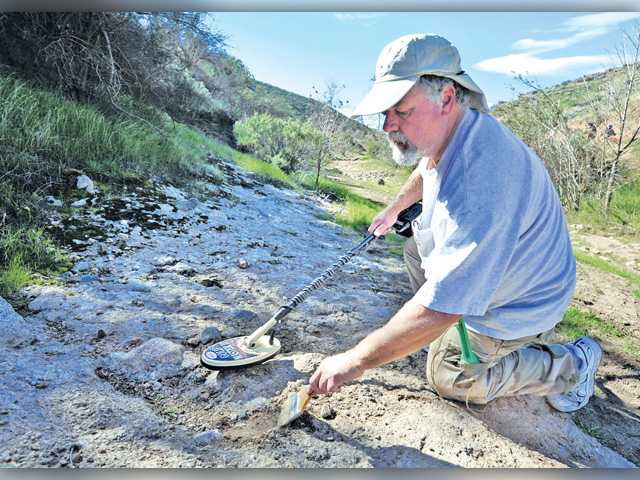
The metal detector chirps and hums as it moves over the rocky ground.
To the uninitiated, it’s indecipherable — little more than electronic gobbledygook.
To the man wielding it, Saugus resident Richard Nuss, the telltale whines of the detector let him know what may lie in the ground below.
Suddenly a different, distinct tone pierces through the quiet in the Santa Clarita Valley’s Texas Canyon.
Excitedly, he drops to the ground. There’s a chance gold might be underfoot.
Nuss isn’t like most amateur prospectors heading out on a sunny weekend with dreams of striking a fortune.
Whenever he goes in search of the precious metal, he’s carrying on a family tradition that stretches back generations.
Prospecting
Nuss is a gregarious sort, with a storytelling streak befitting a prospector.
He’ll gladly talk about his mining claims in the reaches of the Mojave Desert or tell tales of wading into the Yuba River in search of gold.
He waxes poetic about how it feels to actually find the shiny stuff.
“There’s nothing like opening up a crack or digging and you see that nugget of gold — undisturbed until you pick it up,” he said. “That gets the blood flowing.”
But ask him about his biggest find and he only smiles mysteriously.
“Put it this way,” he saya. “I’ve seen gold nuggets that get as big as your palm.”
History
Like many areas of the West, the Santa Clarita Valley had its gold rush in the 19th century.
Local historians love to point out the first authenticated discovery of gold in California was in 1842 in Placerita Canyon — six years before James Marshall’s more famous discovery at the site where a sawmill was being built on the South Fork of the American River.
But like that 1848 find, the Santa Clarita Valley’s 1842 discovery touched off a gold rush of its own, though a more modest one. And among those early gold-seekers were Nuss’ ancestors.
With a twinkle in his eye, Nuss says the person who taught him how to pan for gold at the tender age of 4 years was his grandmother, Melba Walker Fisher — of the famed Walker family of Placerita Canyon.
Family affair
Just as his grandmother taught him, Nuss has made a point to pass along the trade to others.
“My goal, as a miner, is not just to mine; it’s to be an educator,” Nuss said. “Everybody thinks this died out long ago.”
During a recent trek to Texas Canyon, Nuss was accompanied not only by his brother, Steve, with whom he works as an electrical contractor, but also his daughter, Emily.
“Most people, they sit at home and they don’t interact,” Steve Nuss said. “When you’re out like this, it’s beautiful and you’re together.”
That’s why, even if there’s no gold to be found, mining trips are anything but a waste, the brothers agree.
“The camaraderie of the people you’re with is what’s really invaluable,” Richard Nuss said.
“We’re a hard bunch,” he said proudly. “We’re not going to give this up. This is heritage. This is living.”
Mining/conservation
Nuss laments the fact that much of the Santa Clarita Valley’s mining heritage has been lost as the years have passed. A gold mine operated in San Francisquito Canyon in the 1890s. Two were opened in the late 1800s in Acton and operated into the 1900s, along with a handful of copper mines.
Driving along Sierra Highway, Nuss suddenly pulls over to the side of the road at the border of Agua Dulce.
“This all used to be a mine,” he says, gesturing off the roadside.
He points to the nearby hillside, showing the location of a mine shaft long since closed off with rock.
“This is one of the mining areas in the Santa Clarita Valley that people pass through on a daily basis,” he says. “And they don’t realize the history they’re driving through.”
Though decades have passed since Grandma Melba first showed him the ropes, Nuss said the process of gold prospecting has largely remained unchanged — and Earth friendly.
He still makes use of traditional tools like pans and sluice boxes.
Even his metal detector is much the same as those seen sometimes at public beaches. The difference is that Nuss has trained himself to be able to tell which sounds signify possible gold strikes and which can be ignored.
He demonstrates his technique. After his detector indicates the possibility of gold, he digs a small hole, putting the dirt aside.
He then runs that dirt over his detector, seeing if what he’s found is gold or, more likely, some other, less valuable metal.
Either way, once he’s done, he’ll put the earth back in place.
“We, as prospectors, are stewards of our mountains and environment,” Nuss said. “We try to do our mining very responsibly.”
At a few locations in Texas Canyon, Nuss points at sites that were once mines but now appear virtually identical to the surrounding countryside.
“Over a few years, nature hides it all,” he said.
661-287-5525
On Twitter
@LukeMMoney