Launched in 1973, Firetect is everywhere flames aren’t. Manufacturing their own fire retardant products, the Santa Clarita firm owned by Kathleen and Randy Newman, helps to protect globally known theme parks and film studios to keep their properties and the people who inhabit them safe from fire.
“Our primary client is the entertainment industry – any place where large crowds gather,” said Kathleen Newman, CEO of Firetect. “We advise (Six Flags) Magic Mountain where they can and cannot spray our products; and we work with many of the production companies at Santa Clarita Studios to fire-retard their set materials right on site.”
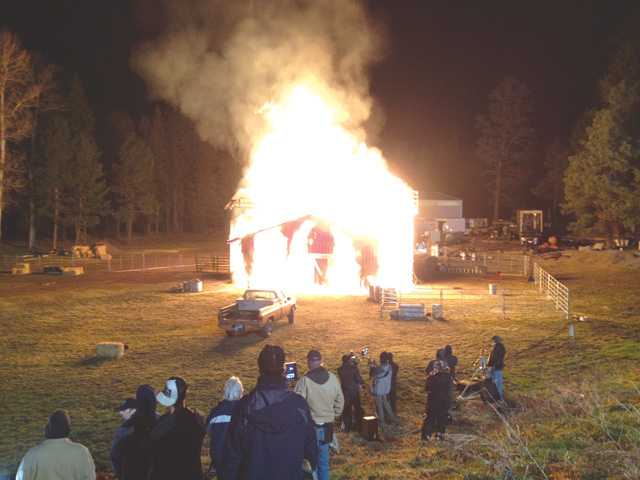
Used on one outdoor TV set for A&E’s “Longmire,” Firetect’s product was used to prolong the all-night burning of a barn – without burning it down – to accommodate multiple film takes of a scene for the mini-series. The firm has also worked Western films and shows that call for a lot of pyrotechnic effects, and often provides free protection services to CalArts. “TV reality series “Twinning” was filmed locally and they used a lot of our fire retardant,” Newman said.
“Our products can slow “flame spread” down by a minimum of 75 percent depending on the rating of the product,” Newman said. “It means the flame retardants slow the spreading of the flame down by a minimum of 75 percent.”
Firetect develops its own retardants and spends a lot of effort, time and money to have each product tested by certified third-party laboratories. The products have several government accreditations. Its nine fire retardant products are distributed globally with heavier concentrations in the U.S., Canada, Japan, China, Thailand, and Germany.
Third-party testing and certification ensures Firetect’s products meet the most rigorous of fire codes – including California’s which has the strictest codes in the nation, Newman said. That means wood products or theatrical draping – and any 'soft' materials on a film set or amusement park – need to protect life and property.
California code measures both flame and char length, whereas national code only measures how much material was burned. In this state, treated material must be able to withstand an ignition source for 12 seconds before even igniting, and must self-extinguish within three seconds.
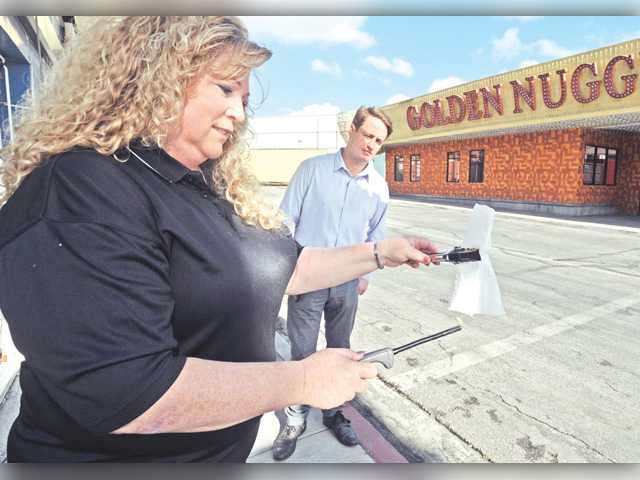
Newman demonstrated one of their products at Santa Clarita Studios with a pre-treated facial tissue which, despite repeated exposure to a fireplace lighter outdoors on a breezy day, would not go up in flames. She also likens the protection their products provide to the window dressings in a hotel room. Nationally, codes were designed on the assumption that drapes would catch fire from a source near the floor. But in this state, the assumption is that flames could come from any direction. Firetect products can also provide protection through up to 10 dry cleanings provided the fabrics have not been exposed to any water, Newman said.
“All materials in California have to be tested in both the vertical and horizontal direction of a fabric, instead of only the vertical direction recommended by national fire codes,” she said. “By using our product we can meet all of those codes.”
Firetect applicators are all licensed certified, which allows them to issue certificates of flame resistance for companies to comply with state codes and for insurance purposes.
“Everything – all soft goods in a commercial building - has to be fire retardant, the furnishings and all, if more than 10 people can sit in one room,” Newman said.
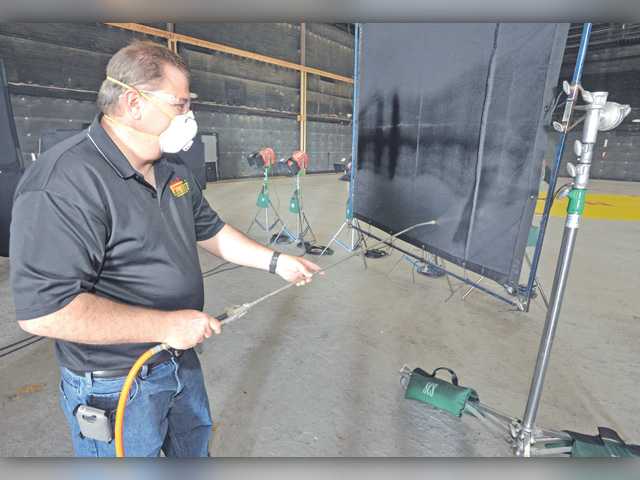
But Firetect also provides onsite training in their Valencia warehouse for people to become certified applicators, teaching them how to properly apply their products and meet code compliance. The firm has also custom designed their own portable sprayers that allow applicators to be mobile and go where the need is on any studio set or business.
“Preventing a fire from starting is the most important thing. It allows more time for people working in a building to exit and for emergency staff to get in and out of a building,” Newman said. “Fire inspectors will make sure they have a certificate of flame resistance but also sometimes perform field testing by cutting a piece of fabric and doing a 12-second fire test.”
When Firetect consults with companies they perform the same onsite field tests to ensure any decorative or set materials will not go up in flames and meet codes.
The privately-owned company grosses over $1 million annually, and at any given time has six to 10 employees. Poised to grow even more, Firetect has been working with the SCV Economic Development Corporation and California Manufacturing Technology Consulting group to access a number of programs and advantages granted to small businesses.
“We’ve been very impressed with them so far. They have a lot of marketing programs available at no charge and a wealth of advice for small businesses,” Newman said.
The SCVEDC has had some initial discussions with Firetect on a sales tax exemption program, said Christopher Gridwood, Business Outreach and Communications Manager for the SCVED.
“It could help them cut their sales tax almost in half – instead of 9 percent, they would pay 4.8125 percent,” Gridwood said. “If a company purchased $2 million in equipment, they could save $84,000 to $86,000.Those kinds of savings could help create more jobs.”
As for future growth, Newman foresees more opportunities in Santa Clarita as film activity continues to grow locally.
“We’ll be expanding in terms of new products, hiring more employees, having larger distribution, and additional certifications,” Newman said. “I see this occurring within the next five years. Our growth is ongoing.”
Her one wish, however, is that fire retardant requirements would be standardized nationally to increase the safety of others and to make all products equal. As it stands now other companies can pitch their goods but they don’t all meet California codes.
“I would like to see more oversight of flame retardant companies to ensure they’re bonafied businesses that are 100 percent insured,” Newman said. “The problem is there is a lot of competition; companies that are not insured, working out of their garages, charging a little less than us without the right certifications and licensing. By providing a false sense of security, the consequences can be devastating.”