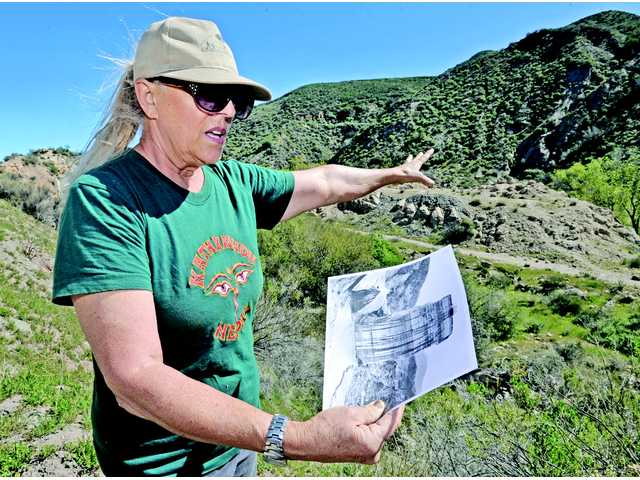
Dianne Erskine-Hellrigel moved steadily along the narrow trail, each step pushing her further uphill.
Reaching the crest of the hill, she stopped. In front of her lay crumbling concrete. Bits of rusted metal poked out in spots.
The whistling of wind warred with the sound of cars whizzing by on San Francisquito Canyon Road.
Erskine-Hellrigel stepped carefully forward onto the ruined remains of the St. Francis Dam.
“There are people who live in Santa Clarita that don’t even know it’s here,” she said. “And it’s time they learned about their history.”
The rubble in Saugus that was the St. Francis Dam represents the second worst disaster in California history.
Collapse
On March 12, 1928, the dam collapsed, sending a massive wall of water roaring down San Francisquito Canyon, through the Santa Clarita Valley, into the Santa Clara River valley and, hours later, into the Pacific Ocean.
The flood decimated Saugus, Castaic, Piru, Fillmore, Santa Paula, Saticoy — entire families disappeared with their homes. Hundreds were killed.
Now — 87 years after the disaster that was second only to the Great San Francisco Earthquake of 1906 in loss of lives — a number of Santa Clarita Valley residents, including Erskine-Hellrigel, are renewing a push to declare the dam site a national memorial.
One of the people who helped kickstart the effort is Alan Pollack, president of the Santa Clarita Valley Historical Society.
Pollack said he was inspired to start the effort after visiting the site of another dam that failed — in Johnstown, Pa., in 1889.
As he researched Pennsylvania disaster, Pollack said he was struck by the similarities between the Johnstown and Saugus incidents.
Unlike St. Francis, though, the site of that disaster is recognized as a national memorial.
“It’s a major disaster which has basically been forgotten,” Pollack said of the St. Francis Dam, “and we’ve never really done the appropriate memorial for the people that died.
“And that’s why I think it’s important to do.”
“We need to memorialize this area for the people who died and for the families that remain,” agreed Erskine-Hellrigel, who is the executive director of the Santa Clarita Valley Community Hiking Club.
Legislation
Following the efforts of volunteers like Erskine-Hellrigel and Pollack, former Congressman Howard “Buck” McKeon introduced a bill last year to declare the site a national memorial. But the bill failed to move through Congress.
McKeon has since retired, but his successor, Congressman Steve Knight, R-Palmdale, has pledged to carry the effort forward.
Knight said he hopes to introduce a bill to memorialize the site later this year, perhaps by summer.
Memorial
The story of the St. Francis Dam had a profound effect on Erskine-Hellrigel at a young age.
She was about 6 years old when her parents took her to see the ruined dam site for the first time.
“At that point in time, you don’t even understand what death is, let alone what a 140-foot wall of water can do,” she said. “To see the remnants, I was very impressed and saddened — and it is something that’s clutched at my heart until now.”
In recent visits to the site, though, wreckage left from the dam is not the only thing that catches her attention.
One way to reach the site is on foot down a now-closed road. Where a trail heads up a hill, the land is littered with shards and specks of shattered glass.
Memorial designation would help secure resources to help protect and clean up the site, proponents say.
“We could get rid of some of the junk that’s over there and have it manned and watched so that we preserve it for the future,” Pollack said.
Recognition
While a memorial would be a fitting tribute to the victims of the dam collapse, Erskine-Hellrigel and Pollack also said they want the memorial to help educate people about the tragedy and its effects on the Santa Clarita Valley, the state and the nation.
“It’s probably the major event that’s ever occurred in the Santa Clarita area as far as history goes, and it’s definitely a forgotten event,” Pollack said.
Lessons learned from the St. Francis Dam failure revolutionized modern dam design.
Pollack and Erskine-Hellrigel said they’d like to see a museum and a visitor center at the site to help catalog the history of the dam and its collapse.
While designation may still be a ways off, the memory of those who perished in the disaster lives on.
During a recent visit to the site, at the base of a large dam chunk that Erskine-Hellrigel calls “the pyramid,” stood two white crosses.
Read one: “In memory of those who died at this spot, 3-12-1928.”
661-287-5525
On Twitter
@LukeMMoney