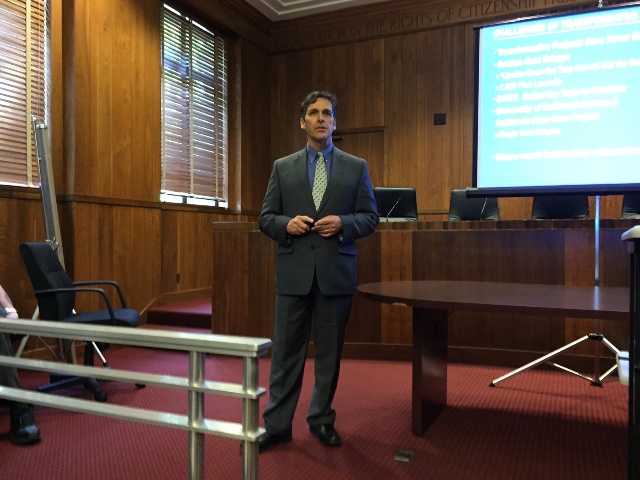
SACRAMENTO — A Santa Clarita Valley community delegation heard two very different visions of California’s high-speed rail plan on Tuesday — one a grand vision to bring parts of the state closer together and another an expensive boondoggle that will financially ruin generations to come.
“California history has been made by big, bold investments,” said Jeff Morales, CEO of the California High Speed Rail Authority, which is implementing the system that it says will connect the state north and south from San Francisco to San Diego.
The system is being built in stages and is expected to go near or through the Santa Clarita Valley. It has drawn much opposition from local residents on the east side of the valley.
Morales said all large California projects, such as the Golden Gate Bridge, that are now considered great were at once controversial.
A delegation of Santa Clarita Valley business and community leaders on an annual trip to Sacramento heard Morales speak among other state officials and legislators addressing issues that affect the local area.
The trip is hosted and sponsored by KHTS AM-1220 and Assemblyman Scott Wilk of the 38th Assembly district.
In his presentation, Morales said parts of the state are disconnected from each other now, and the rail project will connect them, as well as improve air quality and help alleviate traffic in the heavily traveled air corridor between Los Angeles and San Francisco.
Alternative options for helping improve the transportation infrastructure in the state will be two to three times more expensive than the rail system, which now has a price tag of $68 billion.
“You can carry people by adding more trains; you don’t have to add tracks,” Morales said.
The project will create short- and long-term jobs, he added, many of them within small businesses.
When asked about the proposed part of the project that will go in or near the Santa Clarita Valley, Morales said all proposals are still on the table, including the Highway 14 corridor plan, which would more or less follow the freeway, and the East Corridor plan, which would travel under or through the San Gabriel Mountains. Several variations of each plan are under consideration.
Immediately after Morales’ presentation, Kevin Dayton of the Citizens for High Speed Rail Accountability said the plan will bankrupt future generations. High-speed rail supporters don’t know how they’ll fully pay for the proposal that keeps ballooning in cost, he said.
The main problem with the project, Dayton said, is that the plan is not what the voters approved in a 2008 ballot measure. The initial cost was $33 billion but is now $68 billion — just for the portion from Los Angeles to San Francisco.
“The real weakness of this is Prop. 1A was poorly written and there is no way the High-Speed Rail Commission can comply with it,” Dayton said. “A lot of high-speed rail is dream and vision and not a financial plan.”
He said there were several different groups across the state forming to fight high-speed rail, but he cautioned that the opponents need to all work together and not fight against each other.
“If everybody can get together as one, you can win this thing,” Dayton said.