California’s high speed rail project could affect the Vista Canyon master-planned community on Santa Clarita’s east side — but the developer Tuesday wished Gov. Jerry Brown luck with the mess that has become of requirements associated with the California Environmental Quality Act.
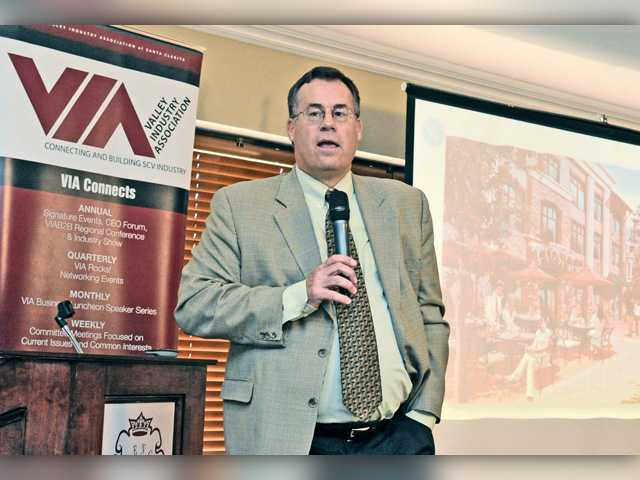
“Our view is that we’re going forward with our project,” said Jim Backer, president of JSB Development, during the Valley Industry Association’s monthly luncheon Tuesday.
“Vista Canyon may be fully built out before the rail would ever come through,” he said.
Describing his company’s plans for the live-work-transportation community near Sand Canyon, Backer described the project as a “zero user” of water. The statement was met with applause from the VIA members.
Vista Canyon will have a full purple-pipe water-recycling system, as well as its own water reclamation plant, which will capture more water than the development needs to use, Backer said. Excess water will go to the Castaic Lake Water Agency.
“People love to talk about sustainability and give it all sorts of labels,” Backer said. “But as far as sustainability, we’re doing everything cutting-edge that we can to be sustainable.”
Plans call for Vista Canyon to feature apartments, single-family homes, office space, retail stores, and eventually a hotel and movie theater. It will also be home to a new Metrolink station intended to replace the Via Princessa Station.
Architecturally, Backer described the project as somewhat craftsman, rustic California style. Phase I is expected to begin this spring in late April or May.
One facet of the project is that it will be comprised of speculative building — erecting retail and office buildings before tenants are signed, Brown said. Spec building was unheard of during the recession and is rare for builders securing traditional financing.
“One of the biggest features of the project is to bring jobs to the east side,” Backer said.
And to that end he described building office spaces tailored to the millennial generation’s want of open, collaborative spaces and room for start-ups, technology-driven firms and entrepreneurs — something that’s been lacking in available current office space.
In answer to VIA member questions about the effects of the project on Soledad Canyon Road traffic, Backer said connections would be built to Sand Canyon and Jakes Way, as well as Soledad, to improve distribution of traffic.
JSB Development is also working with AT&T and Time Warner to make broadband connectivity as robust as possible, Backer said.
Located in Canyon Country between the railroad tracks and Highway 14 near Sand Canyon, the project takes in 185 acres of land, some of that part of the city’s open space district. A 10-acre park will be included in the community.
The project is expected to be completed in five to seven years, Backer said.