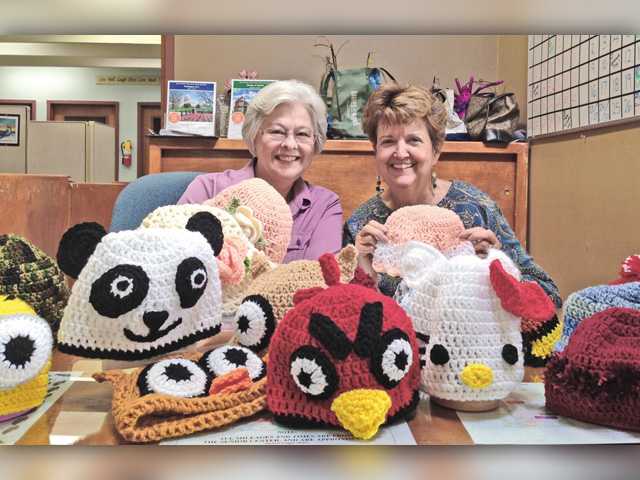
For some, Mondays might be a drag. But Monday mornings at the Santa Clarita Valley Senior Center are reserved for some really crafty seniors.
The NeedleCraft Club meets from 9 a.m. to noon every Monday. Members teach crocheting and knitting to those who wish to learn, and club leaders are always eager to help.
Participants can bring their own materials and projects or use yarn donated to the SCV Senior Center to make items for philanthropic causes.
And the club stays busy for some good causes.
NeedleCrafters, the nickname of the group’s members, donate lap blankets to warm the hearts of wounded soldiers; make baby blankets and hats for Olive View-UCLA Medical Center county patients; make creative hats to bring Christmas cheer to young children with cancer; create hats and scarves for soldiers through Operation Gratitude; and knit crocheted items for the homeless and victims of domestic violence through Project Lead Kindly.
Club leaders Dorothy Katz and Carole Lindsey say that members frequently remark how wonderful they feel doing something for those in need.
“The group has so much fun, and true joy is derived from the camaraderie and interaction. Everyone is made to feel welcome,” Katz said.
And it’s not just the club leaders who enjoy the group.
“I find both the fellowship with the group and the products we create so fulfilling,” said Marilyn Swinford. “I enjoy learning from each other and encouraging each other.”
There are proven health benefits to knitting and crocheting. According to the Craft Yarn Council, knitting has been called the new “yoga” for good reason.
Famous for its relaxing, meditative qualities, knitting is increasingly being used in hospitals, clinics, schools and even prisons to help people lead healthier, happier lives.
Research by Yonas Geda, associate professor of neurology and psychiatry at the Mayo Clinic in Arizona, validated the benefits of doing crafts such as knitting and crocheting.
His studies show “that people who engaged their minds by reading books, playing games or crafting had a decreased risk of mild cognitive impairment, a possible precursor to Alzheimer’s disease and other forms of dementia.”
Stress can be reduced through rhythmic and repetitive movements and according to the Benson-Henry Institute for Mind-Body Medicine at Massachusetts General Hospital, “this can elicit the famous relaxation response, which is the body’s counterbalance to stress, a state in which heart rate and blood pressure fall, breathing slows and levels of stress hormones drop.”
Robin Clough is volunteer and recreation coordinator for the Santa Clarita Valley Senior Center.