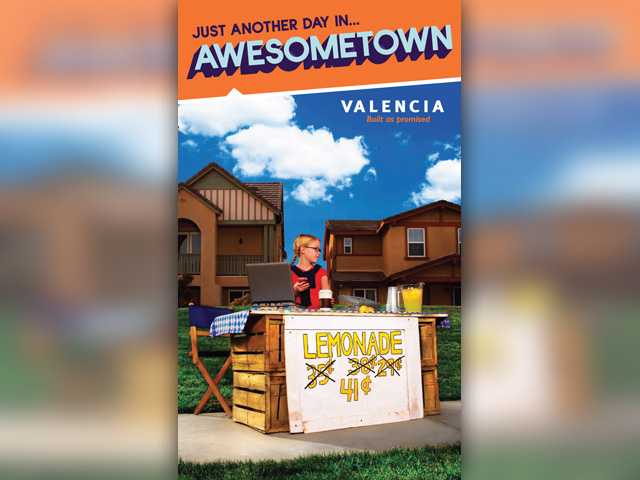
One day, Valencia’s top execs were feeling punchy. Buck tradition, they said. Bring on the unusual, the comical. Let’s see where it takes us.
Putting their heads together, an upstart marketing group and the master-planning firm Newhall Land let a joke become a brand.
“How about Awesometown?” Marlee Lauffer, senior vice president of marketing and communications for Newhall Land, recalled of the group’s decision.
“We knew we were taking a little bit of a chance,” she said. “We’re a very traditional, conservative company, and this was a very different campaign for us. But we had confidence in the pride people take in this community and the sense of humor people have.”
And there it was: a campaign just silly enough to catch, just resonant enough to stick.
***
Newhall Land is the land management firm responsible for envisioning and executing master-planned Valencia. Once Newhall Land & Farming Co., the powerful local firm was founded by Henry Mayo Newhall in 1883 and has owned all Valencia land since.
In 2010, after years of traditional marketing in the conservative Santa Clarita Valley and a hit from the Great Recession, Newhall Land was looking for an inexpensive way to reinvigorate Valencia’s brand — something to get people excited about all Valencia has to offer, Lauffer said.
“Come home to Valencia” and “Live, work and play in Valencia” just seemed too vanilla for the many post-recession, gun-shy middle class families who were just becoming confident enough to spur some economic activity.
“They were great ad campaigns,” Lauffer said, “but they were too similar to what you see in other master-planned communities.”
So Newhall Land brought on Gunn/Jerkens marketing firm. Immediately, the group dove into SCV culture, learning about the community and getting to know residents through videos, interviews and impromptu curbside conversations at well-frequented local venues.
“What do you like about Valencia?” Lauffer recalls them asking.
And a definite theme emerged.
“The schools were awesome. The parks were awesome,” she said. “Whether they were 12 or 92, they used the word ‘awesome.’”
With a laugh, the agency suggested Awesometown.
“We said, ‘Why not?’” Lauffer said, “and kind of ran with it.”
***
The response was immediate.
Within weeks, the various Awesometown social media accounts and website had gathered thousands of followers. Residents tweeted pics. Curbed L.A. and MSNBC produced stories. Whole Foods even made a smoothie about it.
“Some people poked fun. We got a lot of teasing about it,” Lauffer said. “But we saw this very organic development, where it went from being embarrassing to people embracing it.”
The Awesometown campaign had created a social media following for Valencia where, previously, one didn’t exist. More than that, residents paid attention to it.
“We never could have generated that with a traditional campaign,” Lauffer said. “But the organic reuses of the phrase — that’s how we knew it was successful.”
Still riding that awesome wave, Newhall Land has stuck with the campaign for five years, playing with its presentation but rarely straying from the moniker.
Looking to expand the campaign, the developer pushed Awesometown into the greater Los Angeles area, San Fernando Valley, San Gabriel Valley, South Bay and other areas, trying to attract transplants.
The campaign has had it successes and its detractors, Lauffer said, but the positives outweigh the negatives.
“We really do think that Awesometown captures the great spirit of Valencia. But we’re so much more than that,” Lauffer said. “Some people love it; some people hate it. But people talk about it.”
***
Some local business leaders appreciate that talk, especially in big-ticket markets like real estate and business attraction.
Spreading word about all Valencia has to offer is extremely important to Don Fleming, co-owner of Valencia Acura and co-chair of the SCV Economic Development Corp. Executive Committee. And the Awesometown campaign helps attract clients from outside the SCV, he said.
“What I find is people notice it,” he said. “I think it’s catchy.”
Fleming has had customers walk into the dealership already knowing Valencia’s brand, he said. He’s even incorporated the Awesometown logo into Valencia Acura’s advertising material.
“People will bring it up to you: ‘Is this where awesome lives?’” he said.
The campaign also helps Fleming’s role at the SCVEDC, where he works to attract and recruit new businesses to the community. Local residents who work in the SCVEDC’s target markets — the San Fernando Valley and greater Los Angeles area — carry the moniker into those surrounding areas, Fleming says, acting as “ambassadors” for the Awesometown brand.
Local realtor Cherrie Brown also testifies to the brand’s ability to catch and spread.
“Outside the SCV, we’ve mentioned the name Valencia, and many people recognize it for the Awesometown campaign,” said the HomeSmart of Santa Clarita realtor.
But Brown sees the campaign’s limitations. Her younger-generation clients can find the campaign a bit cheesy, she says, and Brown doesn’t feel the campaign has been around long enough to produce a significant effect on the local real estate industry.
She has, however, used the term to set herself apart. “My Instagram name and social name is Awesometown Cherrie Brown,” she said. “There are many people who know me as ‘Awesometown’ or ‘ATCB.’ (The campaign) has been great for my branding. The public follows me on Instagram, and recognizes the town I sell homes in.”
While a quick search of Twitter yields dozens of residents — including a self-proclaimed “Mayor of Awesometown” — who embrace the label as an identity, not everyone appreciates the moniker.
***
As caretakers of the Santa Clarita Valley’s neediest populations, nonprofit leaders see a different side of Awesometown.
Each weekday, Ronda Chobanian walks through the Boys & Girls Club of Santa Clarita Valley hugging kids, shouting words of encouragement and checking up. As development director for the club, she leads fundraising efforts.
“I bristle hard at Awesometown because it’s a really misleading campaign,” she said. “In doing what I do, I see there is so much in this community that is not awesome.”
With about 1,500 registered members, the club serves children 7-17 years old, and about 40 percent are teens, she says.
“There is a whole other side of it,” she said. “I could list 350 kids tonight who are going to sleep in a car and who aren’t going to have dinner. That’s just the facts — and that is Santa Clarita.”
In 2014, more than 16,000 SCV families — or about 5 percent — were living under the poverty level, which the state clarifies as $23,850 for a family of four with two children, according to the SCVEDC 2015 Economic Outlook guide. Comparatively, 12.5 percent of families live in poverty in the San Fernando Valley.
As executive director of Single Mothers Outreach of Santa Clarita, DaAnne Smith also serves an overlooked population — families who earn $15,000 per year, with an average family size of three people. About 49 percent have survived domestic violence, she said.
“There’s definitely a misperception in greater Los Angeles that Santa Clarita is just a wealthy suburb of Los Angeles,” Smith said, “that all is good in Santa Clarita. As a result, funders don’t think we need the help.”
***
Now, Santa Clarita is known for its generous community and givers. But recently, nonprofits have become increasingly competitive as the wealthiest donors receive more bids from the spectrum of local causes, they said.
“Yes, Santa Clarita is awesome, and I love that people take care of others in this community. But the sandbox is quite small. (Local nonprofits) go after a small core group of (businesses) for the same dollars because that core group is tremendous. And the rest of the community rides that," Chobanian said. "I’d like to affect larger change that takes the responsibility off the core 20 percent of people who do support (Boys & Girls Club of Santa Clarita Valley) to make it broader-based, deeper-reaching and impact-driven.”
In response, some nonprofits have re-energized efforts to woo funding sources from outside the SCV — many times, in the same areas where Awesometown ads run. When looking outside, Smith’s grant writer researched who was supporting what charities.
“She found, largely, Santa Clarita nonprofits have been left out of the loop,” Smith said of funding opportunities in the greater Los Angeles area.
It seems, the misperception that the SCV is all wealth and happiness has permeated surrounding areas, the nonprofit leaders said, and Awesometown has something to do with it.
“(Awesometown has) really been an effective campaign, no matter what side of the fence you sit on,” Smith said. “But it doesn’t take a rocket scientist to make the leap that we’ve painted this picture of an ideal civilization, without looking at the consequences.”
When applying for grants, Chobanian goes up against other Boys & Girls clubs in the state, and she also hears a theme emerge.
“They say, ‘We wish we could give out more grants, but we need to put the money in an area with bigger problems,’” she recalled.
Multiple times the decision-makers have referenced Awesometown.
“They said to me, ‘When you’re in Awesometown, it makes it hard when I have kids struggling in the inner city,’” Chobanian said. “My grant writer said: ‘Well, you’re in Awesometown. How am I supposed to raise funds for that?’
“I don’t even really get a chance to plead my case,” Chobanian continued. “Yes, it’s true — my kids don’t face gunfire going to school. But that doesn’t make their need or problem any less real.”
***
Ultimately, the SCV has always had a bedroom-community reputation: good schools, low crime and a great place to raise a family. But what started as an advertisement mushroomed into a larger-than-life campaign, and even an identity for some.
Even Marlon Fuentes, the marketing and communications manager for the Center for Nonprofit Management in Los Angeles, knows the Awesometown name and testifies to its effectiveness as a destination marketing campaign.
“This is the power of brand advertising,” he said, “especially in creating a brand identity.”
While Fuentes doesn’t think Awesometown has created an added challenge compared to other suburban areas with positive destination marketing, he acknowledges that nonprofits will have to work harder at targeted marketing solutions because of the misperception.
Fuentes said there’s a way for even the nonprofits to feel the awesome effects.
“There are solutions,” he said. “Turn this scenario on its head and spin it. If it indeed is a real problem for nonprofits, they have to work it into their marketing campaigns.
“For one,” Fuentes continued, “take credit for the awesome.”
Nonprofits can pitch funders by taking partial credit for Santa Clarita’s quality of life, he said. “They can say: ‘We’re a well-functioning community with nonprofits that create real impact.’”
Funders want to know their dollars aren’t going to waste — that their money is actually working to solve a problem, he said. Nonprofits can use the success of the Awesometown campaign to prove that dollars spent get maximum return.
With both Awesometown and the nonprofits’ success, Fuentes said, Santa Clarita could even position itself as a model for nonprofits, a case study for how nonprofits can work successfully together to erase need.
“We create awesome impact,” Fuentes quipped as an example marketing campaign for nonprofits. “If nonprofits weren’t awesome, then clearly the funders’ money wasn’t working.”
***
“We’re not trying to rename Santa Clarita as Awesometown. We’re not even trying to rename Valencia as Awesometown,” Lauffer said. “We — along with the city, residents and businesses — have helped to keep this community with great quality of life. When people come here, they recognize that.”
And multiple members of the Newhall Land team volunteer and support local nonprofits; Lauffer sits on the board for the Boys & Girls Club of Santa Clarita Valley.
“Like any community, we have a variety of issues that arise. (Newhall Land is) very supportive of nonprofits to help address those issues. Having a good strong economy, housing market and business growth helps keep this a good community, and it gives nonprofits the resources they need to serve the valley,” Lauffer said.
As the community grows, so does the opportunity for businesses and residents to give to local nonprofits, Lauffer said.
“But in the shadow of that marketing campaign, there are all these families struggling to get by,” Smith said. “They came here for the Awesometown dream. They love the community, and they’re fighting to stay here.”