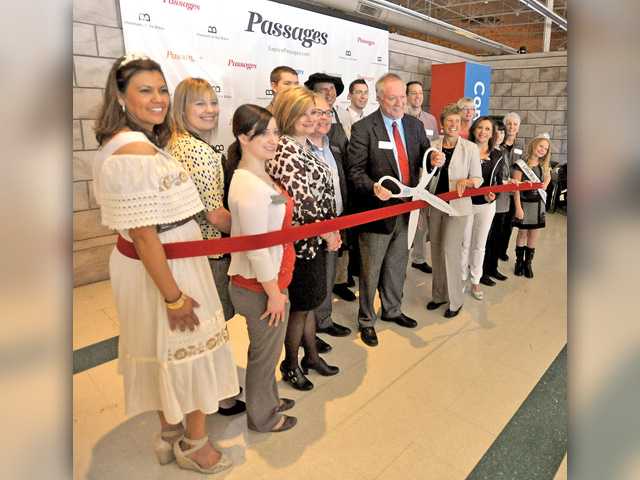
In a 30,000-square-foot building on Bouquet Canyon Road, tucked between Best Buy and Office Max, more than 400 biblical artifacts went on display Thursday.
Passages, a unique exhibit offered by the Museum of the Bible, employs a former hardware store location to share with visitors an expansive presentation that includes rare Dead Sea scrolls, a fragment of the first Gutenberg Bible, cuneiform tablets and a copy of the Bible on microfiche sent to the Moon with Apollo 13.
“There really is something rare in every room,” said Dr. David Trobisch, director of the collection. “We have original papyri (that’s) part of the oldest Christian Bible that exists and the oldest copy in the world of the Christian edition of Psalms.”
Trobisch’s personal favorite is a letter written by Martin Luther. But he says most people are moved by the Holocaust room and the Torah artifacts on display.
Trobisch joined the Passages team a year ago to help curate various artifacts used for the exhibit, which travels around the country to different locations. The mini-museum stays at one location for about one year at a time.
“The exhibit tries to serve the public and people of all faiths and interests,” Trobisch said during the ribbon-cutting ceremony Thursday.
Passages will be on display in the Santa Clarita Valley until Feb. 27, 2016. When it moves to the next location, the space formerly occupied by Orchard Supply Hardware will be renovated for a Hobby Lobby store.
The traveling exhibit began as a personal collection of artifacts by Steve Green, president of Hobby Lobby.
After privately collecting many biblical artifacts, he realized they needed to be shared with the public. To that end, he launched Museum of the Bible and began the first traveling Passages exhibit in 2011.
A permanent 400,000-square-foot Museum of the Bible is being built in Washington, D.C., to house the entirety of the more than 40,000 items collected in the last six years. The permanent museum will open November 2017.
The exhibit focuses on artifacts pertaining to the history of the Bible, original copies, the books that make up the canon and how Bibles of certain religions differ from each other. It also includes exhibits that focus on the impact the Bible has on world culture, government, music and other areas.
One area of the museum tells the impact the Bible made on slavery and includes a slavery bill of sale and African slave bracelets. The museum also features art by Salvador Dali inspired by the Bible.
“People experience God as they read the Bible; it is a very universal experience,” said Trobisch. “It is a very central book to society and has had an enormous impact. We want the Bible to speak for itself.”