Editor’s note: Today The Signal begins a four-part series on coming development on the Santa Clarita Valley’s east side.
The Santa Clarita Valley’s history is one of hunter-gatherers, of miners and oilmen, of ranchers on sprawling lands and workers living in small, isolated communities called Newhall and Saugus.
But the most transforming changes over the years probably started in the 1960s, when planners snaked Interstate 5 into the Santa Clarita Valley, opening up the valley’s small towns for easy access from the south.
Around the same time came a nudge from a new tax policy, which decreed Newhall Land and Farming Company’s thousands of acres of farm and ranchland in the western valley would be assessed based on its “best use” — housing, in other words.
The firm then decided to embark on a new path of development.
Now known as Newhall Land Development Inc., the company designed the master-planned community of Valencia. Homes went on sale in the 1960s. Suburbanites were about to become the new Santa Clarita Valley norm.
Growth continued into the 1970s and picked up steam in the 1980s and 1990s. Residents anxious about its speed formed the city of Santa Clarita in 1987 in an attempt to gain some say-so in its rate.
But without control over outlying county areas, the city couldn’t halt suburbanization. It took the so-called Great Recession of 2007 to grind growth to a near-halt.
However, that’s about to change.
East side
The city of Santa Clarita has burgeoned to become the third-largest in Los Angeles County with more than 209,000 residents. Unincorporated communities like Castaic, Stevenson Ranch, Westridge and Val Verde are home to tens of thousands more.
But estimates in the “One Valley, One Vision” joint planning document crafted by Santa Clarita and Los Angeles County call for the valley to become home to between 460,000 and 485,000 residents — about double the current population.
Many local development projects were green-lighted years ago but were stymied by the recession.
“We were in a holding pattern and waiting for the economy to rebound,” said Santa Clarita city spokeswoman Gail Morgan. “People were just not doing development.”
However, development projects proposed for the Santa Clarita Valley’s east side will add thousands of new homes and millions of square feet of commercial and industrial space.
“Low interest rates, the need for the housing and also a more robust economy have really contributed to these projects starting to come up now,” Morgan said.
“We are definitely seeing renewed activity from the development community in the city, and that’s both residentially and commercially,” said Tom Cole, the city’s community development director.
As to why the collective eye of the building industry seems trained on the east side of the valley, the answer, it seems, is fairly simple.
There’s still a good deal of available, vacant land over on the other side of town.
“There is a lack of jobs and major retail on the east side, and there are opportunities to fix that,” said Newhall Land’s Marlee Lauffer.
Drought
This explosion of new growth comes as California faces what many say could be the worst drought in recorded history.
Amid the sobering drought conditions, the sight of new homes going up next door to them, adding new households’ demands on water supplies, is not sitting well with many local residents.
“You need water for these houses, and as you well know we’re running out,” wrote reader Ron Brown in response to a Signal Facebook survey. “Time to stop building all of these homes out here. Take a break, people.”
“All of these houses need water, which we don’t have,” agreed reader Matt Ake. “They ask us to rip out our lawns and time our showers, but then they go and add all of those showers/toilets/lawns/swimming pools. It sends a very mixed message.”
Others raised issue with how new developments could affect local traffic.
“(It’s) way too crowded here already; we don’t have enough roads out of here, not to mention the drought,” wrote reader Carol Perez. “Driving from one side of the valley to the other takes way too long.”
Not everyone was opposed to new construction, however.
“I’d rather have pretty homes than empty space,” wrote reader Erika Rodriguez.
Regardless of public sentiment, construction on some east side projects has already begun in earnest, with more to come.
East of Bouquet
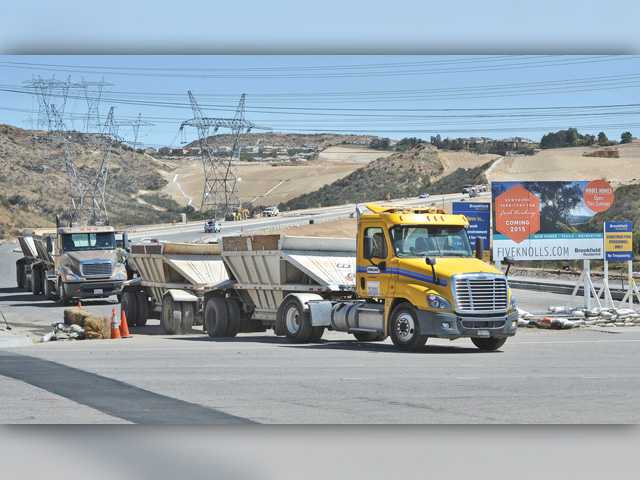
Already, development projects such as River Village and Five Knolls are moving forward in earnest where Golden Valley and Newhall Ranch roads meet.
River Village alone totals around 1,000 homes — 400 of which are yet to be built and finished.
The Five Knolls project includes roughly 500 new homes.
Work is continuing on the 315-unit Villa Metro development on Soledad Canyon Road and Prima Way. Some 78 homes will rise next to Bowman High School as part of the Habitat for Heroes project on Centre Pointe Parkway.
Heading further east, planned developments include the 137-unit Trestles project near the intersection of Soledad and Langside Avenue, which is also currently under construction.
A 95-unit senior housing project is planned on Golden Valley Road south of Highway 14. Another 109 homes are being looked at just north of the Robinson Ranch Golf Club as part of the Mancara project.
Ground has been broken on the La Cocina Shopping Center that will add 10,000 new square feet of commercial space, and the Santa Clarita Valley’s third La Cocina location, to the corner of Golden Valley and Sierra Highway.
A proposed mixed-use development called Sand Canyon Plaza would bring 580 residential units and an estimated 115,000 square feet of commercial, restaurant and hotel space to the intersection of Soledad and Sand Canyon Road.
Just outside the city limits sit two more major projects: 492-home Park Place project at the end of Shadow Pines Boulevard, and the 492-home Spring Canyon project between Shadow Pines and Agua Dulce Canyon Road.
In the center of the action on the east side are the two largest projects of all: Vista Canyon Ranch and Skyline Ranch.
Vista Canyon Ranch
Located across the Santa Clara River from Canyon Country Park and west of Sand Canyon, Vista Canyon Ranch would add 1,100 homes and almost 1 million square feet of commercial space to Canyon Country.
Jim Backer, the president of project developer JSB Development, has made no secret that he thinks the project would create a town center of sorts for Canyon Country and the east side.
“It’s going to be state-of-the-art and an incredibly innovative project,” he said.
He also said Vista Canyon Ranch would help fill long-standing voids in some amenities in the area.
Plans also call for an on-site water reclamation plant that Backer says will produce more water than the project will use on an annual basis.
A bridge across the Santa Clara River to connect to Soledad Canyon Road is also planned.
“I tend to look at development as a positive,” Backer said. “And I look at the public amenities and infrastructure that Vista Canyon is going to bring to that part of town — it’s a staggering number in terms of dollars and what’s going to happen over there.”
Backer said he thinks the project will also help fill a gap in Canyon Country by providing a focus on development as a means to create jobs.
“Most people bought land in Canyon Country over the last 50 years for houses and maybe a little retail,” he said. “But there wasn’t that focus on job creation.”
The sizable project is not without its critics, however. The project was the target of a lawsuit that claimed the Environmental Impact Report for the project did not comply with the California Environmental Quality Act.
An appellate court sided with the planners of the project in December.
“We’ll always have our detractors, but we certainly hope we addressed everything,” Backer said. Plans call for ground breaking this year.
Skyline Ranch
The Skyline Ranch project is not quite as large as Vista Canyon, but it’s still substantial. It proposes 1,260 new homes.
Approved in 2010, the project would be built between Sierra Highway and Whites Canyon Road south of Vasquez Canyon Road.
A substantial amount of land in the project area, approximately 1,770 acres, would be preserved as open space under the adopted plan.
Industrial growth
Another project in the pipeline is in eastern Newhall. The massive Needham Ranch/Gate King development would create 4.2 million square feet of commercial and industrial space near the intersection of Sierra Highway and Newhall Avenue.
Construction on that could start as early as next year, city officials say.
“I think that there’s a significant demand for new (industrial) space,” said Holly Schroeder, the president and CEO of the Santa Clarita Valley Economic Development Corporation. “Our industrial vacancy rates are very low and have been for some time.”
There’s also the planned expansion of Disney’s Golden Oak Ranch in Placerita Canyon, which would add upward of 500,000 square feet of new structures and sound stages to the ranch that is used by the Walt Disney Company and ABC Studios.
Because the economy is doing better, Schroeder said, “Businesses are more willing to make the big decision to expand or relocate.”
Coming Tuesday: New roads for new developments.
661-287-5525
On Twitter @LukeMMoney