Editor’s note: Third in a four-part series about east side development.
At a time when Californians are being told to let their lawns turn brown in the face of a statewide crippling drought, some residents are angered at the prospect of water being piped into new homes planned for construction in the Santa Clarita Valley.
Why should they have to tighten their taps when new homes are being built just down the street?
State officials asked Californians to reduce water use by 20 percent last summer, and earlier this month Gov. Jerry Brown mandated water use reduction by 25 percent.
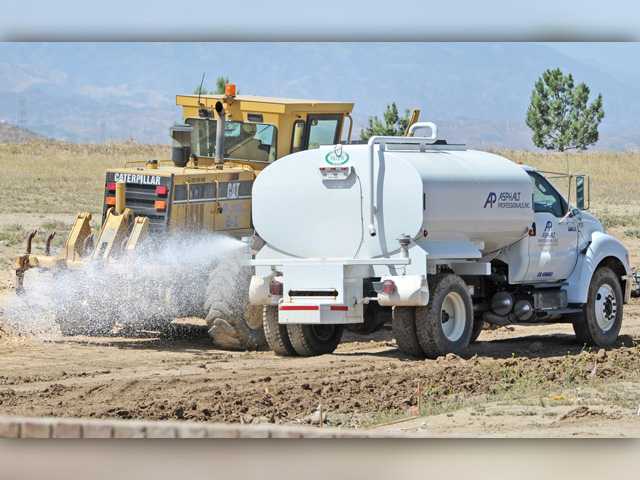
But while state officials debate details of enforcement, thousands of new homes and millions of square feet of commercial and industrial space are either under construction or being planned for the Santa Clarita Valley’s east side.
On the West Side of the valley, other major projects are in the pipeline, including the 21,000-home Newhall Ranch development off Highway 126. And projected growth in the valley calls for a doubling of residents before so-called “build-out” — when growth is considered to be complete.
So where’s all the water coming from?
“We’re telling our existing residents that we have to cut back 25 percent, but then we say, ‘OK, we already have 1,000 fully entitled residences over here.’ What do people think? They don’t think there’s any problem (with water supplies), and why should they?” said Lynne Plambeck, a longtime local environmental advocate and president of the Santa Clarita Organization for Planning and the Environment.
Cycle or permanent?
Whether or not there’s sufficient water to slake the valley’s collective thirst depends on a number of factors — with one major question being this: Is the current water shortage a result of a drought cycle that will break soon, or is it a “new normal” brought about by climate change?
To Plambeck, the best response to the current condition is not to wait for the drought to be over, but to plan in case a drier climate is the new norm.
“It’s pretty well established that this is climate change, and if this is what we’re going to be seeing, everything is going to be entirely different,” she said. “We can’t continue on with business as usual.”
Gov. Jerry Brown also saw the current drought as a game-changer when he outlined his historic water restrictions earlier this month.
“We’re in a new era; the idea of your nice little green grass getting water every day — that’s going to be a thing of the past,” Brown said.
Plambeck, who serves on the board of the Newhall County Water District, said the responsible thing to do is to change the kinds of projects being approved. Instead of new developments sprawling on the outskirts of town, demanding water infrastructure and encouraging lush lawns, developers should focus on so-called smart growth within concentrated areas.
“I’ve always thought that we should be planning to the drought years — not to the average or the wet years,” she said.
Drought cycles
Some of the Santa Clarita Valley’s water officials, however, said droughts have ebbed and flowed throughout California’s history.
“The one thing that nobody can predict is when this drought will be over,” said Dan Masnada, general manager of the Castaic Lake Water Agency. “It will be over; we just can’t predict when.”
Masnada said, based on projections, there is adequate water to meet the needs of the Santa Clarita Valley.
“We project we can meet the existing demand with supplies we have available to us,” he said.
However, should drought conditions become the new definition of “business as usual,” Masnada acknowledged, water companies would have to change their outlook.
“If the drought were to be a permanent condition, then we would have to re-look at all the assumptions based on Mother Nature having made, if not a U-turn, then a significant change in direction,” he said.
Working ahead
As it stands, the assumptions and projections that form the basis of Masnada’s assurance of water supplies are outlined in the valley’s latest Urban Water Management Plan — a cooperative effort between local water suppliers that plans water use taking into account current and future population growth.
Urban water management plans are mandated throughout California by the state government. The Santa Clarita Valley Watershed plan is reviewed every five years and will be updated later this year “based on additional climate change data and factors that could impact the overall supply of water,” Masnada said.
Information from recent years will help show local water officials how their projections fared during some of the driest times in recent memory.
“This time it’s going to be interesting because, obviously, we’re in the midst of this drought,” said Steve Cole, general manager of Newhall County Water District. “So you’ll have that perspective and you’ll have the ability to look at how the plan performed through the drought.”
Local water officials take regular stock of all the data that’s available to make sure they are measuring supply and demand, said Keith Abercrombie, general manager of the Valencia Water Company.
“Nobody has a crystal ball and can say, ‘This is what is going to happen in the next five years, 10 years,’” he said. “We are looking at and using the best available data to try and forecast for and plan for situations where you have severe droughts, and this valley has collectively done a great job in planning for droughts.”
Will serve
While the Urban Water Management Plan is a big-picture document, when a developer seeks water for a specific project he applies for what’s called a “will serve” letter from the appropriate water retailer. The Santa Clarita Valley has three main water retailers: Newhall County Water District, Santa Clarita Water Division and Valencia Water Company.
The “will serve” letters indicate sufficient water to meet the new demand; they are required before construction can begin.
Developers also have to make sure they comply with local, county and state regulations as far as water use is concerned, local water officials say.
“I think what you do see now is that a lot of the building ordinances through the city and the county handle a lot of those issues,” Cole said. “We really rely upon those ordinances now as the vehicle to make sure the new development is up to code.”
Water wise
While many criticize the vast amount of development in progress on the Santa Clarita Valley’s east side, the fact remains those residences are likely to be built more water-wise than earlier construction, local water officials say.
“Conservation is the first line of defense and the most cost-effective way of making sure we have adequate supplies for if the drought continues for another year,” Abercrombie said.
Local water retailers say they are working to help update the fixtures or sprinklers at existing homes, as well as encouraging residents to replace water-guzzling lawns with more drought-tolerant plants.
Builders, too, seem to be more conscious of the water demands and environmental effects of their projects, said Cole, adding: “I think the footprint of a single-family residential home is totally different now than it was maybe 10, 20 years ago.”
Coming Saturday: Beautifying Canyon Country, core of the Santa Clarita Valley’s east side
661-287-5525
On Twitter
@LukeMMoney