Editor’s note: This is the last in a four-part series about east side development.
When the city of Santa Clarita incorporated in 1987, it faced a particular challenge in developing its east side.
While on the west side Valencia was a master-planned community with wide boulevards — or at least land set aside for wide boulevards — roads planned for logical connections, plenty of parks, open spaces and paseos for foot and bike traffic, Canyon Country was a different story.
“Canyon Country had eight or 10 different developers, many of whom were not held accountable for putting in adequate infrastructure,” said Gail Morgan, longtime spokeswoman for Santa Clarita. “So they would have a four-lane road, but only stripe it for two, there were no center medians, one or two very dilapidated parks, no bike trails. The list goes on.”
An anecdote about the city’s first planned new park on the east side illustrates the difference, said Morgan, who has worked with the city for most of its existence.
The new Canyon Country park was going to be the latest and greatest, packed full of all sorts of bells and whistles.
But when the city invited Canyon Country residents out to a public meeting on the project, eager to show off their plans, they learned “really, what people wanted here was a swing,” Morgan said.
Even now, almost three decades later, city officials say they continue to invest in developing and beautifying the east side and its core, Canyon Country.
City investment
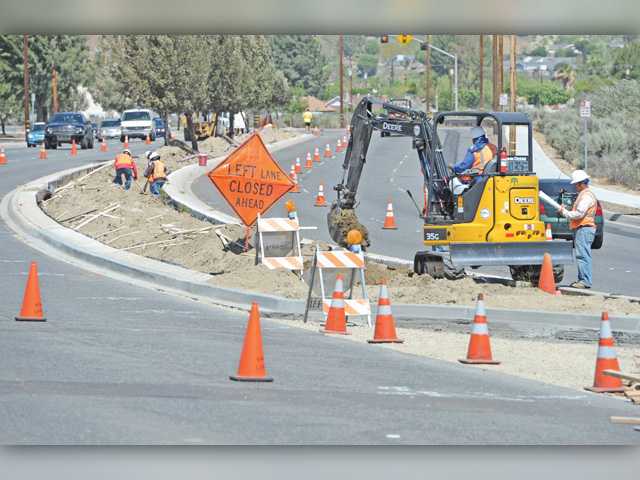
“Over the last 28 years, we have spent tens of millions of dollars on infrastructure — specifically in the Canyon Country area because that’s where the need was,” Morgan said.
Historically, perhaps the biggest example of this is when the city placed utility poles underground along Soledad Canyon Road in 2006, eliminating one of the area’s most apparent eyesores.
The city also plans to build a new Canyon Country Community Center off Sierra Highway and Soledad.
“If we look back over the last 15, 20 years and then come forward to where we are today, the Canyon Country area has just changed remarkably well,” said Bob Kellar, a longtime Canyon Country businessman and resident, as well as a member of the Santa Clarita City Council. “We have beautified so much of our community.”
The city has worked on median refurbishment on the east side area to install new, lower-water-use plants and more efficient irrigation systems, according to Kevin Tonoian, the city’s administrative services manager.
“We’re looking at significantly reducing the potential for runoff into the roadway and also installing ‘purple pipe’ for future recycled water,” he said.
More space
Alan Ferdman, chairman of the Canyon Country Advisory Committee and a longtime Canyon Country resident, said one of the things he’s most noticed has been the city’s efforts to plant trees in the area.
“It certainly looked pretty barren and bare until the city came in and planted a ton of trees in our area,” he said.
“Things have taken place and gotten better — there is more beautification,” said Mike Cruz, a Canyon Country Advisory Committee board member and longtime resident of the area.
“I think there’s still room to go, though,” he said, citing a need for more park space and for improvements to existing parks.
“There’s just not enough space on the east side to accommodate” all the community’s needs, he said.
Plans for three of the larger coming east side development projects — Vista Canyon Ranch near Soledad Canyon Road and Sand Canyon Road; Five Knolls near Golden Valley Road and Newhall Ranch Road; and Skyline Ranch between Whites Canyon Road and Sierra Highway and south of Vasquez Canyon Road — include construction of new parks.
Community feel
Though some hold up Valencia as an example of a beautified community, city officials say what they hear from Canyon Country is that it doesn’t want to mirror its neighbor.
“For the most part, we heard they don’t want to look like Valencia,” Morgan said. “They want to look like Canyon Country, and that’s great.”
661-287-5525
On Twitter
@LukeMMoney