As long as I can remember, alarmists have bleated and prophesied, “The Big One is coming and California will sink into the ocean depths!”
“We’re doomed,” they warned. Yet earthquakes have come and gone and freeway overpasses collapsed — twice in my lifetime — and California yet remains safely above the Pacific’s high tide.
Still, the naysayers are partly right. We are sinking, albeit slowly, into a desert landscape. Think Barstow. Think Victorville. Think the I-15 up to Vegas.
As mandates and “funding limitations” press our quality of life with an ever-tightening grip pressing against lush lawns, calming pools, beautiful boulevards, and attractive highways we see, real time, the degradation of our expensively constructed public spaces and infrastructure.
Our respected governor is known to be ascetic, having first studied for the priesthood, then embraced Buddhist ideology — and has eschewed modern niceties since, going as far as refusing residence in the governor’s mansion and insisting on driving in a Plymouth Satellite to and from his rented apartment.
Surrounded by zealot activists, what might be the underlying intent of forcing and bending society away from lush tranquility to a water-restricted world of rock and paving and cactus and stone?
Have crazed eco-activists finally gained the upper hand? Has the drought become a useful tool, now levered to make us pay for our evil, watery ways? Is this drought one of those “handy crises that should never go to waste?”
Do I sound over the top?
We hope these water mandates are indeed necessary. We hope to trust that the compromises these restrictions put on communities are necessary and just.
Still, one wonders of the urgency to curtail 25 percent of suburban water consumption when driving down Highway 99 to see flooded rice paddy fields looking for the world like Southeast Asia.
California turned First World industrial nation status nearly a century ago. Is growing rice really the highest and best use of our otherwise scarce water?
Plainly not.
Meanwhile, we’re witnessing these damnable results of water mandate zeal in real time over at the Valencia Commerce Center. There, our street medians are maintained by L.A. County Parks and Recreation, funded by a special assessment levied on local property owners.
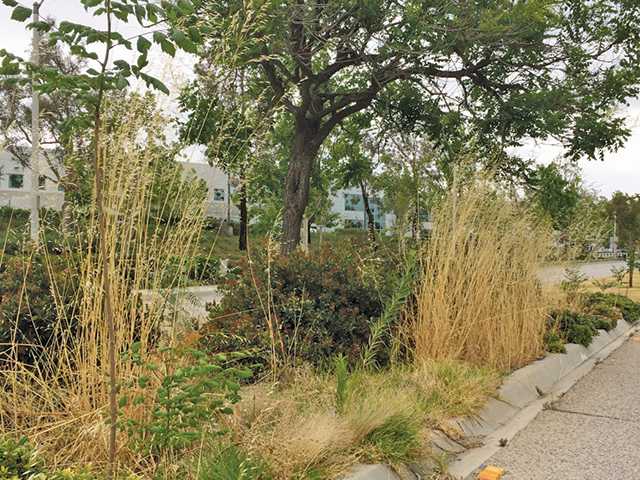
County parks turned the spigot completely off weeks ago, and today half of Valencia’s business owners and employees drive along a forlorn, dried-up, Barstow-ish dead street with medians of crispy brown lawn, dying trees and weeds fully five feet tall.
We’ve now got a noxious, dead street right in the middle of Valencia’s industrial jewel, unfortunately located outside the city limits of Santa Clarita, which plainly values landscape much more highly than non-elected, non-accountable, spigot-shutter-offers at L.A. County.
I’ve written L.A. County Parks and Rec and letters have flown back and forth.
“There are scarcely funds for utilities, let alone for maintaining the landscape.” Yes, the budget is tight, but for every problem there are solutions without killing every living thing.
Geez, the Commerce Center was just fine for a decade before the Mandate.
“We’ve turned off the water and stopped regular maintenance.”
“The county is hiring an architect to ‘study the problem’” and maybe come up with an affordable solution. I dread promises that employ the passive future tense.
“Is hiring,” and, “Will be studying,” brings terror for just how long actual solutions may be in the works.
Meanwhile, with the water Mandate now as a convenient excuse, our once-beautiful Commerce Center Drive has become a Barstowian Boulevard; a meandering post-landscape hell, greeting owners and workers alike with dead lawns and five-foot weeds as an insulting, “Phooey to you!” starting our business day.
I’ve written and warned that the Mandate may be misused and become an excuse for poor public landscape services: We see the parkways are dying.
“We couldn’t water.” Ground cover is spotty. “We couldn’t water.” Trees are fading. “Not enough water.” “That’s just the way things are today.”
No, they don’t have to be.
We’ve got to hold agencies to higher standards today than ever before. Now is the time for creative solutions, rather than simply capitulating to a false inevitability.
Sounding a little like McCoy from Star Trek: “Trust me, I’m a landscaper.” I can assure you that 12 percent to 25 percent water reduction in no way needs to trash our landscapes.
We can pick our landscape battles, but never unilaterally surrender.
Products exist to retain water longer in the soil, allowing turf to thrive with less. Targeted turf locations can be swapped to low-water-use but attractive designs.
Adjustments can be made while actually increasing the attractiveness of our public landscape assets.
But back at the Commerce Center, the Mandate has become the lever for L.A. County to simply give up and let the whole damn thing die and blow away to Barstow.
Beware that Commerce Center Drive is the canary in the cave, for L.A. County landscape-maintenance districts surround the SCV.
Ordinary citizens must become the new activists, pushing back against established over-zealous lobbyists and government machine cogs who perhaps have always despised lush suburbias from the ground up.
Gary Horton is a Santa Clarita resident. “Full Speed to Port!” publishes Wednesdays in The Signal.