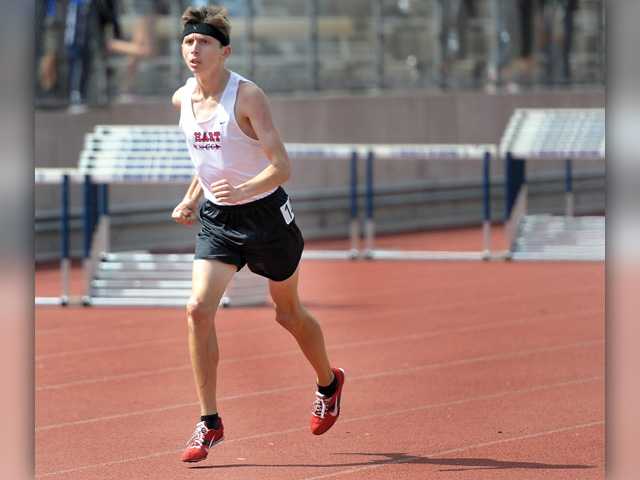
The race official rings the bell to indicate it’s the final lap.
By the time Justin Gallegos starts on the last of his four revolutions around the 400-meter track, most of the other runners have already finished the race.
The 17-year-old Hart High School junior starts to pick up the pace, powering around the final corner as he feeds off the energy of the increasingly boisterous crowd.
“Let’s go, Justin!” yells a runner from a different school.
Gallegos does what he always does, reaching the finish line at full speed.
Sometimes he hardly has the energy to walk off the track without collapsing.
But his falling to the ground has nothing to do with the fact that he was born with a physical disorder known as cerebral palsy. It’s because he doesn’t stop until he’s exhausted every ounce of energy.
“I know I have as much potential as everyone else out on this track. The way I see it, nothing is holding me back. I know I have the potential to run faster times and better times. I know I have the ability to go all the way. It’s what I love to do. There’s nothing else I’d rather be doing,” Gallegos says.
This is his third year running track at Hart, where he also participates in cross country during the fall season.
Outside of some karate classes when he was younger, Gallegos had never competed in an organized sport before. He only started running because he thought it would be a good way to meet new people. It was just something to try.
Little did he know it would become a passion.
“There’s nobody more determined and more dedicated,” says Hart cross country/track and field head coach Larry David. “If he’s in town, he’s here to practice, whether it’s 7 a.m. Saturday or 6 o’clock at night or whatever it is. He’s here.”
When Gallegos runs, his physical limitations are evident. As he describes it, his arms flail as he moves. He has trouble lifting up his knees as high as they should go due to slowly developed strength in his hips.
Cerebral palsy is a disorder caused by brain damage that usually occurs before birth. In Gallegos’ case, his impairment is purely physical, affecting his arm and leg movements and causing him to speak in a slower, varied tone.
Gallegos didn’t walk his first steps until age 2, and he had to wear braces on his legs and attend physical therapy in his early years. But he continues to gain physical strength year by year.
And his mental state isn’t limited whatsoever (he has a GPA north of 3.5), other than the absence of the words “can’t,” “won’t” and “no” in his vocabulary.
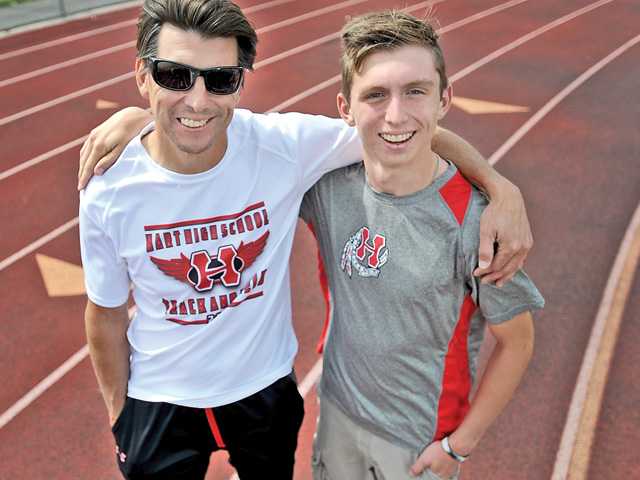
“He’s determined. That is a word that would describe him,” says Gallegos’ dad/coach, Brent. “He wants to get better. He works hard. He’s been sick, but he wants to come to practice. So he puts in the work and he wants to get better and every year he gets faster and faster and he just keeps plugging away.”
Brent was the first one to suggest running cross country after he noticed his son’s ability to keep a remarkably steady stride and pace on a treadmill when he was in junior high.
Gallegos wanted to be an athlete like his dad, who played football and ran track in high school and was a pole vaulter at Cal State Northridge.
Brent is now an assistant track and cross country coach at Hart, and he still tries to run with his son as much as possible while the team trains.
Long-distance running quickly became a calling for Gallegos, whose motor skills are limited to the point where it would make it nearly impossible to play his favorite sport growing up — football.
But running is as much a mental sport as it is physical, requiring pain tolerance and relentless training.
That’s never been a problem for Gallegos.
“I would say even though I’m, quote, unquote, ‘the slowest person out there,’ I’m always competitive in almost everything I do — my workouts, in my races, just everything, because I want to run faster times. I want to make higher goals for myself, so that’s why I’m so competitive. I think my coaches and my teammates see that in me,” Gallegos says.
Gallegos’s training in the last two years speaks for itself.
As a freshman, he struggled to break the 8-minute barrier in the mile. Because he had trouble lifting his legs as high as typical runners, he used to trip and fall during races. At one point, he was falling and scraping his knees so much, his dad bought him knee pads to wear during races.
“He’s had his share of stumbles out on runs. He’ll cut up his elbows and knees and he’ll get up and brush off and finish the run, whether it’s a block away or two miles out,” coach David says. “He just gets up and gets after it again. Never asks for any break or any special consideration at all.”
Two years later, he’s knocked his mile time down to 7:14 and his personal best 3,200-meter time (15:42.13) at last week’s Foothill League finals is nearly 3 minutes faster than what he ran last year.
His three-mile cross country times have improved by more than four minutes. And he hardly ever falls anymore.
Gallegos expects his times to continue improving to the point where he could one day qualify for the Paralympic Games in 2020 or 2024.
As he continues to move at a faster clip, his celebrity in the community grows.
By now, the local running crowd knows who he is. He typically draws a standing ovation and a wave of applause.
After races, athletes and coaches often make a point to approach him and tell him how he’s inspired them.
Gallegos says he never expected his running to affect people in such a significant way.
But it’s part of what keeps him going.
“It motivates me,” Gallegos says. “It motivates me to train harder and race faster.”