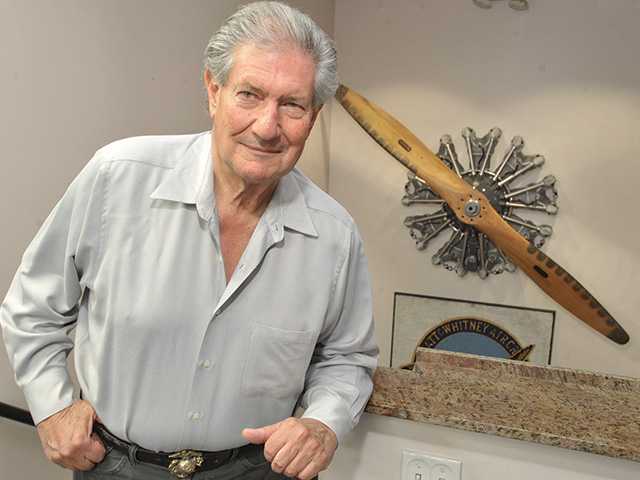
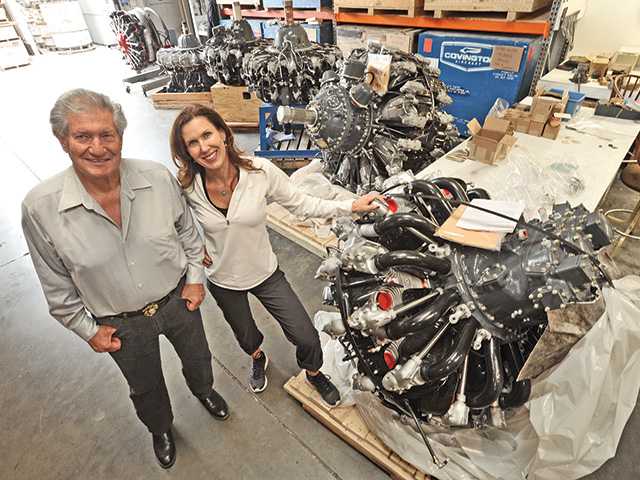
Dennis Nobile of Sun Air Parts has built a thriving business on a dying old aircraft engine – namely the Pratt & Whitney engines once used in McDonnell Douglas DC-3s, 4s, 5s, and 6s, and World War II fighter plans. While Pratt & Whitney has built dozens of new aircraft engines since, and McDonnell Douglas merged with Boeing in 1997, Nobile keeps the old engines flying the skies around the world.
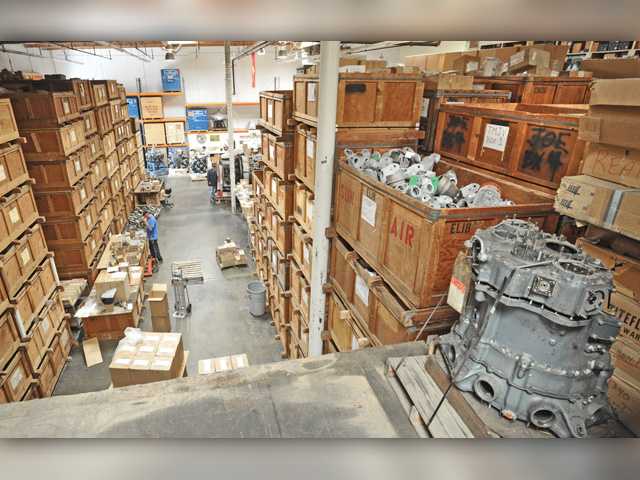
Walk around Sun Air Parts 20,000 square foot facility in Valencia and a visitor will take a tour back in time weaving around old piston aircraft engines and parts tucked into every nook and cranny of the industrial space. But, it’s the engine time didn’t forget thanks to Sun Air Parts.
Founded in 1971 with partner George W. Green, who passed away in 1985, Sun Air Parts originally opened shop in Sun Valley – thus the name for the business, Nobile said. Both men had been working for a Burbank company that operated parts divisions for Pratt & Whitney and General Electric’s aircraft engines. In 1990, the company moved to Valencia where it remains headquartered today.
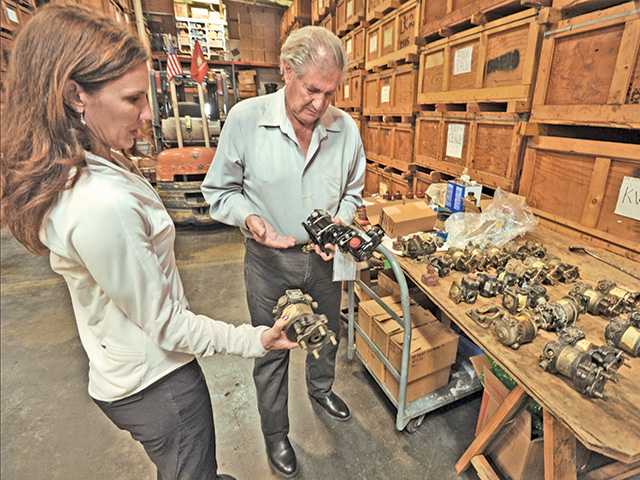
With 240 unique parts, and 11 full time employees, Sun Air Parts has become the largest supplier of the old engines, parts, tools and accessories – both those parts salvaged and those they have newly manufactured. Using manufacturer specs, and with Parts Manufacturer Approval by the Federal Aviation Administration, it sells millions of parts a year.
Forty-three years after Sun Air Parts first began resuscitating the old Pratt & Whitney engines, the firm has a 73,000 square foot warehouse in San Antonio, Texas. And it has eight 20,000 square foot warehouses in Nacona, Texas – a town sitting off two highways and sprinkled with only some 3,000 residents. Each warehouse is filled with aged parts that people beg to go into and mine for the old parts. “One woman runs it,” Nobile said. “She’s the best man for the job.”
Production of the old engines stopped decades ago, and Pratt & Whitney stopped supporting the engines in the early 1970s, he said. The engines started to run short, along with parts and the tools to repair them. Rather than hurting business, Sun Air Parts got busier. After the war, those old planes and engines were sold as surplus and a handful of North American aerospace companies – Northrop, who later bought Grumman, Rockwell International, Boeing, Lockheed and more – were building brand new planes and engines.
But, there were still 6,000 crop dusters flying worldwide with the old piston engines – each of which have to be torn down and overhauled after every 1,500 hours, Nobile said. Parts were getting scarce so Sun Air Parts began manufacturing the pistons, rings, gears, cam cylinders barrels and anything else that wore out with FAA approval.
“We also have our own used engines, we sell or exchange,” Nobile said. “We’ll take an old plane and harvest the parts. We used to go down to get old airplane and jet engines from the air force based in Arizona.”
The firm’s biggest customers are crop dusters, and sea and floatplanes in Alaska – reportedly home to more water landing aircraft than any state in the country. Some foreign countries still use the old DC planes in their air forces. And the company sells parts and engines for firefighting aircraft as well, including the older Super Scoopers. The planes all take different size engines operating with anywhere from 9 to 18 cylinders – one actually has 28, he said.
Selling worldwide, Sun Air Parts sells some 40 overhauled engines a year that it has overhauled for the firm; and it can also have new engines built from parts that it keeps in stock.
Despite the already lengthy lifespan of these engines, Nobile expects his business to last another few decades or more and thinks his daughter, Annette Allen might take over from him.
“I didn’t think it’d last this long,” he said. “But it’ll go 50 years or more.”