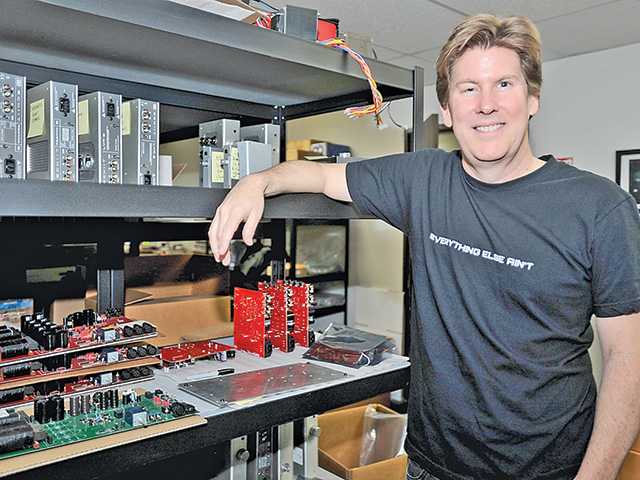
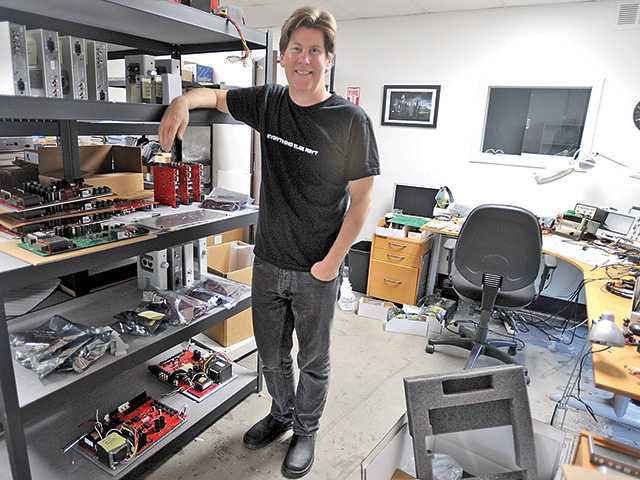
Listening to Jason Stoddard describe the growth of his company Schiit Audio one could fully envision him on TV series “Shark Tank” one day – except, that Stoddard says he can’t imagine what he’d ask for.
Running an all cash-business, he and his partner Mike Moffat founded the company in June of 2010 – right at the height of the Great Recession. Like so many successful entrepreneurs, they began by engineering, designing and building their audio products out of Stoddard’s garage – after he moved a car out of the way to free up one-third of the garage, he said.
Friends and wives built parts and packaged products until they began taking over the home. So Stoddard and Moffat moved to a small 1,800 square foot building on 8th Street in the downtown Newhall neighborhood. Ironically, the space used to be the original offices of The Signal newspaper once upon a time, he said. Ironic because Signal Multimedia publishes the SCV Business Journal, for whom Stoddard is standing by for an interview.
Also owner of Centric Advertising Agency in Santa Clarita, Stoddard said he thought he better dust off his engineering credentials after the economy took a steep dive in 2009 and go back to his old audio days. Both he and Moffat had designed dozens of products for Sumo and Theta amplifiers. The pair started by building headphone amplifiers. After building a couple of their products, Stoddard said anxiety was building.
“You have a product that looks great on paper, the products are well priced, there wasn’t a lot of competition, and it was a growing market,” Stoddard said. “But you never know what you have on paper and what you have in reality.”
But within three days, Schiit Audio got so much attention from tech-media for their well built, well priced audio products because the company zeroed in on a niche market by offering quality products without having to pay for “gold plated equipment,” Stoddard said. Since then, demand has always chased supply at the company. The company sold 150,000 units in their first six months – a response better than expected. Every day after working full time jobs, a handful of people would gather at the house to work another four to eight hours to build and ship products.
By 2013, the company moved to space on Anza Drive in the Valencia Industrial Center, first occupying 5,300 square feet of space – and now 8,400 square feet of space and the company is beginning to run out of space there as well. With 10 employees, Schiit Audio expects to sell $10 million in product this year – all of it cash up front meaning no receivables. The products range from $49 to $2,999 for very top end stuff – but those products don’t make up the bulk of the sales.
“We made the decision that to be able to compete it was more effective to cut our distribution margin; it would cost twice as much if we sold through stores,” Stoddard said. “So, with the exception of a handful of dealers that have agreed to accept a lower margin, 90 percent of our sales are direct.”
And the company is doing well, Stoddard said. It’s not short on cash, the owners know where they want to go, and growth has always been self-funded. There are no debts or bank loans. All of its final assembly and testing is handled out of its Valencia facility; they ship products to Amazon for order fulfillment. In another couple years, they might look at leasing or buying more space. From $10,000 in startup fees to $10 million in sales in four years ain’t bad. And this company doesn’t take itself seriously – they’re totally irreverent, but that’s another story.
While the company expects to sell between 80,000 and 100,000 units this year, it learned a valuable lesson along the way. With design ideas filling their heads, and thinking if a couple products are good, a dozen might be better, last year Stoddard and Moffat launched 12 new products after eliminating four of their other ideas. Being that brilliant, however, resulted in a couple big surprises being lobbed their way.
Lessons Learned
“We had production surprises,” Stoddard said. “You never want a production surprise. We had the dilemma of not enough engineering resources which led to production problems which led to moving our products out to a later introduction date. Instead of having products available in October, we went to Dec. 15 – a terrible time to introduce a new product, especially one that replaces a current product.”
The overzealous product launch left Schiit Audio with too much inventory on their hands, and too many products for audio media to review. It left media with no time to review all the new products and fully digest what we were doing, he said. This year the company plans to scale back the number of new products, launching only three or four new products in the entire year, so it doesn’t cannibalize its own sales of existing products – forcing them to steeply discount – and overrun its engineering resources.
“There’s a danger of sitting on too much product,” Stoddard said. “We try to avoid that but got stuck with inventory at the end of the year that we had to discount. It wasn’t the end of the world, but forecasting is one of the things we do the worst (job of). We look at demand and what we should be making and then undershoot. If you overshoot then you have product you’re sitting on.”
Another lesson the company learned is to be product-ready ready before publicizing a product. When it operated out of its Newhall space, it was an old building, not well insulated or sound proof and near the Metrolink rail tracks when it sent out “a bunch of” Asgard 2 amplifiers. The prototypes worked great but the products weren’t leaving Schiit Audio to take the products back in-house to repair them. As it turned out, that first shipment of products had noisy transformers that actually, physically hummed – but being in a noisy building Stoddard and Moffat couldn’t hear the problem. After these experiences that, Stoddard learned to “keep his mouth shut” before promoting a product or introducing one before the product was actually on the shelf, he said.
Fast forward several months and Schiit Audio is back to running out of stock on products and racing to keep up with demand again. But that’s okay because the company is managing its growth – if it grew any faster it’d run into cash flow issues, he said. Growing at 50 percent per year is pretty aggressive, but it’s still manageable.
While they take their product development seriously, the two men haven’t built their company on stodgy image. For instance, one might think Schitt is a German name.
Fun a Must
A first glance at their website and the visitor reads: “ Shih-tah. It's a proud German name, host to a long line of audio engineers who slaved away in crumbling Teutonic fortresses as lightning lashed the dark lands outside, working to perfect the best amplification devices in the world... Yep, Schiit is our name, and it's pronounced, well, like "hey man, that's some really good Schiit!" And now that we have your attention...”
“In early development stages I’d run in for dinner and go back out to the garage. I was always telling my wife Lisa I had too much shit to do,” Stoddard said. “Finally she said ‘why don’t you just call it (the company) that. I said ‘that’s crazy, no one would name their company that.’ But we did.”
The name lends itself to a lot of puns but consumers remember the name, he said. If someone is really offended by the company name, doesn’t have a sense of humor or can’t laugh about it – then they’re probably insufferable anyway, and Stoddard said perhaps those customers really do need to go buy a $50,000 piece of equipment rather than buy from them.
But, the company also doesn’t throw the name in the face of its customers; it’s actually fairly subtle about placing the company name on the back of the product – and the item’s name on front of the product.
The owners also believe in being transparent with their customers, with Stoddard admitting they’ve had “their less than stellar moments” and tell people “once you see how much we screw up it’ll be amazing if you every buy anything from us again.”
As for the terms and conditions posted on their website, Schiit Audio spells out its terms in comical fashion such as: “Sorry, guys, but in order to CYA in these litigious states (The LSA, aka the USA), we have to have some words on here. If you’re browsing, shopping, or generally just using this website, there’s probably nothing to worry about, but if you’re an alien intelligence looking to weaponize our code and/or our products, knock it off, OK?”
As if Stoddard doesn’t have enough to do with two businesses to help run, he’s also a published science fiction author and decided to write the chronology of Schiit Audio – people read it and really loved it, he said. So he decided to publish it – not to make money on it, but just to have some fun with the whole “we don’t take ourselves seriously” genre of storytelling.
As for the company’s success reaching a niche market, with a large consumer base, of people who want good products without paying an arm or a leg for them, Stoddard said their model is built on launching their least expensive products first to build momentum. That’s counterintuitive to product launches where the lesser expensive products are launched first, and the companies build on product, raising prices once they’ve whetted consumers appetites.
“It’s not about getting everyone to like or tolerate you,” he said. “It’s about getting some people to ‘love’ you. It’s not about someone saying why don’t we look at a rack of equipment worth $500,000, it’s about saying why don’t we sit down and listen to some great music.”