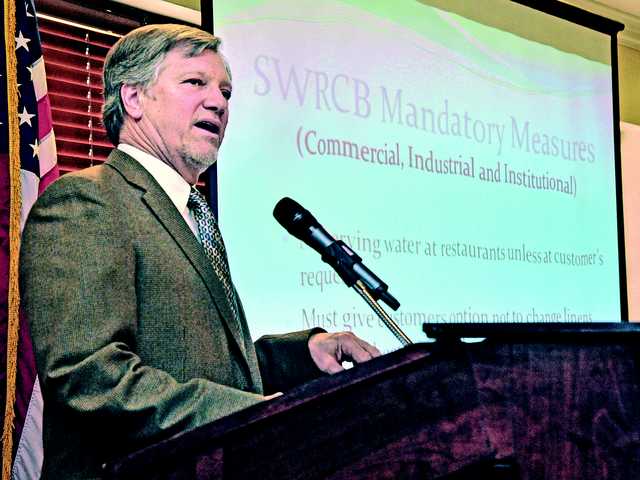
Forced by state mandates to cut water consumption, Santa Clarita Valley water suppliers plan to provide ongoing reliable water to businesses in ways that least hurt the economy, said the head of the local water wholesaler at the Valley Industry Association’s luncheon on Tuesday.
The goal is to reduce water consumption with minimal or no economic impact, said Dan Masnada, general manager of the Castaic Lake Water Agency.
Prohibited actions – like preventing water runoff during irrigation practices – apply equally to residents and businesses, he said.
However, businesses also face some extra rules such as not serving water at an eatery unless requested by a diner, giving hotel guests the option not to change linens, and no irrigation of grass on landscaped mediums. Only trees can be watered via drip systems.
As for new construction of homes or buildings, irrigating with drinking-quality water is prohibited. Water can be delivered, however, via a drip or micro spray system. As for the consumption of water on new developments, that impact is minimal, Masnada told attendees at the luncheon.
Less than 1 percent of current water use is for development activities. And new developments are at least more than 20 percent more efficient, he pointed out.
“Prohibiting development has economic consequences and raises serious equity issues,” Masnada said.
And while CLWA has water supplies available for now and in the foreseeable future, being forced to comply with the mandates is actually stretching water supplies for the future.
The agency’s last five-year plan, however, was completed in 2010 and will be updated this year.
Among the possible actions water suppliers might take in the future to shore up water supplies include capturing storm water runoff, gray water use, cleaning waste water or mixing waste water with clean water.
Responding to questions from the lunch attendees, importing water from Washington or Oregon State isn’t feasible as those states are now in a drought as well, he said. And, as an inland desert city, building a desalination plant on the coast and piping water 40 to 45 miles back to the SCV isn’t viable from a cost standpoint.
“It’s cheaper for us to treat waste water,” Masnada said.
The ideas that show the most promise, he said, include putting recycled water back into the ground to restore natural ground water levels. Also being considered is an “aquifer storage recovery” from the Saugus formation, but he didn’t elaborate on what that plan would look like.
Changing the landscape – most notably lawns, and mindset of water users, will likely conserve the most water.
“If we didn’t water lawns, water conservation would easily result in savings of more than 25 percent,” he said.
Masnada did take the time to specifically highlight what he considered to be bad water policy in the form of a proposal to allow “hauled water” to feed new homes in Northern Los Angeles County in areas like Agua Dulce.
Under current requirements, a project has to demonstrate sufficient water supply to a new development prior to construction.
If the rules are eased to allow for water to be hauled to an area, potentially 43,000 new homes could be built in the northern part of the county, he said.
“The drought notwithstanding, this is just plain bad policy,” he said.