It was mid-June in the summer of 1958, and school was out until fall. My sister, Ruth, would turn 12 in July, and I would be 10 in August.
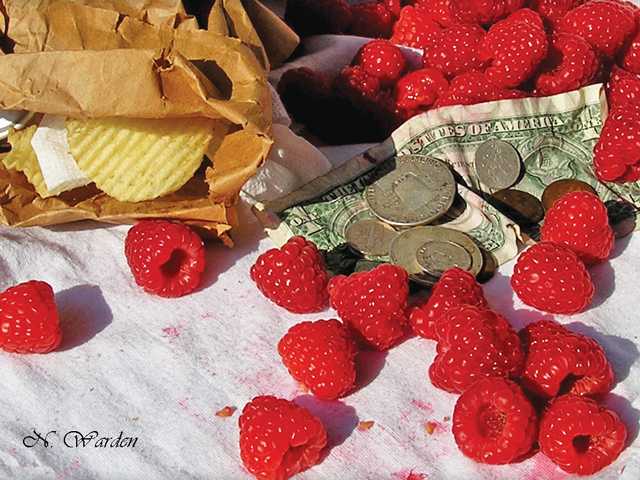
The Oregon spring had been wet as usual, and the berries growing on the farms in and around Portland were ripening right on schedule. Oregon has many berry farms, both small and large producing strawberries, raspberries and blueberries.
In the 1950s, growers relied solely on local children to pick their crops. Old school buses became ‘berry buses’ that were driven through the rural areas of S.E. Portland as early as 4 a.m., picking up sleepy-eyed children, clutching their brown sack lunches and shivering in the damp air.
Diligent pickers could earn enough money by the end of August to buy all of their school clothes for the coming year. Ruth was at an age where having store-bought dresses was important. I was at the age where proving to be as fast a picker as my older sister was equally important. The only reason I was allowed to go was because Ruth was there to watch over me.
And so, for that one summer in 1958, Ruth and I picked raspberries together. The following year, she would find a summer babysitting job and leave the berry fields behind. In the big picture of our lives, it was a fleeting moment, but I remember that summer as clearly as if it was yesterday.
The bus routes were timed to arrive at the fields just as the sun was coming up. Ruth and I always sat near the front of the bus to be among the first to climb off. Everyone hurried over to where a few older teenage workers, usually family members of the farm owners, had set up their station. This was where they weighed the berries and paid cash to the pickers.
At the station, empty crates stacked high on wooden pallets waited to be carried off and filled. All berries, regardless of the type, were put into little wooden containers. Twelve little containers were nestled inside a larger wooden crate. When a crate was full, it had to be taken back to the station to be weighed, and the picker would be paid the prevailing rate, which was five cents per pound that year.
After loading our crates in a rusty wagon, we ran to the big heap of dirty berry buckets that were three-pound coffee cans with two holes punched about an inch from the top where pieces of rope were inserted into the holes and knotted at both ends. The can was tied around the waist, leaving both hands free to pick berries. We placed our lunches inside our buckets, wedged them between the crates to keep them in the wagons, and headed out.
Once a can was filled almost to the top, it was pressed closely against the body with one hand holding it securely, while the ropes were untied with the other hand. The berries were poured over the little wooden boxes hoping each bucket would fill at least three and maybe even four boxes.
Raspberry bushes are planted in long rows that extend all the way across the field. There is a dirt path about three feet wide in between each row. The bushes grow to over five feet tall, so walking down the path between the long rows is a lot like being in a maze without turns.
A child picking the right side of one row shared the path with the child picking the left side of the adjacent row. The bushes were so thick with big green leaves that we could not see through them, but we could easily talk back and forth or sing along to our favorite station, KISN which played the latest rock-and-roll hits on our little two transistor radio.
Once in a while, we encountered spaces where the bushes had not grown properly and were short and sparse. In these spaces, one of us climbed through to the other side so we could take a short break to sit and talk face to face or to eat a little bit of our lunch ahead of schedule.
Raspberries had always been my favorite berry. I loved them, and I ate my fill of fresh berries the entire time we picked. It didn’t matter that they weren’t washed. They were drenched in early morning dew. There is nothing more perfect than eating fresh raspberries right off the vine!
In the first row at the break of dawn, the leaves, bushes and berries were always soaked in dew. The raspberries didn’t turn our hands bright red the way strawberries did, and all that water kept them clean, but wet.
A few hours later, the sun would come out, and we would take our sweatshirts off and tie them around our waists. The cuffs of the sleeves would stay wet for hours, providing a convenient washcloth at lunch time.
We started out talking quietly through the bushes as we began picking. Neither Ruth nor I said anything about it, but we each knew we were in a race to see who would fill their bucket first.
Lunch time was the big social event of the day. We didn’t know that Child Labor Laws were the reason the Row Boss blew his whistle at noon and insisted that everyone stop picking to eat lunch. All of us congregated wherever we could find a shady spot.
Lunch was a big deal! To us, it was our mid-day reward for working so hard. Part of the money we earned was always spent at the grocery store when we got off the bus to buy cans of soda and treats to go into tomorrow’s lunches.
Each morning, the farmers put out huge wooden vats of cold water with those little pointed paper cups used for snow cones. Everyone was welcome to drink the water whenever they wanted, as long as the empty cups didn’t end up all over the ground, but there was nothing like the refreshing taste of cold soda!
We could not start picking again until the whistle blew, so the older kids relaxed and sat around talking, while KISN blared in the background, and younger kids shrieked and played tag. It was fun for me to sit there beside Ruth. I had never felt more like being a part of the group.
When at last all of our crates were full of raspberries, we carefully pulled our loaded wagons to the weigh station. We waited in anticipation while we watched the boys weigh each crate and write the pounds and ounces on a little scratch pad. The numbers were added up and calculated at five cents per pound.
Ruth watched this process carefully to make sure the tallies and the amounts we were paid were correct. It was her opinion that a few of these boys desperately needed math tutoring. We held out our hands to receive our money and tucked it safely into our front pants pockets where it wouldn’t fall out.
It was satisfying to see how much we had earned, and we were quite proud of ourselves. We helped ourselves to cups of water and took second cups to splash on our faces and arms. There was still picking time left, so we took a few empty crates and headed back to the field.
Ruth and I had played together in the past, but I was always two years younger, and she was always two years older. Most of the time we were too far apart in age to be close.
In that summer of 1958, we found the spaces where the age gap between us was short and sparse. In these spaces, we climbed through to the other side and found each other. The age gap was gone.
Ruth already possessed the enviable traits found in many first-born children. She was a natural leader with an engaging personality and many friends. I was even shyer than the typical middle child and eager to listen and ask questions about everything that happened to her and her friends at school.
Matching the other’s pace and rhythm, we each worked our way down countless rows of raspberries bushes that summer and exceeded our financial expectations. Ruth did most of the talking, and I hung on every word, happily soaking up the special feelings of belonging, of sharing and of a friendship known only to the most fortunate sisters.