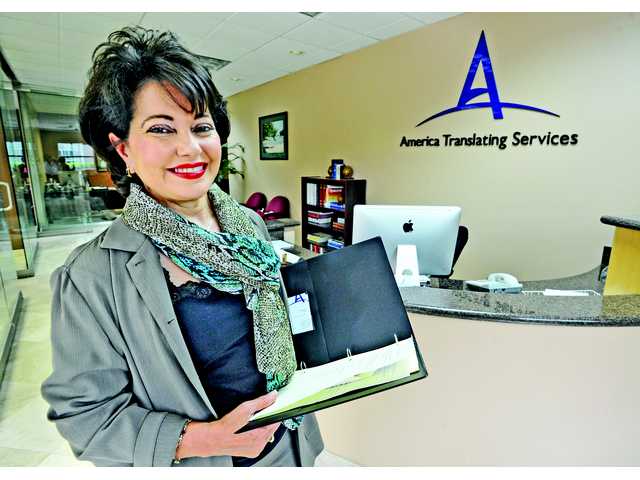
When a Japanese delegation came to a visit a Santa Clarita firm a few years back, an entire business proposition almost failed over something small when an American attempted to interpret the discussion for both parties. Scrambling to salvage the derailed negotiations, the firm called American Translating Services of Valencia to help.
Once the local translation and interpretation service intervened, it became apparent the well-intentioned American had violated a cultural norm and American Translating Services brought in a Japanese-born, educated interpreter to iron things out.
“They (the delegation) were insulted because the business cards they handed out were placed in the American employees’ pockets and folders,” Owner Rosa Steventon said. “Their custom was to keep the cards on the table facing the individual.”
Before saving the local firm in a crisis, and after repeatedly being asked to step in and translate for Spanish-speaking patients at a psychiatric clinic near Henry Mayo Newhall Hospital in 1984, local resident Rosa Steventon decided to launch her own translation and interpretation firm to assist all businesses. In 1988, Steventon, a Cuban immigrant in 1969, launched American Translating Services in Valencia by going door-to-door soliciting business from doctors and lawyers in Los Angeles and Ventura County areas.
“I took the opportunity. I had nothing to lose and I put a lot of work into it and spent an awful lot of time on it,” she said. “If you’re hungry enough you have to do it and in this country you can definitely do anything.”
Today the firm uses people who are certified by the American Translators Association, and each translation is accompanied by an attached, notarized certificate that shows it meets the standards of local, state, federal and non-governmental agencies - as well as foreign governments. The translators are certified by the California Courts for 15 major languages spoken around the world. And 144 languages are actually registered by the courts – meaning this firm needs well trained professionals to tackle any assignment.
Interpreting, however, is even more important. Often time in-person services are required for consecutive, or simultaneous, translations. That work can range from legal depositions or trials, to business meetings or working with a visiting delegation from outside the country, she said.
“It’s not just customs, you might also have to be politically or religiously correct. You can’t necessarily send someone from Iraq who speaks Arabic to another area. You have to localize interpreters so as to avoid conflict,” she said.
As Steventon was describing her firm’s services, she fell quiet. There was an emergency unfolding that needed her attention. Returning to the call she apologized for becoming distracted during the call, but then the firm gets a lot of last minute emergencies and responding to a client’s need is routine, she explained.
Taking on assignments from around the country, American Translating Services’ practice on Smyth Drive is largely comprised of legal work (40 percent), medical (35 percent), and technology-related in business settings (25 percent), she said.
Jumping in to translate technical manuals for businesses, or to help in a legal workplace dispute, Steventon said her firm averages 50 to 75 interpretation assignments daily.
Translation projects, on the other hand, vary.
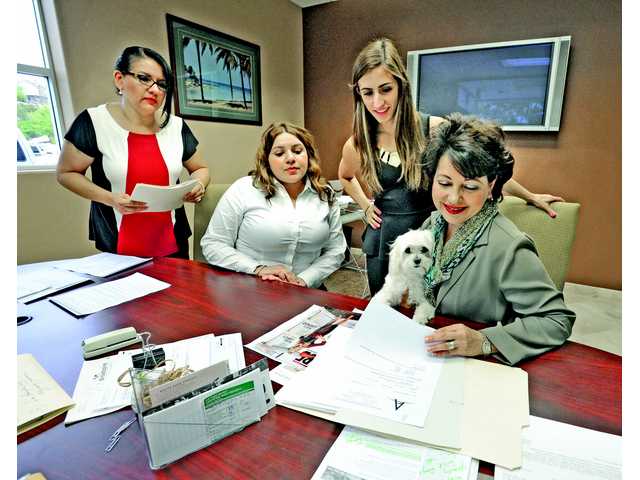
Sometimes the firm is translating a product specific manual, or service, into 11 different European languages. At other times, translations involve machinery that is being built and the firm locates a technically trained translator such as an engineer – or someone trained for that mission. The multitude of assignments keeps her staff of five busy every minute of each day.
“I just got back from meeting with the high-speed rail people in Visalia,” she said. “They’re certifying us to translate, or do interpretations, for all kinds of different projects involving the state, counties, meetings with workers and working with the people in the small town communities that the rail is going to go through.”
Also signs for the rail will probably be in multiple languages – the entire project is going to be very large in scope in terms of the translation and interpretation needs, she said. American Translating Services received authorization to move forward on the project; becoming certified by the state of California specifically to work on the project.
Averaging some 100 regular clients per year, the firm works with many municipalities and agencies including the city of Los Angeles, the district attorney’s office, and the Los Angeles County Metropolitan Transportation Authority. It’s also worked with the city of Santa Clarita on transit issues, Steventon said.
There’s a huge difference between a bilingual person and someone who is a professional translator, she points out, saying it’s a misconception that if you speak another language you can also translate or interpret. A lot of mistakes occur in those instances.
“It can be very embarrassing for a business using someone who doesn’t know how to translate properly, or interpret for live discussions” she said. “Using someone who isn’t properly trained could damage your business.”