It’s just minutes since the Calgrove fire erupted, but already dark stacks of smoke are piling into the air.
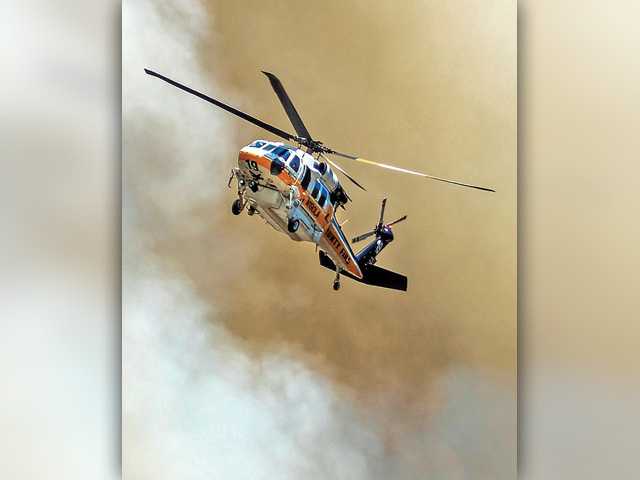
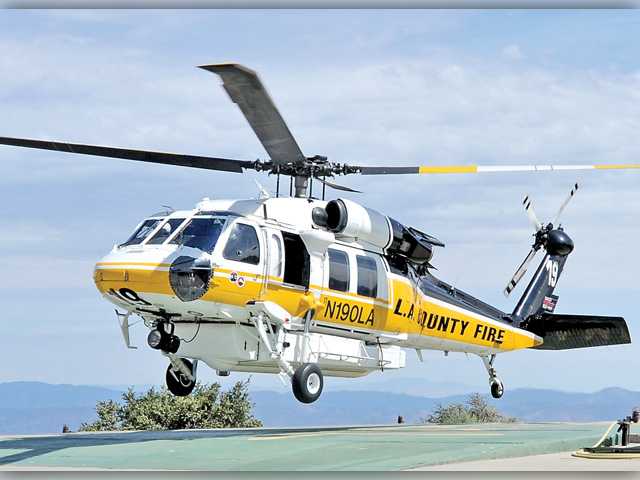
Propeller blades vibrate overhead and sunlight slips across the yellow-and-white fuselage as a Los Angeles County Fire Department helicopter slices into the smoke, diving blindly — yet with calculation — toward flames.
The aircraft sounds an onboard siren signaling an attack on the blaze below. A thousand gallons of water rain down, leaving steam where red flames were galloping across dry grass headed for homes.
The steam swirls in the wake of propellers as the helicopter takes off for a refill.
“Copter 16,” one of three Sikorsky S-70A helicopters stationed around the county that Wednesday, teamed with two other Los Angeles County Fire Department helicopters, one Los Angeles city fire helicopter and two CalFire fixed-wing aircraft to battle the fast-moving June 24 Calgrove fire, which blackened more than 400 acres within hours and forced about 1,000 Newhall residents to flee their homes.
Although some of those residences backed up against drought-parched hillsides, no structures were destroyed. One garage was damaged.
And many homeowners were left shaking their heads in amazement that their homes survived the rapidly moving flames.
Firefighting spotlight
The flashy yellow Super Scoopers — big fixed-wing amphibious aircraft that Los Angeles County leases from the Canadian province of Quebec to help fight fires in the late summer and fall — have stolen the spotlight in Southern California’s now-year-round fight against wildfire.
Following the Calgrove fire, several Santa Clarita Valley residents complained to The Signal that Super Scoopers aren’t available until Quebec releases them following its own fire season. This year they’re expected in Southern California Sept. 1.
But the year-round work horses in Los Angeles County’s battle with wildfire are the Sikorsky S-70As and the Bell 412s, the latter a member of Bell’s famous “Huey” family of helicopters.
Water-dropping helicopters from the Los Angeles Fire Department and fixed-wing aircraft from California Department of Forestry and Fire Protection, or “CalFire,” assist when needed, as they did in the Calgrove fire.
Copter 16, the Sikorsky that first responded to the Calgrove fire from its station at Camp 9 — perched atop Bear Divide between the Santa Clarita and San Fernando valleys — is a modified Black Hawk helicopter known as a Firehawk. Sikorsky Black Hawks are used militarily for troop transport, electronic warfare and medical evacuation.
The Air Operations crews are not in a combat situation, but the Firehawk “has the durability and strength and power to do the missions we ask it to do,” said county fire Air Operations Chief Joel Harrison. “We’re generally off the ground in five minutes” after a call.
“Although it’s not military combat, it’s combat of sorts because of the dynamic and demanding missions we are asked to provide,” Harrison said as he leaned against one of the county’s helicopters parked on the tarmac of Barton Heliport in Pacoima recently during an interview with The Signal.
“This thing is a game-changer,” Mike Sagely, senior pilot for Air Operations, said of the Sikorsky. “It’s like bringing a Howitzer to a knife fight.”
Besides firefighting, the Air Operations fleet — “Air Ops” for short — provides trauma transportation for critically sick or injured people, as well as air rescue for people or large animals trapped in rugged and inaccessible terrain.
During the fire season, one of the department’s three Sikorsky S-70s is stationed at Camp 9 with a fire crew and full tank ready for 24/7 deployment. The other two are stationed on the western and southern edges of Los Angeles County with the same mission.
The remaining helicopters are stationed at Barton Heliport.
Calgrove response
On June 24 at Camp 9, the Calgrove fire alarm sounded as a squeal that could startle the sturdiest of individuals.
“My job is to move to the aircraft as quickly as possible and get it running,” Sagely said.
He was in the helicopter as dispatch sent out the GPS coordinates pointing to Wildwood Canyon and the radio frequencies to be employed by first-responders.
After performing a preflight checklist, Sagely and his crew took off. The aircraft reached the fire within minutes.
“Our goal is to get there as soon as possible and keep (the fire) as small as possible,” Harrison said.
In successful cases, air operations can extinguish the fire in short order, freeing up other firefighting resources for other calls.
“If command doesn’t have a plan yet, we’ll start dropping water in support of the ground crew or where we see needs attention,” Sagely said.
The Calgrove fire quickly swelled to 30 acres as shifting winds sent flames racing across the canyon near homes, triggering a response from CalFire and Los Angeles Fire Department.
On the ground, 400 firefighters from Los Angeles, Riverside and Ventura counties launched an attack coordinated with the air assault as sheriff’s deputies evacuated residents from their homes.
“Our first priority of concern is human life, then property, then the containment and extinguishment of the fire,” said Firefighter Paramedic Mike Dubron.
Air ambulance
When it’s not battling a fire, Copter 16 is an air ambulance, often retrieving the most critical patients for transport to the nearest hospital.
“The helicopters have a medically configured interior to assist in trauma evaluations,” Harrison said.
Onboard systems dedicated to treating up to four patients line each side of the craft’s interior.
Both the Sikorsky and Huey can land in parks, schoolyards and other open areas to pick up patients and at the helipad at Henry Mayo Newhall Hospital to deliver the critically ill or injured.
Sometimes the mission calls for animal rescues, usually horses or other large animals, Harrison said.
Personal toll
A week after the Calgrove fire, Sagely’s Air Ops crew received a call for a medical mission in Malibu. The incident began when sharp-eyed dog-walker Lisa McClelland spotted skid marks on a road leading off a cliff.
“I went to the cliff side and looked over the edge, and that’s when I saw the white SUV,” McClelland said. “I hollered down and I heard a very weak response of ‘Help me.’”
Jenifer Duron of Simi Valley had driven her white Kia SUV off a roadway near Latigo Canyon and careened 50 feet down a cliff on June 29, a Monday. She spent two days stranded, calling for help.
Sagely’s crew airlifted the woman to safety. She was treated at Ronald Reagan UCLA Medical Center and was expected to make a full recovery.
It was a happy ending, a successful mission. But Sagely is a strict self-assessor, always seeking ways to improve a skill set.
“It all revolves around your ability to affect what you’re faced with,” he said. “If something goes wrong, you’re a part of the failure of the process.”
“When the outcome isn’t all that great,” he said, “you start thinking, ‘Is there something I could have done differently?’”
“It can be mentally frustrating. It’s not a perfect world, and there are going to be times when things don’t turn out favorably.”
Sagely’s goal is to safely return those in his team’s care to their families. And he embraces opportunities to see his own family after his 24-hour shifts.
Military background
A brief, unsuccessful stint on the 1984 Olympic volleyball team pushed Sagely to enlist in the U.S. Army. He scored in the top 5 percent on the entrance exam and was recommended for flight school.
After completing flight school, Sagely served 17 years in Army Special Operations, navigating helicopters and airplanes on a number of missions in Panama, Afghanistan and Iraq before taking a military retirement.
“I came to a point and transitioned into the fire world and into the best fire operation in the country,” Sagely said of the Los Angeles County Fire Department Air Operations unit.
Training with other pilots on a number of “helispots,” or locations within the county where the aircraft can safely land and take off, Sagely was quickly promoted to senior pilot.
“Our pilots come with a great amount of experience because they’re doing very technical missions,” Harrison said. “They have to work together to make those things happen.”
“Typically,” he said, “the only people that know of the critical mission that was accomplished are the people onboard the aircraft and the person that was saved.”
For his part, Sagely said, “I want to stick with it for as long as I’m doing well.”
“When I can’t, I’ll step away.”