Question #1
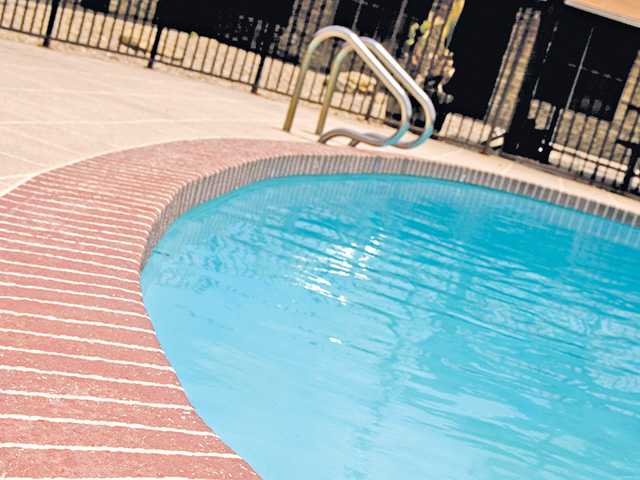
I own a 40-year-old home in Canyon Country. All of the bricks around the edge of the pool are breaking off, and some of them are even falling into the pool.
I’ve repaired some of them, only to have them come loose again. I’ve never heard of this before, and I need your help, please.
Jeff R.
Answer #1
Jeff, looking at your picture, the problem is very clear to me. There is no Dek-O-Seal between your coping (what you are calling “brick”) and your decking. How this got past an inspector, if they were even inspected back then, is unreal.
This is why your coping is falling off into your pool. What you’ll have to do is to cut one-half inch off each stone and reset them. Then the gap that is created between the deck (the part you walk on) and the coping will need to be filled with Dek-O-Seal.
First, backfill this area with either a backer rod or sand, the best of the two being the backer rod. This is a round, Styrofoam rod that can be purchased at any pool supply house.
It’s hard to tell by the photo exactly how big your pool is, but depending on the size, you’ll need one or two kits of Dek-O-Seal. Typically you’ll get about 70 linear feet of installed Dek-O-Seal per kit if it is installed one-half inch deep and one-half inch wide.
Mix the Dek-O-Seal, and with the supplied applicator bottle, inject the product onto the newly installed backer rod and then let it cure. Sometimes you’ll see that people will put a little bit of silica sand on top to give it a slight abrasive/dull look, as this product tends to have a bit of a sheen.
Once the product is dry, then you’ll just vacuum up the excess sand. That will cure your problem, Jeff. It’s clearly a lack of expansion room that is causing this problem.
When the concrete expands, there’s no room or “give” with there being no flexible joint between the deck and coping, so the bricks then get shifted loose and thus fall into your pool. I’ve seen this many times over the years, and the Dek-O-Seal is the answer.
Question #2
Robert, I have a single-family home in Canyon Country. The way my garage door is situated, people tend to back up against my property and from time to time, this door gets hit.
It was in fact, hit again recently. It broke out some stucco also, and the insurance company took care of this situation again. The man who came out to do the repair says that even though the garage door goes up a little crooked, it’s OK — it’s just the way the hardware is.
He did have it taken down and was hitting it with a big hammer trying to make it straight, but shouldn’t it be level on the top when the door is open?
Mary A.
Answer #2
Mary, absolutely this is supposed to be straight. I would demand, especially since this is an insurance claim, that this be repaired properly and new hardware installed.
Beating this back to proper working form is clearly not the proper way. The holes may be elongated and in time it will get worse — and the door could come down. There are some of these doors, depending on the size, that can weigh 400-500 pounds and could be a huge safety factor to both property and life if not secured properly.
I recommend that you call the insurance company back out and have a different installer called in for proper repairs, including new hardware. The most important bit of information here is to know that the hardware is not something that you take any risks on; get new and make it safe.
Question #3
I have a piece of property with a large slope and two of those concrete “ditches” (for lack of a better term) where the water comes down and then moves on to the neighbor’s area.
We used to be an HOA property but are no longer. We are now completely responsible for those concrete areas, and due to the possibility of El Nino this winter, we have had these areas cleared.
I’ve noticed that there are big chunks of concrete missing out of them, some areas two to three square feet. There are also cracks, some a quarter to a half-inch wide.
Are these things that I need to be concerned about?
Michael R.
Answer #3
Michael, yes, you need to be very concerned about that. You absolutely do not want any undermining to happen to these V ditches, because if this happens and we get enough rain, all of that water will end up literally in your home.
I have a relative that this happened to earlier this year, flooding a bedroom and creating quite the long-term headache.
Where there are two- to three-foot chunks missing, you’ll either have to repair them yourself or have someone knowledgeable repair them.
First, pin (drill into the side of the existing concrete, blow out all the dust, add epoxy and minimum one-half inch rebar). Then add your concrete, and don’t worry about the finish on this as it does not need to be aesthetically pleasing.
Where there are cracks, get half-inch backer rod (round Styrofoam) from any hardware store; this is to fill part of the void. First make sure that the surfaces are clean; this is a very important step in making this repair a success.
Set this backer rod down approximately three-quarters of an inch, and then get what they call two-stage epoxy. This is similar to caulking in that it goes into that same type of gun; however, it has two cartridges and for the lack of a better term, a “squiggle-type” nozzle that mixes the two-stage epoxy products (one is the hardener, one is the epoxy) as they are dispensed.
Inject this into the crack on top of the backer rod, and it will prevent the water from getting into the crack and undermining the concrete. Since it is about eight times stronger than concrete, it will help keep the concrete together, also.
Over the years I have seen countless homes destroyed by this very problem, as well as overgrowth of landscape foliage that blocks the path of the water.
When this happens, the four-inch area drains that are in your yard are simply not enough to handle the volume of water that these ditches are designed to direct elsewhere.
I encourage you to take care of this immediately and thoroughly in preparation for the rains that we are expecting this next winter.
The other thing to check at this time is the function of those area drains. Be sure these are clear of debris and tree roots because even if the water from the slope is flowing properly, the volume of water we are expecting will be too much for a yard with improper drainage.
Batten down the hatches; they say it’s going to be big and there will be a lot of damage this year.
Robert Lamoureux has 38 years of experience as a general contractor, with separate licenses in electrical and plumbing contracting. He owns IMS Construction Inc. in Valencia. His opinions are his own, not necessarily those of The Signal. Opinions expressed in this column are not meant to replace the recommendations of a qualified contractor after that contractor has made a thorough visual inspection. Email questions to Robert at [email protected].