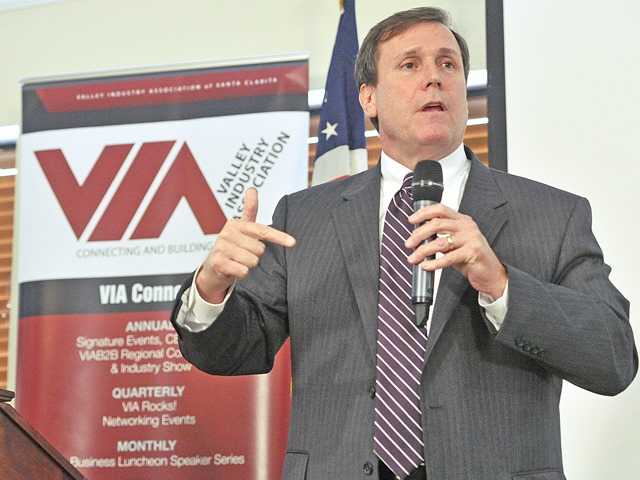
Speaking to members of the Valley Industry Association Tuesday, Assemblyman Scott Wilk, R-Santa Clarita, credited Gov. Jerry Brown for generally being fiscally conservative, but he criticized Brown’s pursuit of the high-speed rail in California.
When presenting his ideal budget, the governor always opts to use the lowest revenue projections, Wilk said.
But the bullet train – Brown’s legacy project – is out of line with priorities the state should be setting to drive economic growth.
“We need to set proper priorities in Sacramento,” Wilk said.
Brown’s killing of the state’s Enterprise Zone program was a grave mistake, Wilk said.
Companies relocated into areas with the program – such as Santa Clarita – with the understanding they would benefit longer term from the hiring tax credits as they grew. The state should have honored its commitment, he said.
Also, business assistance is uneven in the state. Some growth industries seem to get more attention, such as tech and biotech firms with intellectual property for instance. The good news, he said, is 45 cents of every dollar’s worth of venture capital invested come into California.
But, if you build, extract or manufacture, there are fewer benefits to incent growth, he said.
Brown’s talk about California making a comeback is a falsehood, Wilk said. For a state that is the eighth largest economy in the world, it should not be facing the unemployment levels it does.
Wilk did note progress when last year the state legislature passed the film tax incentive to bring film activity back to the state. He anticipates the state will begin to recover jobs and film projects as a result of the program, noting North Carolina has since killed its program.
“Last year, there were 23 network dramas,” Wilk said. “Only two of those were filmed in the state.”
On the flip side, he lamented lawmakers failure to tackle tort reform, workers comp issues and the overly burdensome CEQA – California Environmental Quality Act.
Moving forward, legislators need to do something about tax reform and the budget process, he said.
The state’s general fund is overly dependent on personal income tax from the state’s wealthiest residents, and not enough is being done to plan for the next economic downturn, according to Wilk.
He said the process of approving it so flawed it needs a complete overhaul.
Many of the lawmakers’ votes were made with inadequate knowledge, preparation or rest – in many cases, legislators were forced to vote off matrices, he said.
“I voted on 1,069 bills in one week,” Wilk said. “There needs to be greater transparency.”
As for the high-speed rail, Wilk praised Santa Clarita’s activism when it comes to fighting the disruption the proposed bullet train would create in local communities.
And he firmly believes it is not in compliance with the initiative passed by voters and will be struck down in the courts.
“We’re going to kill it, and I hope Santa Clarita steps up and joins some of the lawsuits being filed,” Wilk said.
This story originally published in The Signal July 22, 2015.