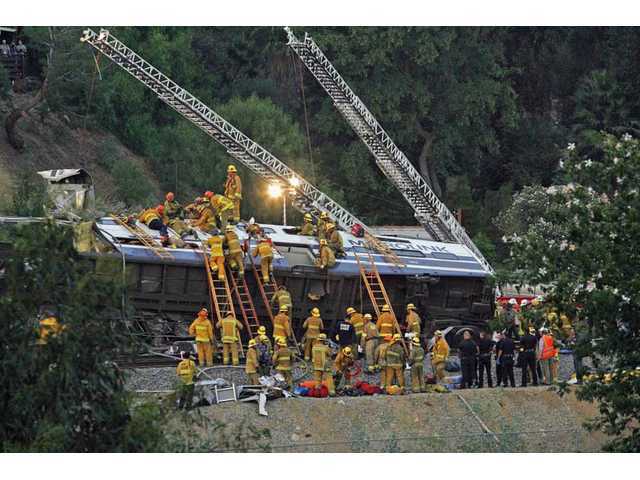
Metrolink’s “smart collision avoidance system,” aimed at preventing collisions like the 2008 head-on in Chatsworth that killed 25 people, is now a “go” across the commuter rail service’s entire 341-mile network.
The life-saving technology is capable of monitoring and, if necessary, controlling a train’s movement in the event of human error, Metrolink officials say.
The system links all locomotives traveling on Metrolink’s rail network, allowing all trains to communicate with GPS, wayside signals and central offices over a digital network.
“When you talk about the ability for trains to automatically stop beyond the controls of the engineer, it’s one of the most significant technological advances that we’ve ever seen,” said Metrolink spokesman Scott Johnson.
Following the multiple-fatal collision in 2008, the National Transportation Safety Board faulted the engineer of the Metrolink locomotive, determining he failed to obey a red signal light while texting. The train crashed head-on with a Union Pacific freight train.
Very shortly after the incident, Congress passed the “Rail Safety Improvement Act” mandating positive train control be implemented by all major railroads across the country.
The Rail Safety Improvement Act of 2008 requires positive train control to be installed on all major U,S, railroad networks by the end of this year.
Metrolink’s rail network is the first to adopt positive train control across its entire network. For PTC to be complete in the region, other train partners who use the tracks will have to complete their systems as well, officials said.
“What PTC will be is not what it is now,” Johnson said. “Eventually it will be able to read and identify all different types of trains — both commuter and passenger — along with freight, no matter whose territory it’s actually on.”