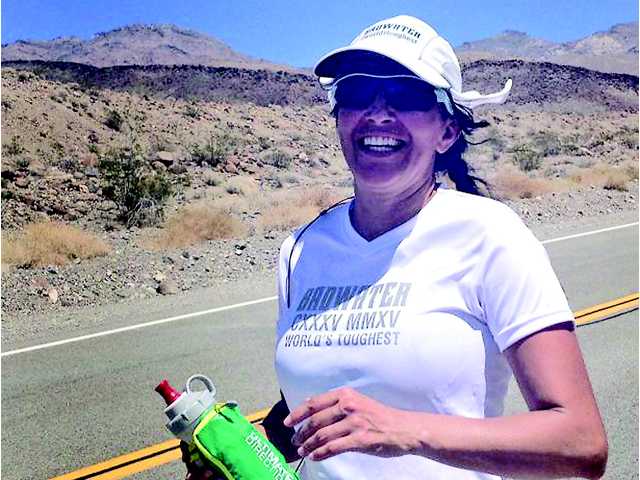
Ultra marathon runner Norma Bastidas trained hard in the Santa Clarita Valley — running up and down Towsley Canyon, doing “planks” in the sauna — all in preparation for running the world’s toughest foot race, which is in Death Valley.
But, as many who run the 135-mile Badwater Ultra will tell you, nothing really prepares a runner for Death Valley.
Bastidas, 47, was born in Mexico, lived in Canada and is now planning to move to Santa Clarita to join her newlywed husband here.
She set off from the starting line at 9:30 p.m. July 28 at Badwater in Death Valley — lowest point in the Western Hemisphere at 245 feet below sea level — where she and the rest of the runners gathered to compete in a race from the floor of Death Valley to halfway up Mount Whitney.
At the starting line, she said: “I’m going to try to do most of the running at night, get it over with.”
“I know I’m going to slow down,” she said. “The first night is not as bad. The second night, I know I’m going to naturally slow down because the heat is going to come.
“Other races, it’s better to be conservative at the beginning, but this is the opposite,” she said. “It’s not going to be cooler until maybe tomorrow night ‘til maybe at Mile 80.
“So I’m going to do the opposite — try to go faster and then after that show down — maybe shower,” she said with a laugh.
“The second night is so hard to stay awake,” she said. “So I’m going to — not sprint — but just kind of run as much as I can the first couple of miles.”
As triple-digit temperatures dipped only slightly with the sunset on the first day, she and the other “second wave” runners made their way to Furnace Creek, 17.4 miles from the starting point. Bastidas logged in at the race’s first time station 47 minutes after midnight the first night.
She then ran through the same first night, as she planned, arriving at the desolate desert town of Stovepipe Wells on July 29, having run 42 miles in nine hours and 25 minutes.
As she ran uphill from Stovepipe Wells, she said her fears about fatigue proved true.
“It was hard to stay awake at 4 a.m.,” she said. “I tried to negotiate with myself. I was thinking I’ll have made the first cutoff and if I can make good time then I can take a nap.”
Bastidas, an admitted fighter, did not nap, however.
She soldiered on to the next desert town, Panamint Springs, arriving there shortly after 7 p.m. on the second day. Then it was up a second mountain range.
Luckily, she had trained on the hills that the Santa Clarita Valley had to offer.
“I was training in Santa Clarita at Towsley Pass,” she said. “That worked.”
And, when she wasn’t running in Towsley, Bastidas was in the sauna — not relaxing but training.
“I went to the sauna for a week and a half and I tried to stay in there for as long as I could .... I was doing planks in the sauna and everyone thought I was a crazy lady.”
Planks are an exercise done in the push-up position with the body’s weight borne on forearms, elbows and toes.
When she conquered her second mountain climb in the race — at 3 a.m. on July 30 — Bastidas had run 90 miles in about 30 hours, still 45 miles from the finish line.
By the time she made Lone Pine it was 3 p.m. on Day 3, and when she crossed the last time station at the Portal Road on Mount Whitney — just four miles from the finish line — she had logged 43 hours and 56 minutes.
Runners have 48 hours to complete the race.
Bastidas had four hours to run four miles, all uphill, after having run the equivalent of five marathons back-to-back, 131 miles across Death Valley.
And she did it — with about two hours to spare.
At 7:14 p.m. the third and final day of the race, Norma Bastidas crossed the finish line with a time of 45 hours, 44 minutes and 15 seconds.
661-287-5527
on Twitter @jamesarthurholt