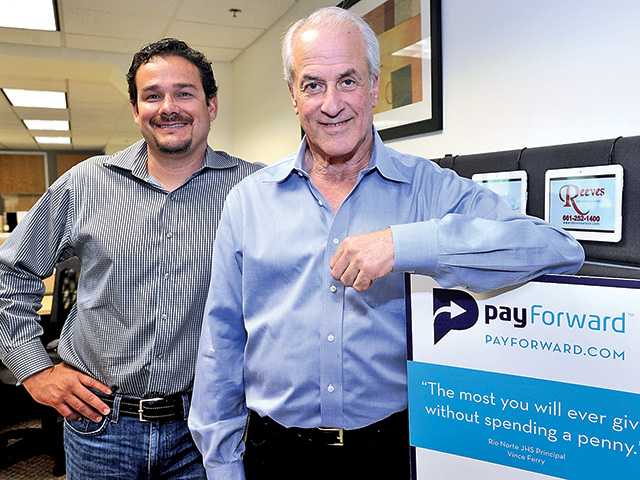
Sell a company for $65 million and that buys you a lot of quality leisure activities or, as these owners of the new social financial network firm PayForward did, you decide you’ve still got plenty of ideas and entrepreneurial fuel to keep going and so you launch a new venture.
When co-founder Steve Marks and team sold ACT Litigation Services, a digital document management firm based in Valencia, in 2011 to The Dolan Company they initially retired. But, the lack of activity didn’t suit the two principals of PayForward for very long.
“Quite honestly, my wife kicked me out of the house,” said Armando Rand, president of PayForward. “I reached out to Steve and said ‘we’ve got another run in us. Let’s come up with a concept and idea that would be a world changer.’”
The men focused on how to increase personal discretionary funds for everyday people, funding everything from college accounts to making donations to nonprofits, and not cost their merchants any more money to acquire and retain customers than what had already been budgeted for marketing – and do it all instantaneously, with each purchase a consumer was already planning to make.
First beta testing the Santa Clarita market, home to both Marks and Rand, their marketing team has signed up close to 100 local and national merchants, from retailers to restaurants including long time local businesses like Salt Creek Grille, J David's Custom Clothiers, Consumers Furniture and Peet’s Coffee & Tea, to national brands like Banana Republic, Bed Bath & Beyond, the Gap, Victoria’s Secret, TGI Fridays, Zales and Foot Locker.
In their local market testing before launching nationally, they found their merchants were reaping more of a benefit that they had projected with return on investments in the program bringing in 100 to 300 percent, said Steve Marks, CEO of Pay Forward.
“The frequency (of returning customers) is higher than we anticipated,” Marks said. “We found that (PayForward) member-consumers were visiting the PayForward merchants more frequently than even they anticipated.”
The platform is so simple the process is almost transparent for the consumer or merchant. The consumer signs up with PayForward at no cost and either receives a no-fee PayForward debit card or is at liberty to use their favorite VISA card to continue racking up rewards or mileage points. The merchant signs up and for each participating PayForward customer, PayForward’s system automatically credits the consumer up to 15 percent cash back of the checkout total, money the merchant had originally intended to use on marketing.
What makes PayForward’s system unique is three-fold. One, the merchant doesn’t need to do anything with their own Point of Sale system, they don’t even need to train employees or necessarily inform the employees the process operates so seamlessly outside of the business. The system is run on PayForward’s end. The cash back on the purchase is money the merchant had already earmarked for marketing. The only fee to the merchants are levied by the credit and debit card issuers, a cost PayForward had no control over eliminating.
Two, consumers decide where they want the cash back to go – in their wallet, to fund their child’s college plan, or donate to a local charity, school, church or local sports team. The allocations are divided up and sent out within an instant of the transaction. Best of all, the consumer is getting money back without having to do anything, at places they already intended to dine or shop at. All without saying a word to the merchant.
Three, there’s the social media aspect of this program. Let’s say the consumer has decided they want a portion of every cash back amount to automatically be donated to one of the 37 local non-profits in Santa Clarita. Again, at checkout time, whatever percentage the consumer dedicated is automatically sent to charity or group of their choice and a message goes out to everyone at that group that the merchant has just deposited X-dollars in their account reaping goodwill for the merchant and a feel good-moment for the customer.
In a reversal of the cost-per-impression model, this is a cost-per-customer acquisition on a sale already made, Marks said. That’s why the ROI is coming in higher than expected.
“There’s the value of helping the average family increase their discretionary spending by 10 percent, it gives merchants effective advertising from marketing dollars already earmarked and the merchant doesn’t have to do anything to participate. There are no contracts or pre-payments of any kind,” he said.
Getting the transactions to take place in real time, instantaneously, took some work. That piece of building the business took some time to get all three pieces of a transaction to come together to work simultaneously, Rand said.
PayForward had to land a financial processing company, a bank, and a rail system – or processor - to make the electronic fund transfers. In other words, it set out to change the traditional process of payments through multiple parties, in what often takes a circuitous route, to a direct, ‘straight-line’ process.
“The financial tech industry is very interesting,” Rand said. “It took us a year to land a bank, nine months to land a financial processor, and three months to land a rail environment. After that it was pure magic.”
“All three (parties) were intrigued by the process and idea that we could build this environment to deliver on solving three big problems. We spent months in conversations with them. In the end they agreed to join and participate," he said.
From concept to launch, Marks and Rand spent two years putting all the pieces of their business together. But the process they created for simultaneous transactions to occur in an instance, is now covered by 74 patent claims.
As for funding the expense of starting the company up, the sale of the former company didn’t hurt. And the firm does have investors. In fact, Mark described PayForward’s “financial security as quite profound.”
And although the company is operating in a start-up environment, it has more employees than many established businesses.
“We’re in 16,000 square feet on Tourney Road and have 40 employees on staff so it’s hard to classify us as a startup,” Rand said. “We operate in a very, very established environment with a full marketing/sales team, technology development and management team.”
And once word got out about how they re-tooled the transaction process, they’ve begun to get calls from different industry sectors who are interested in the technology they created, Rand said.
“We’ve had the fortune of meeting executive board members from 50 of the top corporations who have consumer groups numbering in the tens of millions,” Rand said.
The firm is speaking with eight companies today. Marks believes PayForward can provide those companies with a tremendous operating advantage, increasing the purchasing power of their services and products, attracting new customers, retaining customers while reducing their costs. And contracting with any one of them may require taking millions of new consumers onboard over a period of 24 months, he said.
The next problem for the two men, however, will be the same one that faced them when their first company sold. But this time they have their own company to solve the problem.
“After we sold the (first) company everything around us magnified,” Rand said. “People were reaching out from everywhere asking us to help fund their group or project. The state was broke, schools lacked funding, every one needed help. It was draining emotionally and at some point you have to shut the lid. It didn’t feel good.”
Thus inspired PayForward’s journey to help increase the personal pocketbooks of everyday consumers, use the money to help fund favored projects, and increase business for merchants.
“We looked for a way to dramatically increase personal discretionary income in a meaningful way and found it,” Rand said.