The current El Nino is already the second strongest on record for this time of year and could be one of the most potent weather changers of the past 65 years, federal meteorologists say.
It’s so strong a National Oceanic and Atmospheric Administration blog unofficially named it the “Bruce Lee” of El Ninos — for the late movie action hero.
NASA oceanographer Bill Patzert compared it to Godzilla and said satellite measurements show this El Nino to be currently more powerful than that in 1997-98, which often is thought of as the king.
Though a strong El Nino brings the possibility of much-needed rain for drought-stricken California, officials warn it also carries the risk of the same kind of damaging weather seen in 1997-1998.
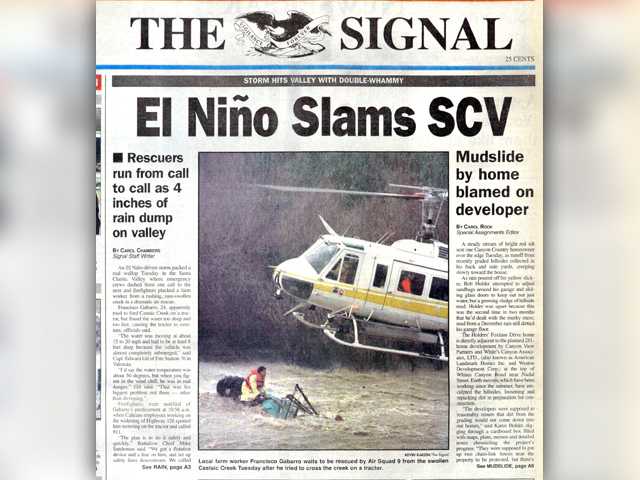
That El Nino brought torrential downpours and flooding that damaged streets and houses in the Santa Clarita Valley.
The weather was so destructive that claims filed with the Federal Emergency Management Agency, or FEMA, totaled $20 million for a single day — Feb. 23, 1998 — in Los Angeles and Ventura counties.
Every few years, the winds shift and the water in the Pacific Ocean gets warmer than usual. The resulting phenomenon, dubbed El Nino, changes weather worldwide, mostly affecting the United States in winter.
California state climatologist Michael Anderson, however, noted that only half the time when there have been big El Ninos has there been meaningfully heavy rains.
Even if an El Nino were to bring more rain than normal, it’s unlikely California would get as much rainfall as it needs to emerge from its four-year drought, officials say.
“A big El Nino guarantees nothing,” said Mike Halpert, deputy director of the National Oceanic and Atmospheric Administration’s Climate Prediction Center. “At this point there’s no cause for rejoicing that El Nino is here to save the day.”
Still, this El Nino is shaping up to be a potential record-setter because of incredible warmth in the key part of the Pacific in the last three months, Halpert said. He said the current El Nino likely will rival ones in 1997-1998, 1982-83 and 1972-73.
Despite the possible weather-related damage, economic studies show that El Ninos tend to benefit the United States. Droughts and Atlantic hurricanes are reduced. California mudslides notwithstanding, the U.S. economy benefited by nearly $22 billion from the 1997-98 El Nino, according to a study.
But El Nino does tend to cause problems elsewhere in the world. And while the ocean temperature phenomenon often puts a big damper on the Atlantic hurricane season, it means more storms in the Pacific, such as in Hawaii, Halpert said.
So far this year, tropical cyclone activity in the Pacific is far higher than normal.