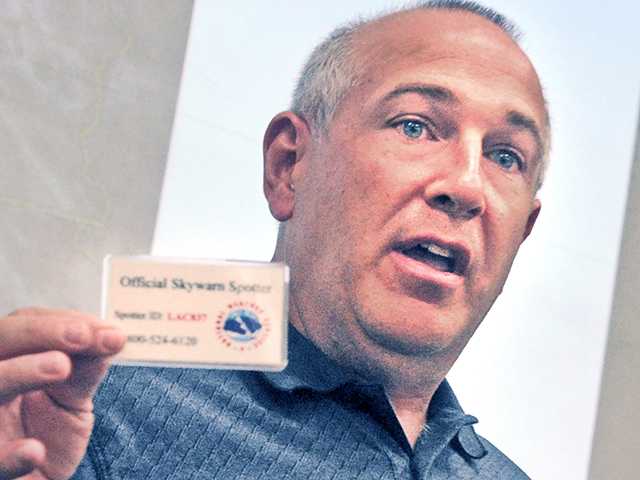
Whether its gray skies or sunny, hot weather, “storm spotters” are on the lookout.
Made up entirely of volunteers, the National Weather Service’s SKYWARN program asks trained participants to identify and report dangerous weather conditions to help keep the federal weather agency up to date with accurate information.
Basically, spotters are the “eyes and ears on the ground,” said meteorologist Joe Sirard of the National Weather Service Los Angeles/Oxnard office.
“The ultimate goal is to save lives and properties, and our storm spotters help with that,” Sirard said.
Sirard was in the Santa Clarita Valley last week looking for a few more spotter volunteers. About 15 people turned out for his 90-minute training session at the Santa Clarita Activities Center.
Those at the session were trained on spotting specific weather patterns and identifying specific events such as tornadoes, funnel clouds, waterspouts, high winds, heavy rain, flooding, hail and heavy snow.
The storm-spotter program originated in the Midwest during the 1970s, specifically in “Tornado Alley” — the swath of land between the Rocky and Appalachian mountains where tornadoes are most likely to hit, Sirard said.
The meteorologist covered most of the weather phenomena that could occur in the Santa Clarita Valley and Los Angeles County during his presentation.
Those who attended were taught the difference between waterspouts and tornadoes, when to report rainfall for measurements and what to do when rain hits a recently burned area.
Storm spotters who complete the training can call the National Weather Service with weather updates whenever there is a need. Sometimes they can come in handy.
For instance, the service’s Los Angeles/Oxnard office doesn’t have an automatic reporting system that detects snowfall, so most of that information comes from spotters, Sirard said.
At times, the federal agency may call spotters in particular areas with ominous or severe weather conditions.
Canyon Country resident Kerry Feldman, one of the potential spotters at the training, is anticipating a big El Nino year, and becoming a storm spotter could help keep people informed about dangerous conditions.
“I’ve always been interested in the weather, and I thought this was the right opportunity to get involved,” Feldman said.
Donna Nuzzi, emergency services supervisor for the city of Santa Clarita, commended everyone who attended the training.
“It’s pretty neat that there are people who are interested enough to join the program and provide good information that is valuable for people,” Nuzzi said.
The federal weather agency typically offers free live training sessions several times a year around the four counties the agency covers, Sirard said.
In all, there are about 1,200 spotters in the Los Angeles, Ventura, Santa Barbara and San Luis Obispo counties.
Sirard didn’t know how many of them reside in the Santa Clarita Valley, but Nuzzi said there were about 90 spotters in the valley a couple of years ago.
Those who are interested in becoming spotters can attend a future training or sign up for online training, Sirard said. If interested, visit www.wrh.noaa.gov/lox/spotter .