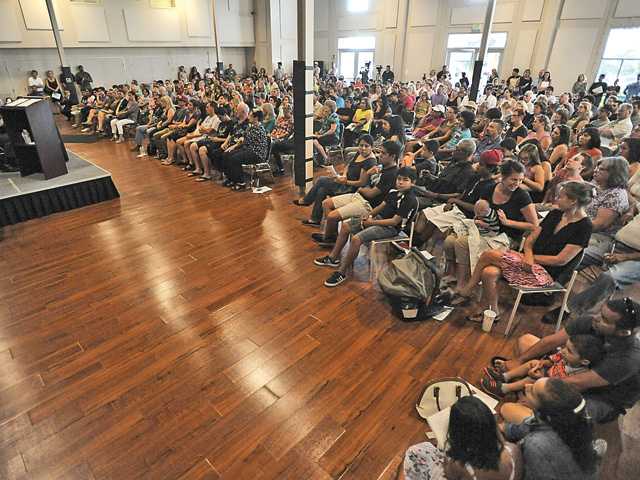
Hundreds of people packed into the Santa Clarita Activities Center Wednesday night for a frank discussion on marijuana and how it can affect the developing brains of teenagers.
The city-sponsored symposium, called “The Immature Teen Brain on Pot,” featured a panel of speakers — including representatives from Henry Mayo Newhall Hospital, the Santa Clarita Valley Sheriff’s Station and the William S. Hart Union High School District — who shared their expertise and advice with a crowd of about 300.
Though marijuana is often viewed as less harmful than other drugs, panelists said it can still be dangerous, particularly to teenagers whose brains have not yet fully developed.
The use of marijuana can “structurally change” the teenage brain, said Dr. Darrin Privett of Henry Mayo.
“There’s a lot of propaganda on the Internet trying to support that marijuana really is not that dangerous because there are a lot of adult users who are highly functional, highly successful,” he said Wednesday. “That’s why we’re here tonight, because we can make a difference among those with developing brains, among teenagers.”
There’s also the concern that marijuana use will eventually lead to further drug use down the line, said Cary Quashen, the founder of Action Family Counseling.
“All drug use starts innocently,” Quashen said Wednesday. “Nobody decides they want to grow up and be a drug addict.”
Wednesday’s event was the fifth in the city’s “Heroin Kills” series — a public-awareness program launched to educate community members about how to recognize drug use, work to prevent it and intervene to stop it.
“The city is committed to educating teens and parents of teens on the perils of drug use, including marijuana,” said Santa Clarita Mayor Marsha McLean, in a statement this week. “Through our various teen-focused programs, like the Heroin Kills series, we hope to bring more attention to the dangerous realities of drug use.”
Over the past few years, agencies such as the Sheriff’s Station and the Hart district have worked to develop new programs and tactics aimed at reaching out to children and teenagers and educating them about drugs or intervening when necessary.
One program that’s been particularly effective, officials say, is Drug Free Youth in Town, or DFYiT.
“I think it’s really started to change the culture on a junior high or high school campus away from, ‘The cool kids are the ones who are smoking cigarettes or smoking weed,’ to, ‘No, the cool kids are the ones who have a plan for their lives, and know where they’re going and behave in a positive manner,” said Hart district Superintendent Vicki Engbrecht.
“We’re starting to make a difference here,” she added.
661-287-5525
On Twitter @LukeMMoney