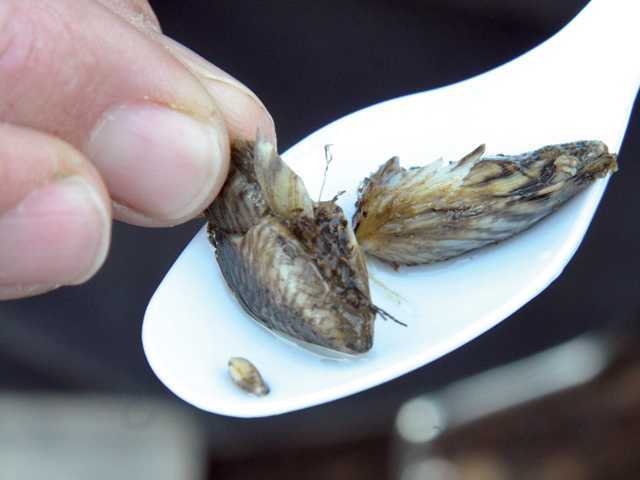
Santa Clarita Valley residents are not the only ones surviving the drought locally - so are the invasive zebra and quagga mussels at Lake Piru, a spokesman for the lake park said.
As water levels continue to drop at Lake Piru, quagga and zebra mussels attached to docks and walls are dying with exposure to the sun but not enough to eradicate the pest, Lake Piru Recreation Area Senior Park Services Officer Clayton Strahan told The Signal recently.
“As the water level goes down, the adult mussels that have attached themselves to fixtures are exposed,” he said. “It’s not like they’re human and can just walk away.”
The exposed oxygen-deprived environment to which the mussels cling, however, is not going to get rid of them.
“Once they’re established there isn’t anything that can be done to get rid of them,” Strahan said, including the drought.
As a precaution, officials with several state agencies fearing a spread of the mussels, rallied before the Labor Day weekend to inform boaters heading out to local waterways about the risks of inadvertently transporting the mussels.
Officials with the California State Parks Division of Boating and Waterways, California Department of Fish and Wildlife, the Department of Water Resources California Department of Food and Agriculture issued a joint news release urging boaters to help stop the spread of quagga and zebra mussels.
Their message was simple: “Remind boaters to remain vigilant over the three-day Labor Day weekend.”
People who launch vessels at any body of water were subject to watercraft inspections, they mentioned in their news release, and were encouraged to clean, drain and dry their motorized and non-motorized boats.
The message also applied to owners of personal watercraft, and any equipment likely to come into contact with the water before and after recreating at a waterway, the release said.
Quagga and zebra mussels are non-native freshwater mussels native to Eurasia that multiply quickly and encrust watercraft and infrastructure, and compete for food with native and sport fish species.
Officials from the various agencies reminded boaters the mussels can be spread from one body of water to another attached to nearly anything that has been in an infested water body, or through “standing water from an infested water body entrapped in boat engines, bilges, live-wells and buckets.”
The fresh-water mussels that can cause millions of dollars in waterway and pipeline damage invaded Lake Piru in December 2013, putting park officials at nearby Castaic Lake on heightened alert.
The prospect of hundreds of boaters taking advantage of the late summer long weekend heightened their concerns even more.
The Lake Piru discovery in 2013 marked the first time the destructive mollusks, called quagga or zebra mussels, had been found in a Southern California water body that does not receive water from the Colorado River.
The mussels were found attached to a patrol boat, and several additional mussels were subsequently found on devices deployed in the lake for the purpose of detecting mussels, as well as on the shoreline.
The zebra mussel destroys aquatic ecosystems once it gains a foothold in a body of water, causing millions of dollars in damage to reservoirs, dams, pipelines, power plants and boats.
Its tougher cousin, the quagga mussel, is even worse, according to one Castaic Lake official. “They’re like zebra mussels on steroids,” lake Aquatics Manager Joe Walsh told The signal in July 2013 during routine boat inspections at Cataic Lake.
Lake Piru is managed by United Water Conservation District and is not connected to the waterway that carries Northern California water to Southern California, and that includes Pyramid and Castaic lakes.
Quagga mussels were first detected in the Colorado River system in January 2007 and were later found in San Diego and Riverside counties.
They are now known to be in 29 waters in California, all in Southern California. Zebra mussels were discovered in San Justo Reservoir in San Benito County in January 2008.
Both species can attach to and damage virtually any submerged surface. They can:
- Ruin a boat engine by blocking the cooling system and causing it to overheat.
- Jam a boat’s steering equipment, putting occupants and others at risk.
- Require frequent scraping and repainting of boat hulls.
- Colonize all underwater substrates such as boat ramps, docks, lines and other underwater surfaces, causing them to require constant cleaning.
- Cost the owners of these items a lot of money.
661-287-5527
on Twitter @jamesarthurholt