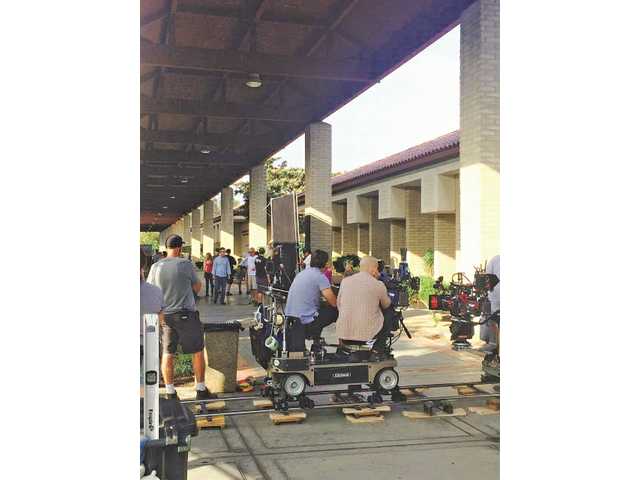
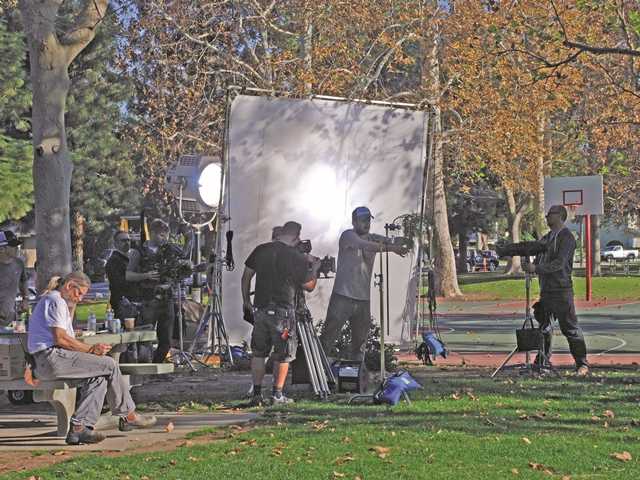
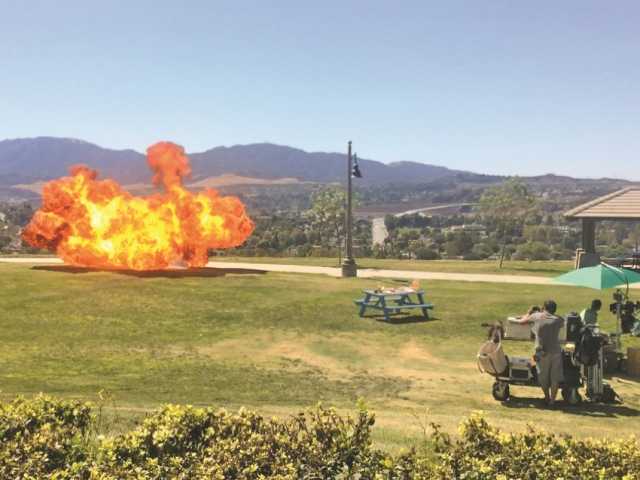
While Santa Clarita’s Film Office first grew from a business organization’s grass roots effort, the city soon formalized the endeavor in 2001. However, it did not set up a bureaucracy designed to generate a revenue stream for the city, but rather set up the bait to ensure residents and businesses in the community profited from the burgeoning film activity.
And in only 14 years, that foresight led Santa Clarita to now represent nearly a quarter of all filming activity in Los Angeles County, according to an official who oversees the office – giving the city the monikers like ‘Hollywood’s Backlot’ or ‘Hollywood North.’ And nearly a fourth of the productions that have qualified for state’s incentive film program in Santa Clarita.
We asked the city’s Economic Development Manager, Jason Crawford, who also oversees the city’s Film Office, to describe how the city set up its film office. Crawford, by the way, isn’t your ordinary city official. Crawford came on board shortly after earning his Bachelors of Fine Arts degree from Disney’s CalArts in Santa Clarita.
SCVBJ: What was the vision for the Film Office?
Jason Crawford: The film office started with a group of volunteers within the SCV Chamber of Commerce. In 2001 the city council decided to formalize the process by setting up a Film Office. The work then transitioned from a small volunteer group to a fully staffed, functioning city office. The city really wanted to prioritize increasing the amount of filming in Santa Clarita and increasing the number of stages.
That’s when I was hired. One of the first things we did was to look at how film permits were issued by the county (Los Angeles). We kept hearing from production companies and movie ranches that it was difficult and that they would prefer to be able to do that stuff locally, rather than drive down to Los Angeles to hand-deliver a check or fill out paperwork. They said they’d love for it to be done locally.
We wanted to make the process as customer service oriented as possible; and we wanted to lower permit fees to give even more of an incentive for film production companies to film locally. We wanted to work with the local studios to really target TV production. At that point movies were exciting but they may film for one week or at the most a couple months whereas a TV show can film for years.
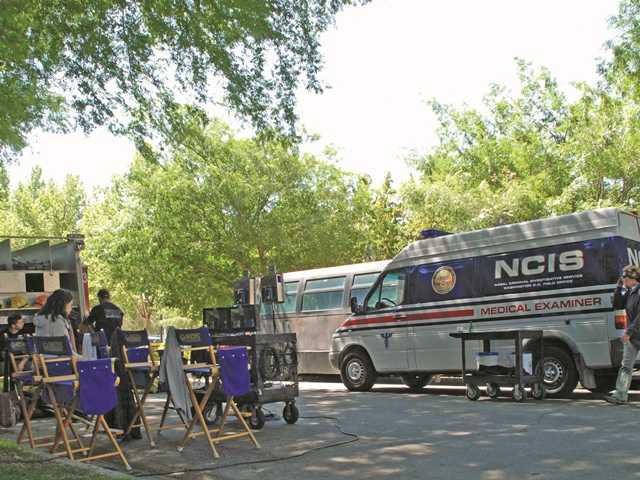
“JAG” filmed for 10 years in Santa Clarita, then spun off into “NCIS” which has filmed for another 10 years. We worked with the studios as a base for long term filming. At the time “CSI” was here in Santa Clarita and also worked at the Mann Biomedical Park. They had a warehouse for the TV shows and the first season of “CSI-Las Vegas” filmed at the (biomedical) park.
SCVBJ: When did the city officially start issuing permits?
Crawford: The Film Office launched in 2001 and it was probably about a year later that we started issuing the first film permits.
SCVBJ: How did you approach processing film permits?
Crawford: We started with lower fees and gave people the opportunity to file paperwork locally. Our fees were less than half the cost of Los Angeles County. At the time the Entertainment Industry Development Corporation processed permits, but the name was later changed to Film LA which issues permits for the city of Los Angeles and unincorporated areas of Los Angeles County.
SCVBJ: And so how do you approach setting fees and incentives?
Crawford: We look at what Film LA is doing and what other cities are doing and then strategically subsidize our fees so they’ll be lower. It’s much more strategic than just trying to get film permit fees to flow into the city; instead we want to ensure the whole community benefits through the process.
Our interest is in not in making money from film permits. Our interest is in increasing the amount of filming that generates jobs and paychecks for our residents, and revenue for local businesses. That all adds to economic impact.
SCVBJ: Okay, so what do the lower permit fees and incentives translate to in terms of benefit to residents and businesses?
Crawford: The city estimated an economic impact of nearly $34 million in the past fiscal year from when the film crews are in town. That’s money spent at local businesses, hotels, restaurants, gas stations, hardware stores, and money into film industry workers’ pockets. We estimate some 6,000 residents out here work in the film industry.
SCVBJ: What is the city’s film incentive budget?
Crawford: The city recently raised the budget to $75,000 annually to incentivize production because in the past couple years we’ve had more productions that qualify for it than we had funds that could pay out. So hopefully we could continue to see increases year after year. And now we have the Movie Ranch Overlay Zone, with six ranches in it. They have an even more expedited and lower cost than the standard permit of about $100 vs. $400.
SCVBJ: And what are some of the incentives film productions can benefit from?
Crawford: Production companies can get rebates on all location filming permits when based here. And when based here they’re much more likely to hire local residents and build relationships with local businesses as their vendors.
Also, for any production that is participating in the state’s (incentive) program can also participate in our’s. It’s a partnership between us and the state of California. Almost a fourth of productions that have qualified for thestate’s program have filmed in Santa Clarita. For us to be getting about 25 percent of that is a huge number.
And if someone films with us four times a year they can get their fees rebated. For example, a TV commercial company based in L.A. might film with us once for a specific location and we want to make them repeat customers so we use the program to get them to come back again and again. Once they’ve done maybe three productions with us, we call them and let them know that if they film with us one more time all of their fees will be rebated. It gets them thinking about Santa Clarita and generates more repeat customers.
As for law or safety enforcement with location filming, we also pass on a savings to productions. If they hire Sheriff or Fire department personnel, they can do both of those through our office and we’ll take the payment and schedule the officers for them. In other cities you have to go to all those places separately and do it yourself. We also have cost savings they can pass along.