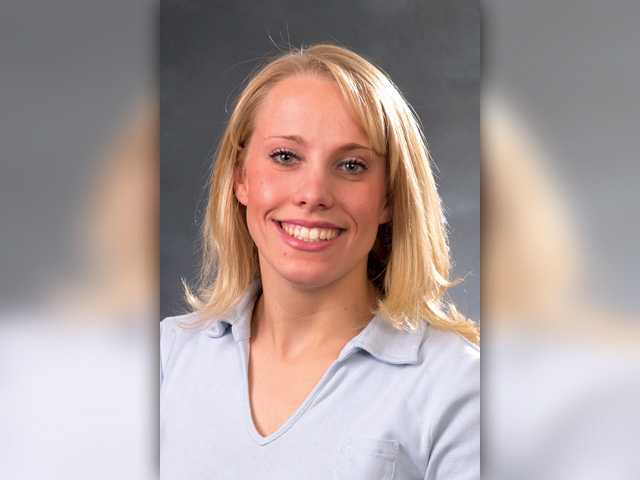
On March 10th, 1983, Cam Walker drove his wife, Patsy, to the Medical Center of Tarzana in California to deliver their third child, Aimee, but the doctor whisked the baby away. The umbilical cord had been wrapped around her neck 3 times, leaving her blue from anoxia. With time, the Walkers learned that their baby was born deaf and blind in her right eye. No other single event changed their lives more than this news.
As the young parents coped to help their child learn and progress, they eventually enrolled her in a beginning gymnastics class at the age of 7, in which she had to pretend to be hearing because deaf children were not allowed to participate. Coaches quickly took note of Aimee’s natural talent in the sport, which launched her gymnastics career. Despite challenge after challenge and setback after setback, Aimee competed on the UCLA National Championship team in 2004 and achieved international success. She is an inspiration to everyone because her life shows how people can overcome all odds to realize their dreams. Aimee has given inspirational talks to hundreds of audiences in various venues. Although dozens of articles have been written about Aimee in newspapers and magazines, her complete story is being told for the first time in her biography: “No Excuses: The Story of Elite Gymnast Aimee Walker-Pond” by Adam U. Kempler, which was released on August 10th, 2015.
Adam Kempler, a resident of Santa Clarita, is a former high school English teacher and past chair of the English Department at College of the Canyons. He has worked with students with disabilities in high schools, detention facilities, and colleges.
In the preface to Aimee’s biography, Kempler writes, “Helen Keller said, ‘Blindness cuts us off from things, but deafness cuts us off from people.’ Most of us don’t have much experience with blindness, deafness, or other disabilities. When I was working my way through college, the only job I could get was working with severely handicapped students as an instructional aide at a high school, which I reluctantly accepted out of financial desperation. I worked with a young man who had been a popular running back on the school’s football team but had been hit head-on by a drunk driver, placing him in the severely handicapped program. When I first saw him, he was drooling in a wheelchair, and I felt sick to my stomach. After four years of working together, he became one of my best friends. Through that experience and many others like it, I gained a better understanding of some of the struggles that others face, and it prepared me to see the significance of Aimee’s story when I first heard about it.”
Kempler continues, “After twenty-seven years in prison, Nelson Mandela said, ‘As I walked out the door toward the gate that would lead to my freedom, I knew if I didn’t leave my bitterness and hatred behind, I’d still be in prison.’
People with disabilities are imprisoned by their bodies, and most of them are never set free in this life. I taught a class in a juvenile detention facility for five years, and I had a student who stopped me outside of class one day. She looked across the grass at the tall fence at the end of the field. It was wrapped with razor wire at the top. She said, ‘I can’t take it in here. I’ve got nine months left, and I can’t handle being away from my family.’ Being incarcerated can change us, and by teaching in detention camps, I gained a better understanding of the need that we all have for hope, especially the disenfranchised. I hope that readers of Aimee’s biography will gain a better understanding of the world of people with disabilities and encourage others to feel hopeful.”
For more information on Aimee please visit www.impact-publishing.com.