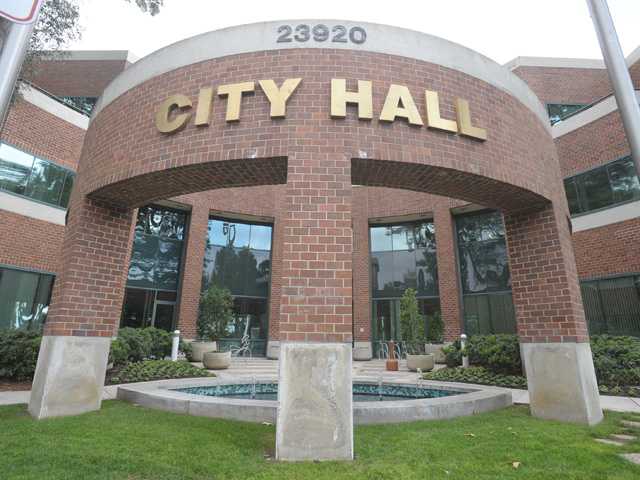
Looking to fight back what Mayor Marsha McLean characterized as a legislative assault on local control, Santa Clarita City Council members opted to take strong stands opposing two pieces of legislation this week.
Council members voted unanimously Tuesday to oppose Senate Bill 254 and Assembly Bill 806, two pieces of legislation that McLean dubbed “really terrible.”
The council periodically votes to take official positions on different pieces of legislation, so Tuesday’s action was not out of the ordinary.
What set it apart, though, was McLean asking Michael Murphy, Santa Clarita’s intergovernmental relations manager, how the city could more strongly lobby against these two bills in particular.
“How can we make some noise about this kind of stuff so that the public knows about it and the public can contact the governor and tell him not to sign these things?” she asked during Tuesday’s council meeting.
SB 254 would change the process for the state to relinquish segments of roadways to local governments.
Existing law outlines a process by which the state can hand off roads to local agencies, and “also requires an agreement is reached between the state and the receiving local agency prior to a relinquishment taking place,” according to city documents.
City officials, though, say there are concerns that SB 254 could make it possible for a roadway to be turned over to a local agency without prior approval by the recipient, leaving that agency holding the bag for repairs.
Of particular worry from the city’s perspective is a three-mile stretch of Sierra Highway from Newhall Avenue to Friendly Valley Parkway.
The California Department of Transportation has expressed interest in relinquishing the roadway to the city for several years, Murphy said, but the city has consistently refused to accept it until the road has been brought up to standard.
The most recent estimate for bringing that stretch of Sierra “into a state of good repair” is about $31 million, according to Tuesday’s agenda.
“Under this legislation, it could end up that a determination could be made that the road would go to Santa Clarita,” Murphy said Friday, “and all of a sudden, we’re stuck with a $30 million price tag because the state has neglected to do the appropriate maintenance on the road.”
Council members also opted to oppose AB 806, which would exempt adding strand-mounted antennas to previously permitted communications towers from local permit requirements, “regardless of the potential negative impacts associated with them,” city documents said.
The issue, Murphy said, really comes down to an “erosion of local control.”
As McLean put it: “They are absolutely taking away local government’s ability to have any say in what our community’s going to look like.”
Typically, when the council takes a position on a bill, a letter expressing the city’s viewpoint is sent to legislators.
Depending on the bill and the council’s wishes, Murphy said, the city can also reach out to the League of California Cities, call or schedule meetings with legislative representatives to express the city’s concerns, or send information out to the public and encourage residents to weigh in on the legislation.
“We treat every bill differently in terms of how we approach it,” he said.
Both AB 806 and SB 254 have passed the legislative house where they originated and are awaiting further review in the state Legislature, Murphy said.
“They still need to go through a policy committee and a fiscal committee process before being enacted,” he said. “That will occur in early 2016, assuming the bills continue to move forward.”
661-287-5525
On Twitter @LukeMMoney