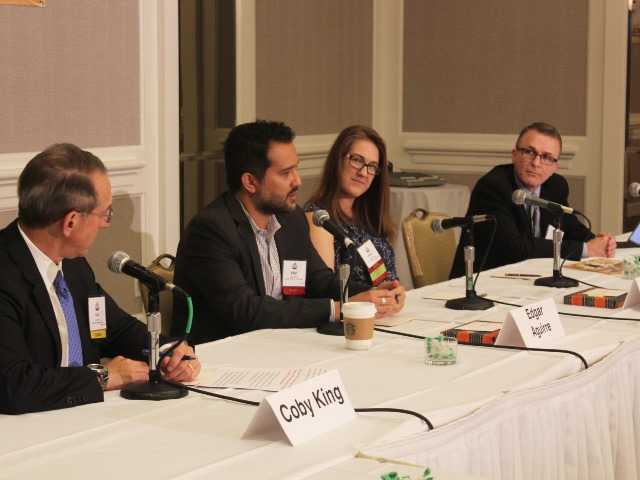
Topics were meaty, the answers were honest, and news aficionados' critiques were straightforward, in a media workshop hosted by the Valley Industry & Commerce Association at their Business Forecast Conference Friday in Universal City.
Dubbed the “State of Confusion,” VICA held multiple workshops for its greater Los Angeles area business members to address topics including transportation, real estate, water, earthquakes, wage hikes, the state tax structure and credits, and the entertainment and news media industries.
Los Angeles Mayor Eric Garcetti was the keynote speaker at VICA’s luncheon.
With a rapidly changing media environment, a panel of news experts all agreed that while demand for news won’t die, how it’s delivered is changing rapidly.
While advances in technology have driven the change, news organizations are continually investing in new delivery platforms from e-readers and tablets to mobile devices.
“We’ve seen a really big evolution over the last eight years,” said Jessica Davis, digital editor of the Los Angeles Daily News. “You have to be versatile in meeting the challenges head-on; it’s (the model) no longer 'readers come to us.' We believe we have to bring to the news to where the readers are.”
The trick is in balancing the wishes of very loyal print newspaper subscribers and those of the Millennial generation’s thirst for digital delivery.
“We got rid of the TV guide listings and print readers nearly busted our doors down,” said Jason Schaff, executive editor of The Signal newspaper.
Southern California Public Radio is facing the same challenge, said Edgar Aguirre, managing director of external relations and strategic initiatives.
The nonprofit public radio station also has a very loyal older audience, but in order to stay in business, it has to connect with new audiences, Aguirre said. The station depends on a “patronage system” of donors.
Digital and social media changes aside, all three experts agreed that good content is still king when it comes to customers, and a hyper-local focus is one customer demand the news groups are working to meet.
“There will always be a demand for news, and for news about where you live,” Schaff said.
To that end, at least one workshop attendee criticized the Los Angeles Times for not covering neighborhoods, and key social issues affecting people in the San Fernando Valley.
But even the Times’ competitors in the news industry stepped up to defend the newspaper.
Every news business is struggling to find enough resources to cover all of the beats readers and listeners want, and the news groups have to be careful not to get spread out too thin, the panel experts said.
“The Los Angeles Times will be around for a long, long time,” Schaff said. “It will still be a strong, great newspaper.”
Given that, each news group is doing “more with less,” the panelists said, in an industry that has a very expensive business model – covering all of the news, all the time, and delivering it door-to-door.
Attendees queried the panel members as to why news groups seemed to be using more freelancers – and for what kinds of stories; whether they still have beat reporters assigned to specialize in certain topics; and if they could offer even more digital advertising options – including options which haven’t even been dreamed of yet.
Attendees also wanted to know if newspapers still had the editorial opinion influence they once had.
“I think people still value the opinion of a news entity,” Schaff said. “In print it’s still important; candidates and civic groups still come to the paper for endorsements or support.”
But a newspaper’s opinion gets drowned out and diluted once it goes online, both Schaff and Davis agreed.
For one, it doesn’t have the physical online presence that an editorial viewpoint does on an opinion page in print.
And online commenters sometimes further dilute the message. But sometimes they enhance it through healthy debate.
“Social media acts as an amplifier for democratic interaction, but it does create more competition,” Davis said.
Asked whether printed versions of newspaper will survive, Schaff believes they will go away one day, and if that occurs, it will only level the playing field if every news group is delivering content digitally.