On Twitter: @agnewsd
As professional distance runner Lauren Fleshman puts it, the sport of track and field is crumbling on an international level.
But that’s not to say it can’t be fixed, the Canyon High School graduate said.
The ongoing drama surrounding the suspension of the decorated Russian track and field team due to a massive doping scandal has caused turmoil and public distrust of athletes and the sport itself.
But two Santa Clarita Valley homegrown athletes — Fleshman and fellow Canyon graduate Alysia Montano — are at the forefront of trying to clean up track and field’s tarnished image.
“Sometime the greatest weapon you have is public opinion and shaping public opinion,” said Fleshman on why she’s been so vocal about the doping issue.
Montano, 29, has a different reason entirely for speaking out.
Last month, the World Anti-Doping Agency released a 323-page report that revealed the Russians were using an elaborate and widespread system of performance enhancing drug use and subsequent deceit and bribery during the 2012 Summer Olympics in London.
Immediately after the report came out, Montano became the center of attention for American media because of how directly she was affected by the report.
Put plainly, the evidence suggests she was cheated out of an Olympic medal and probably a few more major accolades.
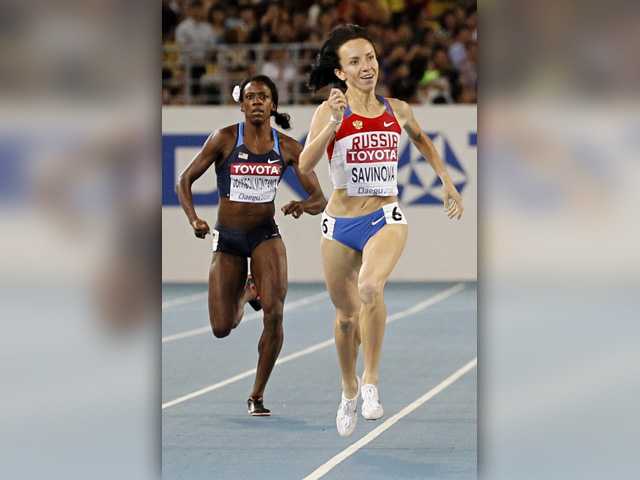
In her first Olympic Games in 2012, Montano finished fifth in the 800-meter final. She came in behind Russian runners Mariya Savinova (first place) and Ekaterina Poistogov (third), both of whom were accused of using performance-enhancing drugs in the report.
In several interviews with major media outlets, Montano, a six-time U.S. 800-meter champion, admitted she was well aware of her doping opponents all along.
“When you’re cheated out of a medal and you know it, it eats at you internally and you’re going after it again. It’s hard,” Montano told Sports Illustrated last month. “The Olympics are huge and you think that’s your shot and then you miss. You blame yourself and think, ‘What can I do differently?’”
With the evidence uncovered and the public pressure mounting, the International Association of Athletics Federation, the sport’s worldwide governing body, voted to suspend the entire Russian track and field team from competing in international competition.
That could very well mean the Russians will be held out of the 2016 Summer Games, and it may also result in athletes like Savinova and Poistogov being stripped of their medals.
Most importantly for Montano, it could also mean she’ll be retroactively awarded an Olympic bronze medal in the process. And maybe more.
Montano and Savinova have raced together 10 times in competition, with Savinova winning every one of the matchups. That also includes both the 2011 and 2013 world championship 800-meter finals, both of which Montano just missed out on medaling, placing fourth in each.
“Absolutely I deserve that bronze medal,” Montano said last month in an interview with the New York Times. “Even if I don’t get my podium moment, it’s still a symbol of my work and also this time in history.”
The IAAF will ultimately decide whether or not new medals will be given out, but that ruling likely won’t be made any time soon. In past cheating cases where athletes received Olympic medals after the fact, they weren’t given out until several years later.
American shot putter Adam Nelson, for instance, was given an Olympic gold medal nine years after he actually competed in the event at the 2004 Games. Nelson was elevated to gold medal status in 2013 after his opponent was disqualified for doping.
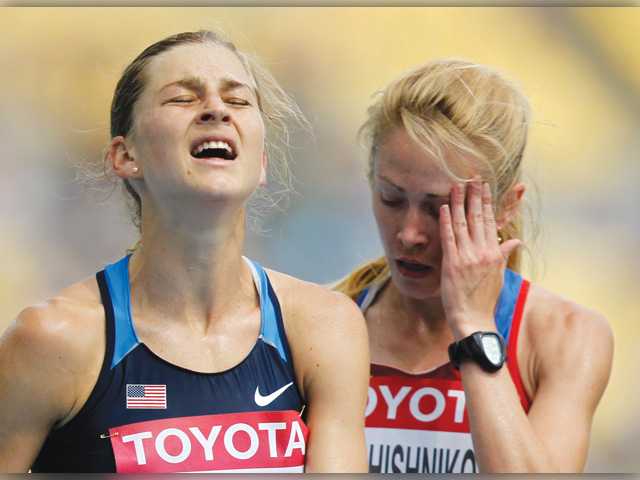
Fleshman said she fully supports the idea of giving Montano her medals. And although the 34-year-old hasn’t come quite as close to winning world championship medals and has never competed in the Olympics, she feels certain she’s also fallen victim to cheating.
“I’ll never really know how much I’ve been affected, but I guarantee I’ve been beaten by dirty athletes many, many times in my career,” said Fleshman, who finished as high as seventh place in the 5,000-meter world championship final in 2011.
Fleshman has long been open about her personal life and opinions on all things running related. She started an online blog in 2009 called Ask Lauren Fleshman, where she answers questions from fans and talks about other issues.
Lately, there’s been a lot of talk about doping. She feels like it’s the responsibility of athletes like her to promote fair play to the next wave of up-and-coming runners.
“If the younger generation of athletes doesn’t hear the older generation of athletes speaking strongly for a clean sport, the temptations are always going to be great,” she said.
The subject of doping has many layers, including the lack of proper drug testing in certain parts of the world and many reported cases of corruption and bribery within the IAAF.
Illegal drug use has always been the elephant in the room in this sport, but the World Anti-Doping Agency’s report put everything on the table and launched international track and field into a state of disarray.
But Fleshman said this doesn’t have to mean catastrophe.
While clean athletes suffered as a result of cheating for so many years, it’s people like Montano and Fleshman who may come out on the other side of this controversy in a better place.
“I think it will rebuild if everyone is mindful and does the right thing in the next year,” she said.