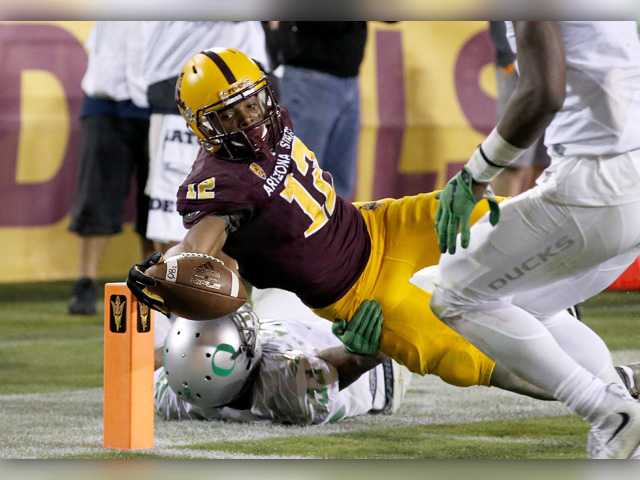
Lindie Kane, her husband and her two teenage sons stood beside their seats, located on the corner of an end zone in a family-and-friends section of Rice-Eccles Stadium in Salt Lake City.
Kane, the longtime College of the Canyons track and field coach, had made the 700-mile trip in mid-October to see Arizona State football play then-No. 4-ranked Utah — more specifically, to see one of her former athletes in action.
And wow, was Tim White in action, legs churning, darting past Utah defenders and toward Kane.
She had her cellphone ready to take a picture, but that pursuit was lost in the jumping and yelling and joy, as White glided 100 yards for a kick-return touchdown that tied the score 7-7 in the first quarter.
ASU eventually lost 34-18. But White, a 21-year-old redshirt junior, finished the night with 169 kickoff return yards, a Sun Devil record.
After the game, the Kanes posed for a photo out on the 50-yard line, then they waited by Arizona State’s buses.
Kane and White chatted about football and schoolwork and life. She sensed maturity. She wasn’t looking at the young teenager she’d first met at Sports Chalet years earlier, buying cleats in preparation for his first football season at Hart High.
No, now she saw a disciplined student, an involved father, a Pac-12 playmaker.
It’d taken time — maybe longer than expected — but White, who’ll suit up for the Sun Devils (6-6) against West Virginia (7-5) in the Cactus Bowl Saturday at 7:15 on ESPN, was finally the total package.
Go long
Certain players in pro football history are forever linked to one spectacular play, or set of plays: Dwight Clark’s catch, Franco Harris’ reception, John Elway’s drive.
At least locally, White will never outrun his game-winning touchdown against Valencia High on Oct. 28, 2011.
After the snap, the then-senior receiver remained almost still before taking off on a slant. He tipped a wayward pass away from a Vikings defender, snagged it and scampered 40 yards for a score with 36 seconds left in regulation.
It delivered Hart a 19-14 win — the last league loss for seven-time defending Foothill League champion Valencia.
COC football coach Ted Iacenda was coaching at Alemany High of Mission Hills at the time and returned to the school’s football office after a game that night. He flipped on Fox Sports West.
“I vividly remember watching that play in the football office and going, ‘Man, that kid’s special,’” Iacenda says.
But White’s career over the ensuing three-plus years wasn’t the blur of red, black and white streaking toward the end zone that people had grown accustomed to.
It was a process.
Athletically, White didn’t break stride at COC, where he caught 46 passes for 864 yards and 10 touchdowns in 2012.
The following spring, he won a state title and a national championship in the triple jump, an event he’d picked up as a Hart senior.
But then came a sit-down with Iacenda and Kane. The subject: White needed to redshirt the upcoming football season for academic reasons.
White’s grades had limited his options out of high school. He was, however, academically eligible to play the 2013 football season, Iacenda says. That wasn’t the problem.
The real issue: White was on pace to finish his football eligibility with far fewer transferable credits than he needed to be immediately eligible to play at an NCAA Division 1 school.
They needed to buy time, Iacenda says.
“He was pissed at first,” Iacenda says of White, who by all accounts is soft-spoken and humble. “He wanted to play. … But after time passed, he understood.”
It proved to be a blessing, as academics finally clicked for White that year. He began visiting The Learning Center at COC for tutoring and help on papers. He focused. He stopped procrastinating.
School stopped being simply a means to stay on the football field and became a road to a better future. He acquired an interest in real estate and marketing.
The year was a turning point.
“At some point you have to make a decision,” Kane says. “You’re either going to buckle down and get this done (or not). If you want to go (to a four-year university with a prominent athletic program), you have to get this done or it’s over.”
Iacenda says a key might have been that White saw talented COC football players from that year not go anywhere, or not go D1, because of grades.
That wouldn’t be White. He earned an associate degree in the spring with a 3.1 GPA, he says. And the dual sociology and communications major hasn’t slowed down as a Sun Devil.
“He’s done a good job as a student,” DelVaughn Alexander, White’s position coach at ASU, said Tuesday. “The grades are still on their way in for us, but from what I’ve done in the research and the progress reports, I’m hoping that he’s going to be a 3.0 ‘scholar baller’ for us.”
Death and life
White’s story, in some ways, is that of many teenagers-turned-20-somethings: the boy-meets-reality-and-becomes-a-man narrative.
But other aspects of White’s journey are heavier.
According to The San Diego Union-Tribune, White’s 22-year-old brother, Elwood, was shot and killed by a San Diego County Sheriff’s deputy on May 20, 2012.
Eyewitness accounts, according to the Union-Tribune, depicted Elwood as speaking incoherently, attacking strangers and trashing a gas station convenience store in Oceanside.
Five law enforcement officers formed an arc around Elwood (who was holding a broken broom handle with a jagged edge), drew their weapons and ordered him to drop the stick, according to the newspaper.
Elwood moved closer to a deputy, the Union-Tribune says, and was shot in the torso.
The Whites filed a wrongful-death lawsuit that was rejected in June, according to the newspaper.
White’s best friend and Hart/COC teammate Aaron Porter visited the Whites’ home shortly after Elwood’s death.
“He was strong,” Porter says of White. “He was trying to keep himself composed. He was clearly impacted greatly.”
White didn’t react emotionally, but he holds tightly to his brother’s memory. At ASU practices, he calls to mind Elwood’s prods.
“Let’s go T. … Step it up T, you got this T,” Elwood would say.
White’s father, Timmy, who played receiver at USC from 1980 to 1982, says the tragedy caused White to embrace the present, to grab ahold of every moment.
“It has shaped me as a man, as a friend, as a brother to my sisters,” says White, the second youngest of Timmy and Darleen White’s nine children (seven girls and two boys).
Another key moment for the younger White came on July 23, 2013.
His girlfriend gave birth that day to a baby girl, Brooklyn.
Kane points to the birth’s maturing effect on White, a reminder to focus on long-term goals and the collective “we” rather than “I.”
White, who lives in an apartment 15 minutes from ASU, says raising his daughter, with his girlfriend, has grounded him.
“When you look at her every day,” White says of his daughter, “you just know you have a job to do and that’s to be a better father and to let her be comfortable.”
Sometimes that has meant teaching Brooklyn to step up the bleachers at Cougar Stadium after a game, other times it’s involved calming her down in the middle of the night with 5 a.m. practice looming.
“He’s going to be a great dad, there’s no doubt in my mind,” Iacenda says. “He already is.”
Something really special
White opened up to Doug Haller, a reporter for The Arizona Republic, for a story in September that detailed a childhood involving multiple moves and stretches of homelessness before he settled in at Hart.
White hopes it will help kids who are going through what he faced, he told The Signal last week.
His family’s moves meant White didn’t first play organized football until his sophomore year at Hart. But his raw athletic ability more than compensated for his lack of experience.
White’s friend Porter says White would catch up with the Hart football team in the weight room after track practice in the spring.
“He would just go in, no warm up, and then just rep out over 400 pounds on the squat,” Porter says. “When I saw that, I just knew something was different.”
White’s physical feats have only grown more awe-inspiring.
Against Mt. San Antonio College in 2014, White made a leaping grab, turned up field and hurdled a defender who was taking aim at his midsection.
It was one of 55 catches his sophomore season for 667 yards and six touchdowns.
In the spring, Iacenda began to call Division 1 coaches, trying to revive interest that had waned during White’s redshirt year. He’s going to get it done in the classroom, Iacenda urged.
When White did finish, a deluge of phone calls and texts followed.
“Arizona State and Washington State were, like, beating down the door,” Iacenda says. “… It was a madhouse.”
White chose Arizona State, where he’ll also compete in track and field and has a chance to make the Olympic Trials in the triple jump next summer, Kane says.
His role on the football team wasn’t as immediately clear.
It is now.
White broke out against Cal Poly San Luis Obispo on Sept. 12, taking a jet-sweep handoff 59 yards and then catching a 4-yard TD moments later to seal a Sun Devils victory.
He caught seven passes for 144 yards and two touchdowns against Colorado on Oct. 10.
And after the Utah game, he was named Pac-12 Special Teams Player of the Week.
He’s caught 53 passes on the year for six touchdowns and 554 yards, second most among Sun Devils.
“It’s been a real breath of fresh air,” Timmy says of watching his son play.
Now White’s ready for his Cactus Bowl close-up and what lies beyond. As he says, “It’s a review for my first year here and a preview for the next.”
And another opportunity for a snapshot.