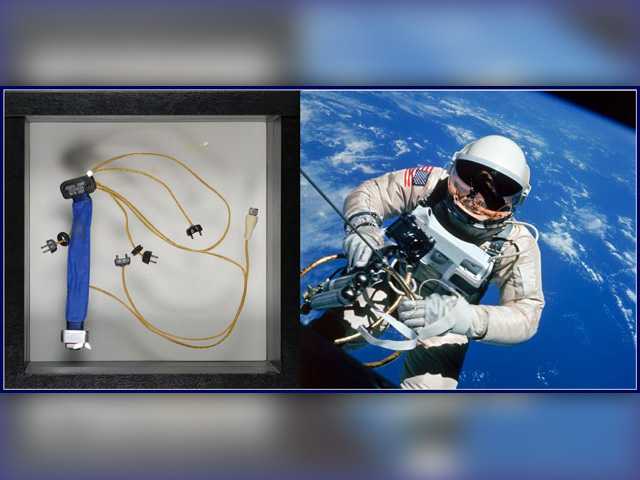
A cable harness used to help fly some of the first astronauts into space nearly 50 years ago is back home at the Santa Clarita Valley corporation that manufactured it.
The Bio-Harness Assembly — a cable harness used to check body temperatures and oxygen levels of astronauts in space — was purchased by Valencia-based Cicoil Corporation at a NASA Apollo Space Program auction late last year, said Rich Buchicchio, the company’s marketing manager.
The cable harness, which is more than 2 feet long, would wrap around the upper torso underneath an astronaut’s suit when he was either inside or outside the space capsule.
The harness Cicoil bought at auction was famously worn by Commander James McDivitt of the Apollo 9 space flight in 1969 — NASA’s first manned flight of the lunar module.
Because it was essential to keep the astronaut alive, “the cable couldn’t afford to have any errors,” Buchicchio said. “There couldn’t be any types of failure.”
The cable was made from a type of silicon-like material, called Flexx-Sil, Buchicchio said. The same type of cable was worn by astronauts Neil Armstrong, Buzz Aldrin and Michael Collins during their Apollo 11 mission to the moon.
Those cables are displayed in the Smithsonian National Air and Space Museum, Buchicchio said.
Purchasing the one worn by McDivitt was quite a coup because NASA keeps things top secret, he said.
“It looked really good considering the time that has passed,” Buchicchio said. “We were surprised it was still in good condition because it’s been on a long journey.
“Here it is, 46 years later, and it’s still around,” he said.
Buchicchio said the company plans to enshrine the Bio-Harness Assembly cable inside a display case in the company’s lobby for customers and space geeks to see.
“Nothing big, but it will impress,” Buchicchio said.
Cicoil manufactures different types of flat cables used in industries including space applications, aerospace and jets.