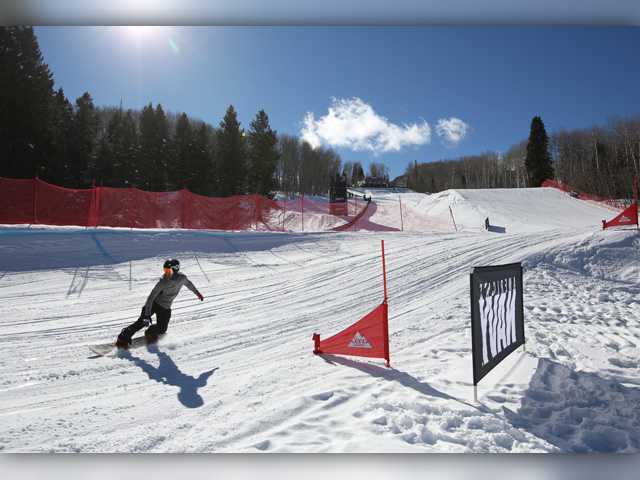
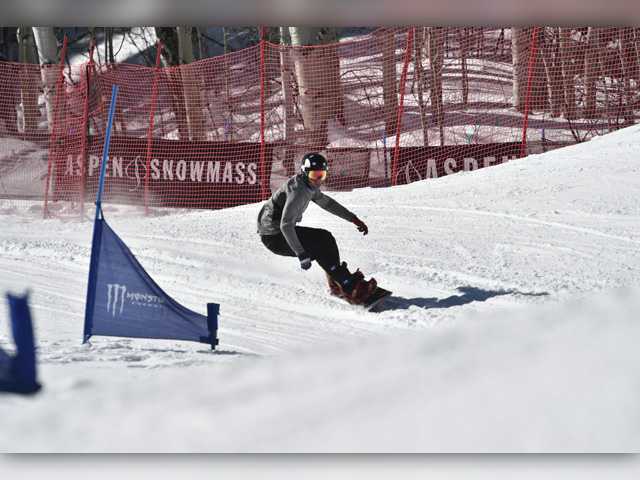
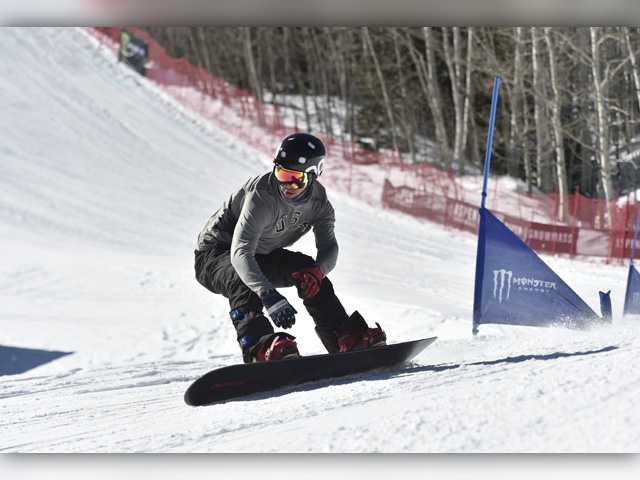
Mike Shea stood atop Buttermilk Mountain on Sunday, lined up next to five of the top adaptive snowboarders from around the world — each of them in search of a Winter X Games gold medal.
As snow poured from the Aspen, Colorado, sky, Shea looked down the initial 450-foot vertical drop of a course that covers roughly 2,700 feet with an average slope of 15 percent.
He was ready.
But the Castaic native mistimed his push out of the starting gate, though, hitting the block with the front of his snowboard before it was fully lowered.
The double clutch left Shea at a disadvantage and having to play catch-up in the Men’s Snowboarder X Adaptive finals for the first third of the course.
But Shea recovered, like he has so many times before.
A life change
In September of 2002, Shea was wakeboarding with friends at Castaic Lake when a ski rope wrapped around his ankle, instantly severing the then-19-year-old’s left leg from the knee down.
Shea, though, sees positives in the horrific incident.
He says he is doing more with one leg than he ever did with two.
“When something traumatic happens in life, it tends to change your perspective on things,” Shea said via email. “All of a sudden you begin to appreciate life and things that once seemed normal are all of a sudden magical moments.”
One of those magical moments came just four months later, in January of 2003, when Shea (using a prosthetic) returned to the slopes. He’s never looked back.
The now 32-year-old, who has entered his 17th year of riding, had always been drawn to snowboarding, which he picked up in his adolescence.
He says the sport constantly forces him to live in the moment.
“It’s nearly impossible to snowboard while thinking about all the other issues going on in life,” says Shea. “When I snowboard I think about absolutely nothing. Only what’s directly in front of me.”
A long road
Although Shea was able to get back on top of a mountain quickly, emotionally he still suffered.
He began to rely more heavily on alcohol and prescription drugs after his accident.
“I was masking it all (his emotional recovery) with painkillers and alcohol,” Shea told The Colorado Springs Gazette last year. “It took me some time but I eventually realized it.”
Shea realized it in 2007, when he went into rehab. He’s been sober since, and his snowboarding career has taken off.
In 2010, Shea got the news that snowboarding would possibly be making its debut at the 2014 Paralympic Games in Sochi, Russia.
Once the invitation from the National Sports Center for the Disabled came via phone call asking him if he’d be interested in representing his country and moving to Colorado, there was no doubt what Shea was going to do. Even if it meant leaving behind the career he’d built in woodworking.
“I saw this as an opportunity to chase a childhood dream, and within a few days I sold all of my woodworking tools to fund my move to Colorado,” Shea says.
Shea had seen success on the mountain, winning the 2013 World Cup Landgraaf and Europa Cup Landgraaf and the first ever overall title for the International Paralympic Committee Alpine Skiing Para-Snowboard World Cup circuit in 2014.
But he was able to put an exclamation point on his journey when he stepped on the Paralympic podium with a silver medal around his neck next to his teammates, Evan Strong and Keith Gabel, who helped Team USA sweep snowboadcross at the Paralympic games.
“Being a part of the Paralympic Games in Sochi Russia was absolutely incredible,” says Shea. “To be standing next to my two best friends and teammates (gold medalist Strong and bronze medalist Gabel) on the podium in front of thousands of people was even more surreal. Representing your country is one the most amazing honors and it’s a moment I will likely carry with me for the rest of my life.”
Last year Shea kept shredding, capturing the 2015 IPC Snowboard World Championships in La Molina, Spain, and earning a No. 1 world ranking. He was a finalist for Team USA’s Male Paralympic Athlete of the Year.
Winter X Games and beyond
The 2016 Winter X Games in Aspen started as well as Shea’s previous World Cup seasons had ended.
He finished first in both the qualifying and semifinal rounds of the X Games, looking to improve on his 2015 fifth-place finish.
But he had a rough start in the finals on Sunday.
Shea appeared to have a third-place finish in the bag, after recovering from a sixth-place start at the beginning of the race. But in the final turn, 16-year-old Australian Ben Tudhope edged him for the bronze medal.
Shea took it in stride.
“X Games is one of the biggest courses in the world,” he says. “You have to leave your ego at home if you want to be successful on a course like this.”
He said his main goal was to try and stay healthy during the X Games and, of course, to have a little fun.
“I’m living it up these last few seasons and enjoying the ride as much as I can,” Shea says, adding he plans on retiring from snowboarding in 2018. “After all, it’s about the journey not the destination.”
Shea often makes it back to Castaic and the Santa Clarita Valley, where his family and girlfriend live. The adaptive snowboarder is leading a team later this year at the local portion of the Wings For Life World Run, which will help benefit spinal cord research.
“To see the support of my hometown and the friends that I grew up with is amazing,” says Shea. “I don’t think I would be where I am today if it wasn’t for those people who believed in me.”