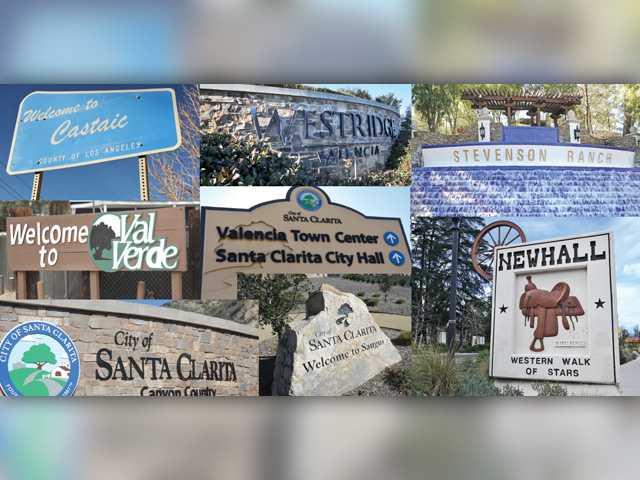
“Everything west of Seco is Valencia.”
Written large on a white board in The Signal’s newsroom, it’s a reminder not to raise the ire of Valencia residents who live west of Seco Canyon Road by saying they’re in Saugus, a stone’s throw across the street.
But like most boundary rules in the Santa Clarita Valley, it’s not entirely true. Seco Canyon Road peters out somewhere northeast of Valencia in Saugus.
Dorothy Street — the residential road that’s been in the news for several months because speeding motorists determined it’s a great shortcut — has no such convenient rule.
“Dear Mr. Money,” wrote one irate man to The Signal’s City Hall reporter in November. “How long have you reported in the SCV? Dorothy Street is in Canyon Country, not Saugus.”
Well, not if you go by ZIP codes. Just a little west of Florence Lane, Dorothy Street’s Canyon Country 91351 ZIP code switches to 91350, long associated with Saugus. Thus more of Dorothy Street is in Saugus than in Canyon Country.
Asked the location of the Canyon Country/Saugus boundary, Bob Kellar — longtime Canyon Country resident and Santa Clarita mayor — said it would “pretty much rest with the ZIP code. 91350 — that would be considered Saugus.”
But the U.S. Postal Service, which used to call 91350 Saugus, now calls it Santa Clarita. However, much of the 91350 ZIP code area isn’t within city boundaries.
Then again, why would a federal agency know where the lines are between communities in the Santa Clarita Valley? These are the same folks who moved the Newhall Post Office to Stevenson Ranch.
Valencia factor
In the 1960s, when the Newhall Land and Farming Co. introduced the Valencia factor into what had long been Newhall-Saugus, things got even more complicated. Valencia, the planned community created by Newhall Land on property it owned, has a very clear boundary — at least clear to the development firm.
Newhall Land drew that boundary line right across what was long Saugus, putting the River Village housing development and the Via Metro of Valencia housing/business complex across the river, or a single street from the Saugus Speedway.
That drew the ire of 33-year Saugus resident Kevin Eliason.
“This is Saugus and we are proud of our past and our present,” he wrote in a column published in The Signal Nov. 4, a counter-objection to some Via Metro residents’ complaints about a longtime soccer center by their just-built homes.
“So in full disclosure of your prime location, change your main entrance sign from ‘Villa Metro of Valencia’ to either ‘Saugus’ or ‘Santa Clarita,’” wrote Eliason, a resident of the Greenbrier West Mobile Estates. “Villa Metro is not in Valencia, so stop misleading your clients.”
The West Side of the valley isn’t immune to geographic confusion, either. The newest SCV industrial center is in Castaic. But it’s called the Valencia Commerce Center, and businesses there use a Valencia address. The Facebook page for one of them says it’s located in “Castaic, Valencia.”
South of the Valencia Commerce Center is Stevenson Ranch. Its default town center is the Valencia Marketplace shopping center. But while Claim Jumper restaurant in the Valencia Marketplace has a Valencia address, the Wells Fargo Bank a little south of there lists a Stevenson Ranch address. They’re both in Valencia Marketplace, both on The Old Road, and both use the 91381 ZIP code.
Communities
Back on Feb. 7, 1919, when The Signal published its first issue, Santa Clarita Valley communities included Newhall, Saugus and — way up in the northwest corner of the valley — Castaic. Vast empty space separated them, and nobody wondered about boundaries.
Although Valencia and Canyon Country had arrived on the scene by 1973, when residents were trying to secede from Los Angeles County and form Canyon County, the lines were still pretty clear.
“The ill-defined communities of the Santa Clarita Valley are built on small plains or wide canyon mouths separated by jumbled hills, which make for a highly fragmented residential pattern,” secessionist Dan Hon told the state-appointed Council on Intergovernmental Relations in May 1973.
Hon went on to argue the valley is nevertheless a unified entity both economically and politically, according to founding Santa Clarita City Council member Carl Boyer’s book “Santa Clarita.”
Community identities remained important to Santa Clarita Valley residents even after they approved cityhood in 1987 and Santa Clarita was formed.
The newly elected City Council faced a daunting list of tasks upon city formation: put together a government from scratch, hire an entire staff, figure out what laws were needed immediately and write them, find a place to call city hall, and build unity among a collection of residents in separate communities drawn together by sheer exasperation with a distant and unresponsive county government.
Yet one of the first issues encountered, Boyer recalled in an interview last month, was a unified “We don’t want to be called Santa Clarita. We want to keep our identity.”
Particularly adamant were residents of Valencia, Boyer said.
“What we told them was: ‘You can keep your community name; the post office names are not going to change,’” Boyer said. “’If you want to say you’re in Santa Clarita, that’s OK too. No problem.’”
Drawn together
Over the years, those communities described by Dan Hon as “small plains ... separated by jumbled hills” gradually grew together. Yet each maintains its own identity — clear boundaries or not, community leaders say.
“Canyon Country is a distinct community and a very warm environment in which to live,” said Kellar. “It’s so nice to have people say ‘hi’ when you stop at the store — it definitely does have a small-town feel.”
“Canyon Country is the most eclectic area of the city,” says Alan Ferdman, the Canyon Country Advisory Committee chairman who became a resident of the community in 1965 — when it was still Saugus.
He reminisces about hunting rabbits where Canyon High School is now, block parties that shut down entire streets, and the days when a dirt bike or other off-road vehicle was in every Canyon Country garage.
Asked where he puts the boundary between Saugus and Canyon Country, Ferdman says it’s about where The Home Depot is on Golden Triangle Road. Then he adds: “There are no absolute boundaries.”
“It’s hilarious how some people are dead set on saying they’re in a certain community,” he said.
Flo Lawrence, longtime member of the Castaic Area Town Council, describes his community as “the quirky red-headed step child of the Santa Clarita Valley” but quickly adds: “I raised my family here and I’m thrilled — I’d never want to live anywhere else.”
“I couldn’t go put my foot in the sand and say, ‘This is where Castaic’s boundary is,’” said Lawrence concerning where to draw the line. “I don’t see boundaries; I just see great people.”
Coming next Saturday: Valencia, the one with lines.